

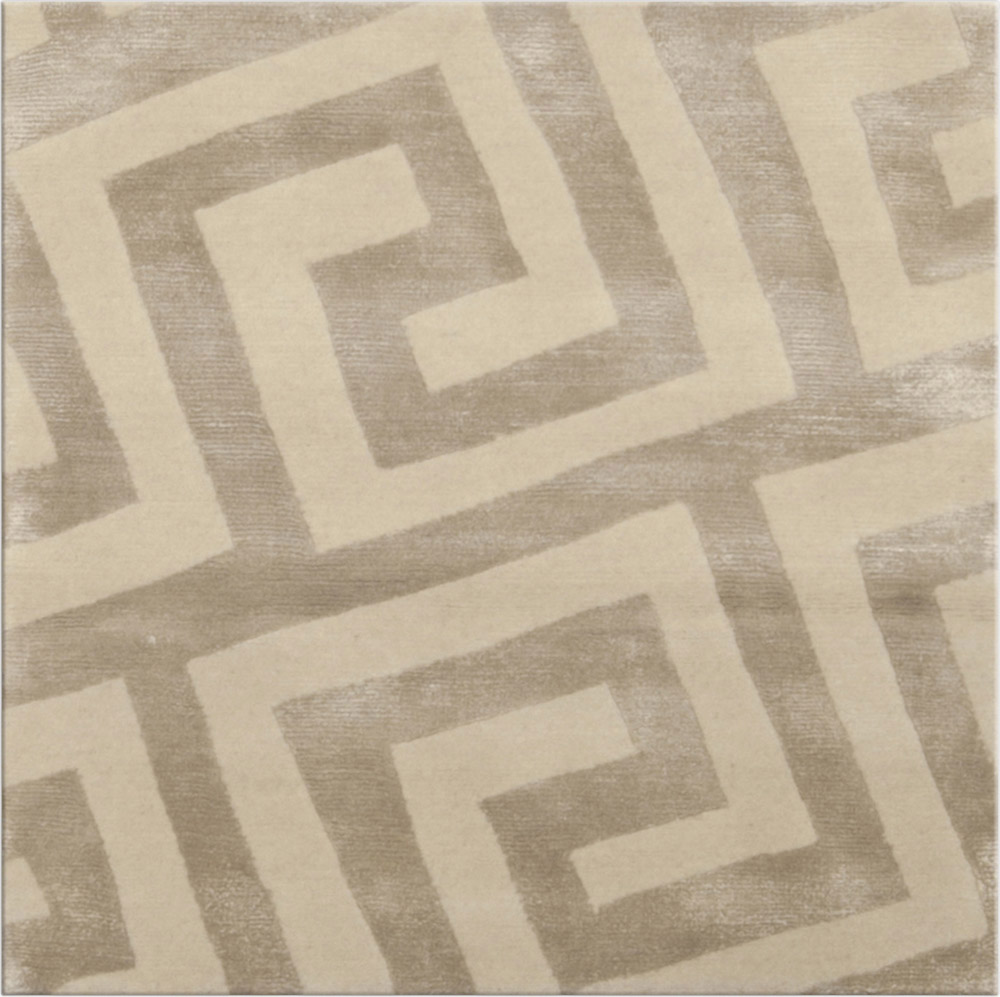
When people shop for custom rugs, durability is often treated as a single number or a vague promise. In practice, rug durability is a combination of construction, fiber, finishing, and how the piece will actually be used in a specific room. A rug that looks delicate can perform well in a formal sitting room, while a heavy-looking piece may flatten quickly if its backing, edges, or pile structure are not suited to traffic. The right question is not simply “How long will it last?” but “How will it age, and where will that aging be most visible?”
That distinction matters in luxury interiors because a rug is rarely judged only by wear. It is also evaluated by how it holds its outline under furniture, how the surface reads in changing light, and whether the pattern still feels balanced after years of use. In a well-composed room, a rug has to support scale, anchor seating, and maintain its visual authority without appearing overworked. That is why rug durability should be read as a design issue as much as a material one.
Explain the difference between wear resistance and perceived durability
Wear resistance refers to how well a rug’s fibers, knots, or tufts tolerate abrasion, compression, and repeated foot traffic. Perceived durability, by contrast, is the visual impression that the rug is still performing well even if it has started to soften or change slightly. A low-pile wool rug in a hallway may show minimal surface distortion for years, while a plush silk-blend rug may look tired much sooner simply because the pile reflects light unevenly as it is stepped on. Both are “durable” in different ways, but only one may suit a high-use setting.
This is where material selection and construction need to be separated from marketing language. Wool is often favored because the fiber has natural resilience, so it springs back after compression better than many softer fibers. Silk introduces luminous detail, but it is less forgiving in passage areas and tends to register every direction change in the pile. Cotton can be useful in certain foundations or weaves, but it does not carry the same structural memory as wool when used as the main face fiber. In other words, a rug can feel substantial and still be vulnerable if its surface does not recover cleanly.
Designers also look at the way a rug reads from standing height and from a seated position. A rug with a nuanced border or allover pattern can hide gradual wear better than a flat, pale field that exposes every change in texture. Dense pattern does not automatically mean better performance, but it can make wear less conspicuous in rooms where furniture shifts, pets move through, or sunlight marks the floor over time. That visual camouflage is part of durability, even though it is rarely mentioned in product descriptions.
Identify which constructions age best in high-use rooms
For rooms that see daily movement, hand-knotted rugs often age with the most grace because the structure is deliberate and the surface can be specified for density, pile height, and fiber mix. A tightly executed knot count is not valuable just because it is high; it matters because it creates a more stable, integrated surface that resists premature distortion. In a family room or main corridor, that structure can be more reliable than a thicker construction that feels soft at first but collapses unevenly under load. Quality is not about maximum plushness. It is about whether the rug is engineered for the room it inhabits.
Low to medium pile usually outperforms very deep pile in active interiors because shorter fibers are less likely to mat, shade, or catch debris. This is especially true under dining chairs, at seating edges, and in circulation paths where repeated contact happens in the same spots. A restrained pile also supports cleaner furniture lines and improves proportion when the rug sits beneath substantial upholstery or a large table. If the room already contains generous upholstery and architectural detail, an over-soft rug can make the floor feel unstable rather than composed.
For more formal settings, such as a salon, library, or primary bedroom, a slightly more delicate surface can still be a smart choice if the traffic is controlled. Here, durability means resilience to occasional use, not constant abrasion. A silk-and-wool blend, for example, may be perfectly appropriate when the rug is protected by layout and the room is not a shortcut between spaces. The trick is matching the construction to the room’s actual behavior, not to its label.
If you are comparing options for custom carpets, ask how the piece will be used before you ask how it is made. A properly specified rug for a dining room, entrance hall, or open-plan living zone will often differ in pile, edge treatment, and foundation from one intended for a private sitting area. That is where made-to-order work has real value: the construction can be adjusted to fit the room instead of forcing the room to accommodate the rug.
Describe finishing details that influence longevity
Rug finishing is often where longevity is won or lost. A well-made rug can still fail early if the edges are not secured correctly, the backing is not appropriate to the structure, or the binding and fringe details are treated as decorative afterthoughts. Finishing should stabilize the rug, not merely make it look complete. In a luxury home, those details matter because the most expensive-looking rugs are often the ones with the most disciplined finishing.
Edge work is a good place to start. A clean selvedge, precise binding, or well-executed border helps the rug hold its shape when vacuumed or moved. If the edge begins to abrade, the deterioration spreads inward and becomes much harder to control. That is why the quality of rug finishing should be assessed alongside pile and fiber, especially if the rug will sit beneath dining chairs, near doorways, or in rooms where corners are frequently brushed by furniture.
Rug backing is another critical factor, though it is not always visible to the eye. Backing influences stability, dimensional behavior, and how the rug responds to humidity changes, especially in homes with strong seasonal swings or radiant heat. An inappropriate backing can make a rug feel secure initially while quietly encouraging curling, rippling, or strain at the perimeter. In bespoke work, backing should support the weave rather than disguise structural weakness.
There is also a subtle relationship between finishing and acoustics. A rug that lies properly flat and has sound edges will absorb movement more evenly, which contributes to the calm, composed atmosphere people expect from a well-appointed interior. If the corners lift or the surface puckers, the visual interruption is matched by a practical one: the room feels less settled. For designers, that is reason enough to care about finishing as much as fiber selection.
Offer a room-by-room durability checklist
Different rooms place different demands on a rug, and a one-size-fits-all approach rarely works in high-end interiors. The most durable choice for a hallway may not be the most sensible choice for a bedroom, and the best rug for a formal living room may be wrong for a playroom or breakfast area. A useful durability checklist starts with traffic pattern, then moves to furniture weight, exposure to light, and how often the rug will need to be cleaned. Once those factors are clear, the material conversation becomes much easier.
Entryways and hallways
These spaces punish rugs with constant foot traffic, directional wear, and frequent exposure to grit. Choose a construction with a firm, stable surface and a finish that resists edge fray. Low pile, strong fiber memory, and a pattern that disguises minor soiling are all useful here. If the space is narrow, proportion matters as much as durability; a rug that is too small will wear in concentrated paths because people avoid stepping fully onto it.
Living rooms
In seating areas, the rug has to handle furniture weight, shifting chairs, and regular circulation without flattening at the center. This is where scale and placement affect durability more than many buyers expect. If the rug is undersized, traffic lands on the exposed floor around it and the rug edges become overworked. A properly scaled rug distributes pressure more evenly and usually looks better for longer because the furniture reads as intentionally grounded.
Dining rooms
Dining rooms are demanding because chairs move repeatedly over the same path and crumbs or spills are inevitable. A tighter surface, moderate pile, and practical finishing detail make far more sense here than a lofty decorative pile. The rug should extend far enough beyond the table to allow chairs to be pulled back without catching the edge, otherwise the perimeter will age quickly. In this setting, durability is partly a matter of proportion.
Bedrooms and private sitting rooms
These rooms can accommodate more softness because the traffic load is generally lower and the rug is less likely to be dragged or scraped. That said, a fragile construction can still suffer if it sits at the foot of the bed or beneath a chaise that is frequently shifted. A good rule is to balance tactile comfort with enough structure that the rug does not visibly collapse under light recurring use. Bedrooms reward a quieter kind of durability: surface stability, not brute resistance.
Home offices and studies
Office chairs, desk bases, and repeated lateral movement can be surprisingly hard on a rug. Look for a surface that can tolerate rolling or pivoting if the chair remains on the rug, or consider placing the chair partially off the rug if the layout allows. A pattern with subtle movement can make the room feel composed, while also reducing the visibility of wear where the chair travels most. These rooms reveal how practical design and visual restraint often work together.
How to judge long-term performance beyond the showroom
The showroom test is useful, but it is not enough. A rug can feel dense in the hand and still prove vulnerable once it is exposed to natural light, a heavy sofa base, or a family’s daily route through the house. Ask how the fiber will behave in sunlit spaces, how the pile will respond to cleaning, and whether the construction supports the room’s exact pressure points. The goal is to predict the first three years of use, not just the first five minutes of admiration.
It also helps to consider how the rug’s colors and pattern will age visually. Very pale grounds can show soil and traffic lanes faster, while very dark grounds may reveal dust or lint more readily. Mid-tone palettes, abridged contrast, and controlled pattern rhythm often age more gracefully in active homes because they do not exaggerate every small change. That does not mean the rug has to be neutral; it means the palette should be chosen with the room’s behavior in mind.
If you are commissioning or reviewing a rug for serious use, the most helpful questions are practical: What is the face fiber? How is the edge finished? Is the backing appropriate to the construction? What pile height makes sense for this room? Those questions produce a much more accurate durability reading than a general claim of “premium quality.” They also help interior designers specify pieces that remain visually composed after the room has been lived in.
For homes where layout, circulation, and material performance all matter at once, the ideal approach is often to coordinate the rug with the architecture rather than treat it as a separate furnishing. A rug can be tailored to reinforce a seating arrangement, quiet a large space, or define a transition between zones without becoming fragile in the process. That is one of the reasons custom rugs remain so valuable in luxury projects: they let design intent and real use meet in the same object.
FAQ
What parts of a rug fail first?
In many rugs, the first signs of failure appear at the edges, corners, and high-contact zones beneath furniture or along traffic paths. Surface wear may show up later than edge strain, especially if the rug is well made, but an unsecured perimeter can unravel or distort before the pile looks obviously tired. Backing issues can also cause rippling or curling, which often becomes more noticeable than fiber wear in the early stages. The earliest failure point usually reveals whether the rug was designed for the room it is in.
Does a denser rug always last longer?
Not necessarily. Density can improve stability and help a rug resist compression, but only if the fiber, pile height, and construction are appropriate. A very dense rug made with a delicate fiber or an unsuitable backing may still age poorly in a high-use room. Long-term performance depends on the balance between structure, material, and finishing rather than density alone.
How can I tell if a rug is built for real use?
Look at the construction details before you look at the styling language. A rug built for real use will usually have disciplined edge finishing, a backing that supports the weave, a pile height suited to the room, and fibers chosen for the level of traffic it will receive. If possible, ask how the rug is expected to age in sunlight, under furniture, and in relation to cleaning. A rug intended for genuine use should have answers to those questions that are specific, not vague.
Are custom rugs better for durability than ready-made options?
They can be, because custom rugs allow the construction to be matched to the room rather than forcing a standard product into a difficult setting. That might mean selecting a lower pile for a dining room, a more resilient wool for a family space, or a finish that better suits the architecture. The advantage is not automatic, though; it depends on the quality of the specification and the craftsmanship behind it. A well-made ready-made rug can perform well, but custom work gives you more control over the variables that affect aging.
For projects where performance, proportion, and tactile quality all need to work together, Doris Leslie Blau can help refine the choice with gallery-level expertise and practical design judgment. If you are weighing materials, finishing, or scale for a room that will truly be lived in, a specialist conversation is usually the best next step.