

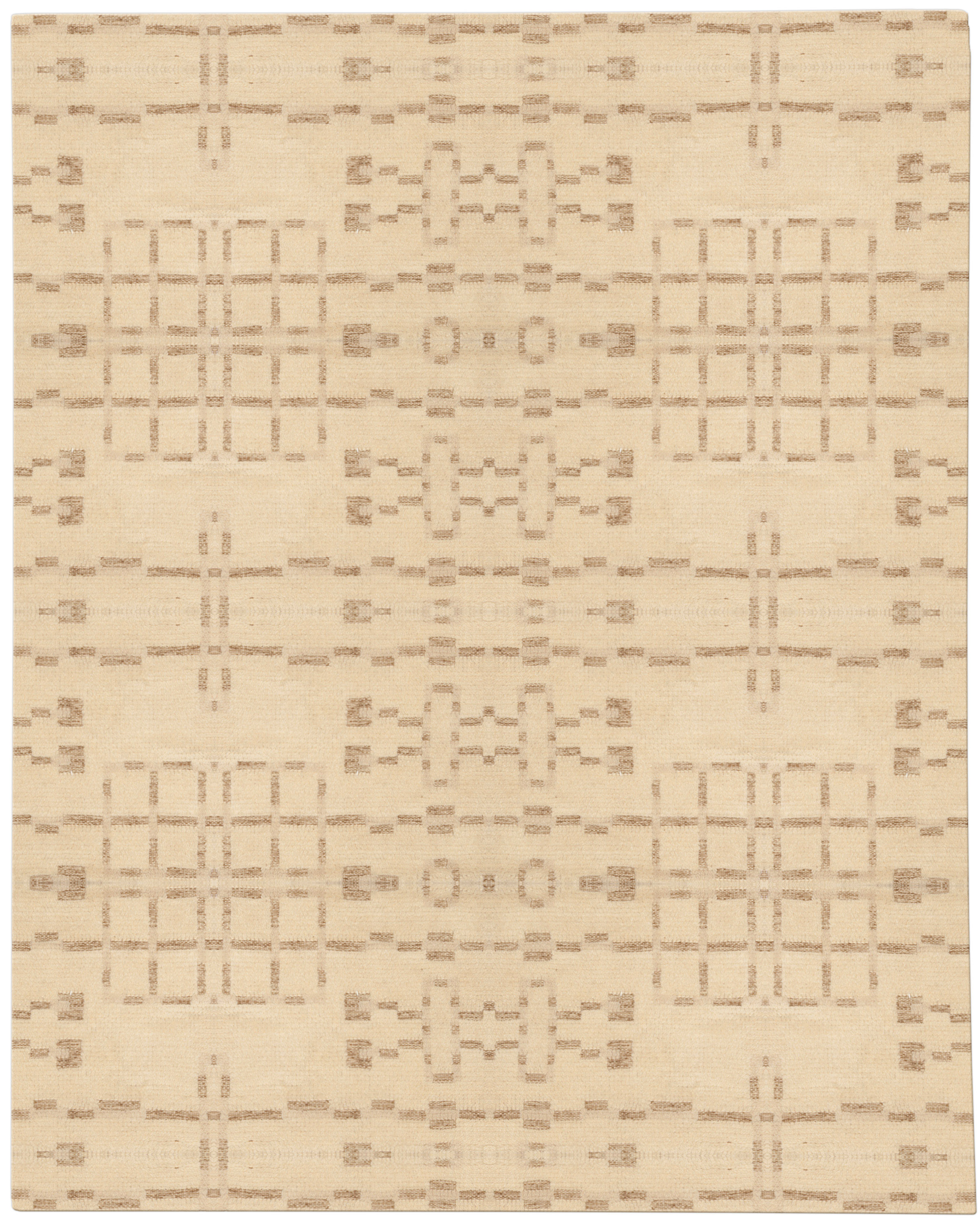
Designing rugs for showhouses is a balancing act: the rug has to photograph well, support the room’s concept, survive heavy traffic, and still feel believable in a space that may only live for a season. For designers specifying custom rugs, the challenge is not simply choosing something beautiful. It is making sure the floor covering strengthens the narrative, works under unfamiliar lighting, and complements sponsor pieces without flattening the room into a catalog spread.
Showhouses reward clarity. Every room usually has a purpose, a sponsor list, and a limited window in which it needs to persuade visitors and cameras at the same time. That means the rug cannot be treated as a neutral filler that arrives at the end of the process; it needs to be part of the composition from the first layout sketch. When the scale, palette, and texture are considered early, the rug can organize furniture, soften architecture, and give the space a legible point of view. When it is an afterthought, the room often reads as fragmented, no matter how strong the furnishings are.
Decide whether the rug should support or stage a vignette
A showhouse room usually needs one of two things from the rug: support or stagecraft. A supporting rug recedes just enough to let the furniture, artwork, and architecture carry the visual narrative, while still anchoring circulation and making the room feel finished. A staging rug, by contrast, becomes part of the room’s expression, using pattern density, border treatment, or a deliberate color hit to frame a specific moment. The mistake is trying to make every room do both, because then the floor competes with the furniture and the eye has nowhere to rest. In practice, the decision should follow the room’s intended hierarchy, not the designer’s attachment to a favorite motif.
In a formal living room or reception space, a quieter rug often works best when the furniture plan is already strong. Think of a restrained wool ground with subtle abrash, a textured field, or a border that outlines the seating area without shouting. In a powder room, dressing room, or sponsor-heavy vignette, more expressive designer custom rugs can help the room feel edited rather than assembled from separate parts. The key is knowing which rooms need a baseline and which need a focal point. That distinction keeps the showhouse from feeling over-programmed.
Balance photography needs with lived-in realism
Showhouses are made for photography, but good rooms still need to suggest use. A rug that photographs beautifully under flash but looks brittle in person can make the whole interior feel staged in the wrong way, especially in a room meant to imply comfort or everyday luxury. Designers should look for materials and constructions that have visual richness without becoming so reflective or delicate that they seem off-limits. Wool remains a dependable foundation because it holds shape, absorbs light well, and offers enough body to ground furniture. Silk can be effective in smaller doses, but in a busy showhouse it should usually be handled with care so the room does not read as precious or impractical.
The rug sampling process matters here because samples reveal how surface texture behaves in real light, not just in a mood board. A hand-knotted rug with a low sheen may feel understated in the studio yet photograph with depth under directional lighting, while a more lustrous weave can create hotspots that break up the image. If the room is expected to host events as well as photos, the safest choice is usually a rug with enough texture to disguise footprints and enough pattern structure to look composed from multiple angles. Designers specifying custom rugs for these environments often need to test not only color, but also pile height, edge definition, and how the surface responds to movement through the room.
Coordinate rug color with lighting and camera angles
Color in a showhouse should never be selected from a single daylight view. Morning sun, afternoon shadow, artificial uplighting, and camera flash can all pull a rug in different directions, especially when the room mixes matte textiles with polished wood or metal. A cool gray that looks crisp in person may turn flat on camera, while a warm neutral can read muddy if the room has low color temperature bulbs and reflective walls. The smarter approach is to choose a rug color that maintains structure under mixed lighting: layered neutrals, softened jewel tones, and grounded earth shades usually age better visually than very pale or hyper-saturated fields.
Camera angle matters too. Wide shots tend to flatten contrast, so rugs with some internal variation—tonal striping, subtle medallions, or a carefully scaled repeat—help preserve depth. Close-up editorial images, on the other hand, reward tactile detail and precise finishing. This is where custom area rugs can outperform off-the-shelf pieces, because the designer can specify a color balance that supports the room’s dominant materials rather than fighting them. For example, if a room includes pale oak, brass, and a creamy upholstered sofa, a rug with gentle warmth and a restrained pattern can connect those elements without erasing their differences.
Keep the design coherent across multiple rooms
A showhouse becomes disorienting when each room is treated as an isolated moment. Visitors may enjoy the contrast, but the overall narrative weakens if the floor treatments feel unrelated from one space to the next. Coherence does not mean repetition; it means using a shared design grammar. That might involve a consistent palette family, a recurring border language, or a disciplined relationship between pattern scale and room size. The goal is for the house to feel curated, not accidental.
One useful method is to map rooms by function before finalizing rug selections. Public-facing spaces such as entry halls, salons, and dining rooms usually benefit from clearer geometry and stronger orientation cues. Secondary rooms can take more risk with asymmetry, color, or texture. If one space uses a bold motif, another can echo its color in a calmer arrangement so the eye understands the relationship without seeing a literal repeat. This is also where custom carpet solutions can be helpful, especially in rooms with unusual dimensions, archways, or multiple seating zones that do not suit standard rectangular formats.
Practical coordination moves that keep the house connected
- Repeat one or two core colors across the house, but vary their saturation from room to room.
- Adjust pattern scale to the architecture: larger repeats for larger volumes, finer detail for smaller rooms.
- Use border treatments to unify rooms with different furnishing styles.
- Keep pile height and surface sheen consistent where rooms are visually adjacent.
- Let one room be the “pause” so the more expressive spaces have room to breathe.
Choose materials that support the installation timeline
Showhouses often move quickly, and the material specification has to acknowledge that reality. A rug may be moved, rotated, cleaned, or layered over existing flooring during setup, so construction needs to be robust enough to tolerate handling without losing its polish. Hand-knotted rugs offer substantial visual and structural value because they can be made to precise dimensions and constructed with a density appropriate to the room’s use. If the room requires a softer, more approachable feel underfoot, a well-chosen wool pile will usually outperform a fragile novelty fiber that photographs beautifully but performs poorly under wear.
Thickness also affects the room’s architecture. A very plush pile can interfere with the clearance of cabinet doors, cause dining chairs to drag, or throw off the proportion of low seating. A flatter construction may be preferable in circulation-heavy rooms, especially when the floor plan already includes dramatic furniture or high-contrast wall treatments. In other words, construction is not merely technical—it shapes how the room functions and how it is perceived. A good specification keeps the visual story intact while respecting the practical realities of staging.
Use scale and proportion to solve the room before style does
Showhouse rooms are often photographed from the doorway, which makes scale more unforgiving than in a private residence. If the rug is too small, the furniture floats; if it is too large, the perimeter can feel heavy and restrictive. The correct proportion should help the viewer understand the room immediately, even if the furnishings are still being edited during installation. In seating areas, that usually means allowing enough rug under the front legs of major pieces to unify the composition. In dining rooms, the rug should extend well beyond the chairs so the arrangement feels intentional when seats are pulled out.
Unusual rooms are where custom rugs are most persuasive. Narrow galleries, double-height spaces, and angled layouts rarely forgive standard sizes, and a made-to-order approach can solve those problems without forcing furniture into awkward positions. If the room is long and linear, a rug with an elongated border or directional motif can reinforce movement; if it is broad and shallow, a central field with quieter edges may make the space feel more settled. Designers who work through the custom rug design phase early are better able to preserve the room’s proportions instead of correcting them later with furniture compromises.
Work sponsor pieces into the rug story, not around it
Sponsor-heavy rooms can easily become visual negotiations between products that were never meant to live together. The rug should not fight those pieces, but it also should not disappear so completely that the room loses structure. A strong rug can create a common ground for mixed finishes, furniture brands, and decorative accents by carrying one unifying material language. That might mean softening a very glossy room with a matte wool ground, or introducing a subtle linear pattern that echoes casegoods, millwork, or textile seams already present in the space.
In some cases, the best solution is restraint. A room with highly distinctive furniture and accessories may only need a rug that has depth, balance, and accurate scale. In others, especially where multiple sponsors need to be acknowledged, the rug can serve as the visual hinge between competing elements. This is where designer custom rugs are especially useful, because the specification can be adjusted to the room’s exact mix of surfaces, tones, and traffic patterns. The result feels designed, not negotiated.
Preserve the narrative by editing the floor as carefully as the furniture
A showhouse is not just a collection of beautiful objects; it is a sequence of decisions. The floor plane is one of the most powerful of those decisions because it affects how every other piece lands in the room. A carefully chosen rug can give a room its tempo, define its boundaries, and quiet visual noise before it spreads. It can also protect the integrity of the story by preventing the room from becoming a collage of unrelated gestures. That is why the strongest showhouse interiors often feel composed rather than crowded: the rug has done part of the editorial work.
For designers and homeowners working at this level of detail, the best path is usually a specification process that treats the rug as architecture underfoot. Start with the room’s purpose, then consider the light, the camera view, the furniture footprint, and the materials already in play. From there, choose whether the floor should recede or lead, whether it needs texture or clarity, and whether the room calls for a quiet ground or a more distinctive pattern. In the right hands, custom area rugs give a showhouse the precision it needs without flattening the story the space is trying to tell.
FAQ
What makes a showhouse rug successful on camera?
A successful showhouse rug has enough visual structure to hold up in wide shots, but not so much contrast that it steals attention from the room. It should photograph cleanly under mixed lighting, avoid glare where possible, and provide a stable base for furniture groupings. Texture, border clarity, and color balance matter as much as pattern.
How much pattern is too much for staging?
Pattern becomes too much when it competes with the room’s other focal points or breaks the reading of the furniture layout. If the upholstery, art, wall treatment, and accessories are already visually active, the rug should usually be quieter. Strong pattern can work beautifully, but only when the room has enough restraint elsewhere to support it.
Should showhouse rugs be more durable than they look?
Yes, ideally. Even a room designed for display often sees more foot traffic, repositioning, and handling than a private room. Durable construction, stable fibers, and appropriate pile height help the rug keep its appearance throughout the installation and viewing period without sacrificing refinement.
For designers shaping rooms where narrative, photography, and practical performance all matter, the rug deserves the same level of specification as the furnishings above it. Doris Leslie Blau can support that process with gallery expertise and tailored guidance for custom rugs that are made to suit the room, not just fill it.