

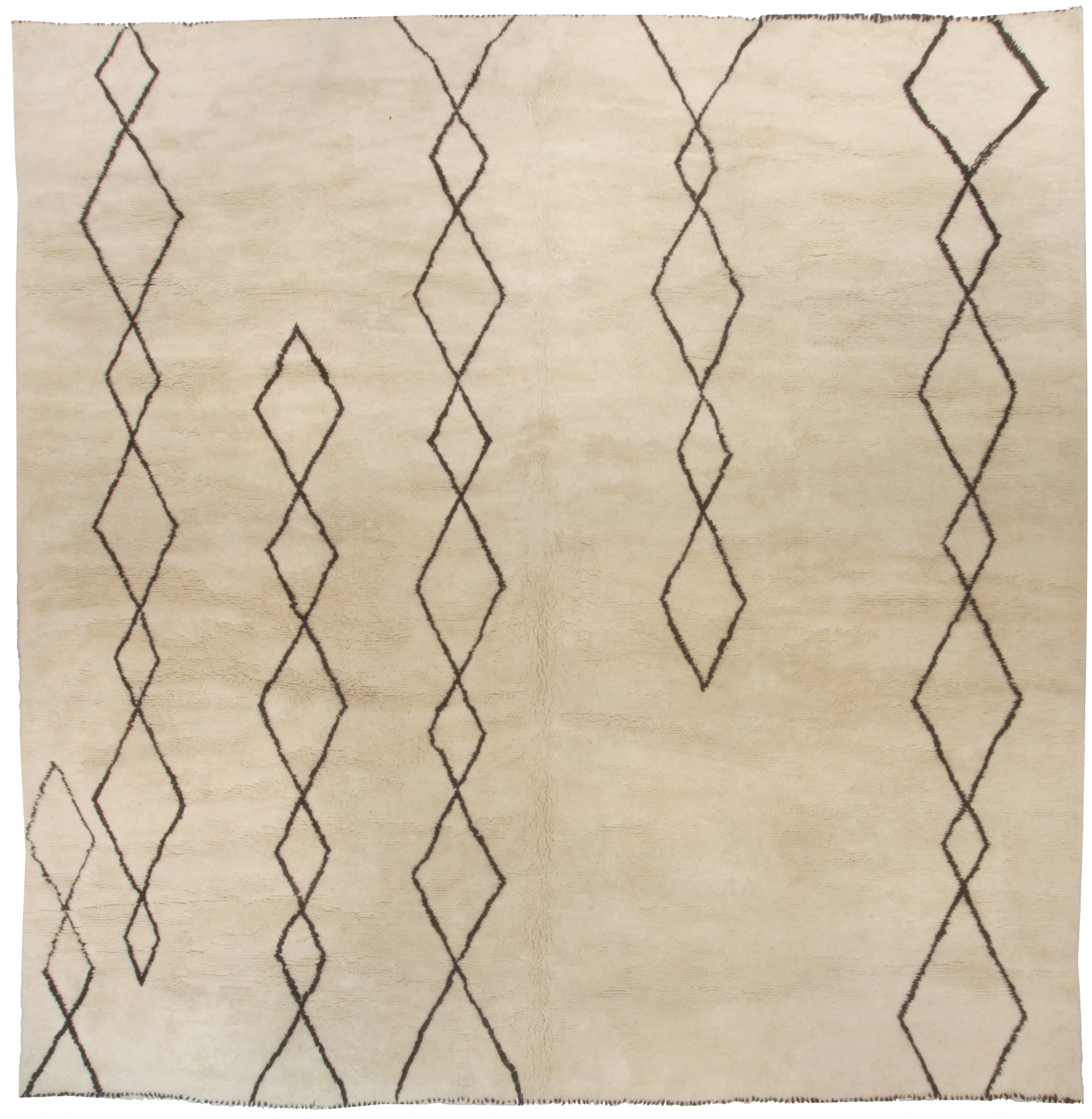
When clients compare custom rugs, the construction method often matters as much as the pattern, color, or fiber. Hand-knotting is not simply a marketing label; it is a production logic that shapes how a rug feels underfoot, how sharply it can render detail, how its edges hold up over time, and how much flexibility a designer has when specifying scale. For trade professionals and discerning homeowners alike, understanding hand-knotted work helps separate true craftsmanship from rugs that only look luxurious at first glance.
At Doris Leslie Blau, the distinction is especially relevant because many luxury interiors rely on rugs to solve more than decoration. A rug may need to anchor an open plan living room, soften acoustics in a formal dining space, or bridge antique furnishings with a pared-back architectural shell. In those settings, the construction behind the rug affects proportion, longevity, and the quality of the finish as much as the visual field. That is why hand-knotted rugs remain a reference point when people are specifying custom rugs for serious interiors.
Explain the knotting process in plain language
Hand-knotting is a woven construction built on a vertical or horizontal loom, where individual knots are tied around the warp threads one by one. Those knots form the pile, and the density of the knotting determines how much detail the rug can carry. A finer knot count can support more intricate pattern work, tighter line definition, and subtler color transitions, while a looser structure often reads with more tonal softness and a slightly more relaxed character. The process is slow because each section is built manually, which gives the maker more control over texture and design accuracy.
For custom hand-knotted rugs, that control is what makes the format so useful. A designer can ask for specific dimensions, a tailored border width, a particular pile height, or a composition that aligns with the geometry of a room. Unlike off-the-shelf pieces, the rug does not need to be forced into a room after the fact; it can be planned around furniture placement, architectural thresholds, and sightlines from adjacent spaces. That is one reason hand-knotted construction often feels especially resolved in interiors where scale and proportion are being managed carefully.
The structure also affects how the finished surface behaves visually. Because the knots are tied individually, the face of the rug can carry tonal variation, directional sheen, and crisp pattern transitions in a way that many machine-made constructions cannot match. In silk or silk-blend pieces, this can produce a refined luster; in wool, it can create a denser, more matte field with excellent tactile depth. The result is not only a decorative object but a textile with a clear architectural presence.
Compare hand-knotted with tufted and flatweave construction
Tufted rugs are typically made by punching yarn through a backing material, then securing the pile from the reverse side. This method allows for faster production and can still deliver attractive results, but the structure is fundamentally different from a knotted rug. Tufted pieces often have a softer initial feel and can be useful for certain residential applications, yet they generally offer less structural longevity and less precise control over fine pattern detail. For clients seeking a more tailored, heirloom-minded object, tufting is often a compromise rather than the first choice.
Flatweaves occupy another category altogether. They are pileless, which makes them lighter, visually leaner, and often well suited to high-traffic areas, casual interiors, or rooms where a lower-profile floor covering is needed. Many flatweaves are beautiful and highly practical, but they behave differently in the room: they do not provide the same depth underfoot, nor the same capacity for nuanced shading or sculptural pattern. In a space that depends on quiet luxury or layered texture, that difference can be decisive.
Hand-knotted rugs sit between these options in a useful way. They can be more robust and more dimensional than tufted pieces, while offering greater richness and pattern articulation than most flatweaves. The construction allows for a wider range of materials, from durable wool to lustrous silk, and supports more disciplined design execution when a room calls for exacting color relationships. For designers specifying custom rugs, that combination of flexibility and substance is often what justifies the investment.
Discuss durability, detail level, and edge finishing
Durability in a rug is not a single trait; it is the result of construction, fiber, knot density, pile height, and finishing quality. A hand-knotted wool rug with proper finishing can handle regular use for many years, especially when the pile is balanced and the foundation is well made. A higher knot count may improve detail, but it is not the only measure of strength, and a lower-density rug can still be structurally sound if the materials and workmanship are right. The real question is whether the rug is designed for the intended room and level of traffic.
Detail level is where hand-knotting becomes immediately visible to a trained eye. Fine borders, subtle tonal shifts, small-scale motifs, and precise pattern repeats all benefit from the control that knotting provides. In larger rooms, this matters because a broad expanse of floor can make weak design feel flat or blurry. Hand-knotted construction helps the composition hold together from a distance while still rewarding close inspection, which is why it is so often chosen for formal living rooms, libraries, and hospitality settings where visual authority matters.
Rug finishing is equally important, and it is one of the clearest signs of quality. Well-executed edges should look deliberate rather than bulky, with binding, overcasting, or fringe details that suit the design rather than distract from it. The reverse side should also be tidy and consistent, because the back of a rug reveals much about the maker’s discipline. Good finishing does not just improve appearance; it helps the rug maintain its shape, sit properly on the floor, and age with dignity. For clients comparing custom rugs, the finishing often separates an exceptional piece from one that merely looks expensive.
Edge work should be assessed in relation to the room itself. A tailored border can sharpen a contemporary interior, while a softer finish may suit an antique-inspired scheme or a more relaxed family room. The point is not to choose the most ornate option, but the most coherent one. In a well-specified room, the finishing should support the architecture, furniture line, and color story rather than compete with them.
Describe when trade clients should prioritize hand-knotting
Hand-knotting is especially worth prioritizing when the rug must do several jobs at once: define a seating group, carry a specific palette, tolerate regular use, and look composed under changing light. Designers often choose it for projects where the rug needs to feel integrated rather than merely placed. That may include formal residences, reception areas, layered master suites, and dining rooms where the floor covering must stay visually stable beneath table and chair movement. In those cases, the construction becomes part of the architectural order of the room.
It is also the right choice when the design brief calls for controlled color and pattern. If a client wants a rug that bridges walnut furniture, lacquer, stone, and upholstery in multiple tones, hand-knotting gives the maker more latitude to refine those transitions. The same is true when a project involves unusual dimensions or a room with difficult geometry. A custom approach allows the rug to respond to the room rather than forcing the room to adapt to a fixed-size product, which is one of the practical strengths of made-to-order work.
There are situations, however, where a different construction may be more appropriate. A low-profile flatweave can be more useful in a secondary circulation area, and a tufted rug may suit a less formal space with a shorter design horizon. Trade clients make the best decisions when they match construction to function instead of assuming that every room needs the same level of visual density. That is also where specialist guidance matters: the right construction supports the design intent without overcomplicating the specification.
For clients developing custom rugs, it helps to think in terms of room behavior rather than product category. How much daylight does the floor receive? Will chairs move over it daily? Is the furniture layout centered or floating? Does the palette need quiet texture or stronger contrast? These questions quickly reveal whether hand-knotting is the most effective path, and they also explain why custom hand-knotted rugs remain a standard reference in luxury interiors.
How to read quality when comparing luxury rugs
When comparing hand-knotted rugs with other luxury options, the best evaluation is visual and tactile. A good rug should feel balanced in the hand, with a foundation that reads evenly and a face that shows consistent density. Look closely at the clarity of pattern edges, the smoothness of color transition, and the coherence of finishing. If the rug has fringe, binding, or an applied edge, those details should appear integrated rather than added as an afterthought. Good construction is often quiet; it does not need to announce itself loudly.
Material choice should also be assessed in context. Wool is often the most practical foundation for durable use because it offers resilience, softness, and good visual depth. Silk introduces sheen and precision, but it may be better reserved for lower-traffic areas or for designs where refinement matters more than resilience. Blends can offer a useful middle ground. The right decision depends on the room’s function, the desired tactile quality, and the amount of maintenance the client is prepared to support.
Another point that designers often consider is how the rug will interact with surrounding finishes. A polished stone floor may call for more texture to avoid glare, while a room full of tactile upholstery may benefit from a cleaner, more disciplined pile. Hand-knotted construction gives the specifier enough nuance to respond to those conditions without losing structural integrity. That responsiveness is one of the reasons these rugs remain so central to serious interior design work.
Why finishing and proportion matter as much as craftsmanship
Even an expertly made rug can feel wrong if it is scaled poorly. A hand-knotted field that is too small for the seating arrangement can make the room feel fragmented, while an oversized piece that ignores architectural boundaries can overwhelm a refined space. The best custom rugs are not just well made; they are well proportioned. Their borders, motifs, and field dimensions should reinforce the layout of the room, guiding the eye without stealing focus from the furniture or architecture.
This is where the relationship between rug finishing and room planning becomes especially important. A neat edge can sharpen a floor plan and help a rug sit more cleanly under furniture legs, while an overly heavy finish may make the piece feel visually crowded. In rooms with strong geometry, the finishing details can either support the order of the space or interrupt it. That is why a design-minded specification process pays attention not only to the pattern but to the literal perimeter of the rug.
Imagine a long living room with a pair of sofas facing each other, a low table in the center, and a broad expanse of glazing on one side. A flat, lightly finished rug might disappear under the architecture, while a hand-knotted piece with subtle tonal movement and a controlled border can anchor the arrangement more effectively. The same logic applies in dining rooms, where the rug must extend beyond the chairs to maintain visual balance when the chairs are pulled out. In both cases, the construction and finishing are not secondary details; they are part of the room’s structure.
When hand-knotting is the most defensible choice
Hand-knotting is most defensible when a project demands precision, longevity, and design flexibility in equal measure. It is especially strong in rooms that are visually important, physically active, or unusually shaped. It also makes sense when the client wants a rug that can hold its own alongside collected furniture, art, and architectural detailing without becoming decorative noise. In other words, hand-knotting is less about luxury as a label and more about whether the construction serves the room with enough sophistication.
For interior designers, this construction is often the safest way to specify a rug that will feel resolved for years rather than seasons. It supports close attention to palette coordination, furniture layout, and tactile depth, while offering the structural discipline that serious interiors require. When the brief calls for a piece that is both practical and exacting, hand-knotting remains one of the most persuasive answers.
FAQ
Why do hand-knotted rugs usually cost more?
Hand-knotted rugs usually cost more because they require far more labor, skill, and time than many other constructions. Each knot is tied individually, which means the maker has greater control over pattern, density, and finish, but the process is inherently slower. Material quality, knot count, design complexity, and rug finishing all influence the final cost as well. In practical terms, you are paying for precision and structural integrity, not just for surface decoration.
How can I spot the signs of good finishing?
Good finishing looks intentional at the edges and consistent on the reverse. The border treatment should be neat, the fringe or binding should align cleanly with the construction, and nothing should feel oversized or loosely applied. On the back, the knot rows should read evenly, and the overall structure should appear balanced rather than patchy. If a rug is well finished, the details will support the design instead of distracting from it.
Are hand-knotted rugs always more durable?
Not always. Durability depends on more than the hand-knotted method alone; fiber choice, knot density, pile height, and intended use all matter. A well-made wool hand-knotted rug can be extremely durable in a residential setting, while a delicate silk piece may be better suited to lower-traffic rooms. The key is matching the construction to the function of the space rather than assuming one method is universally stronger.
Are hand-knotted rugs a good choice for custom sizing?
Yes. Hand-knotting is one of the best constructions for custom sizing because it gives the maker control over scale, proportion, and pattern placement. That flexibility is useful when a room has nonstandard dimensions, when furniture must sit precisely on the rug, or when the design needs to align with architectural elements. For many trade clients, this is one of the main reasons custom hand-knotted rugs remain so desirable.
For projects that demand a rug with real structural intelligence, the best next step is often a specialist conversation about room conditions, use patterns, and finish detail. Doris Leslie Blau can help refine those decisions so the rug supports the interior with the right balance of craftsmanship, proportion, and material character.