

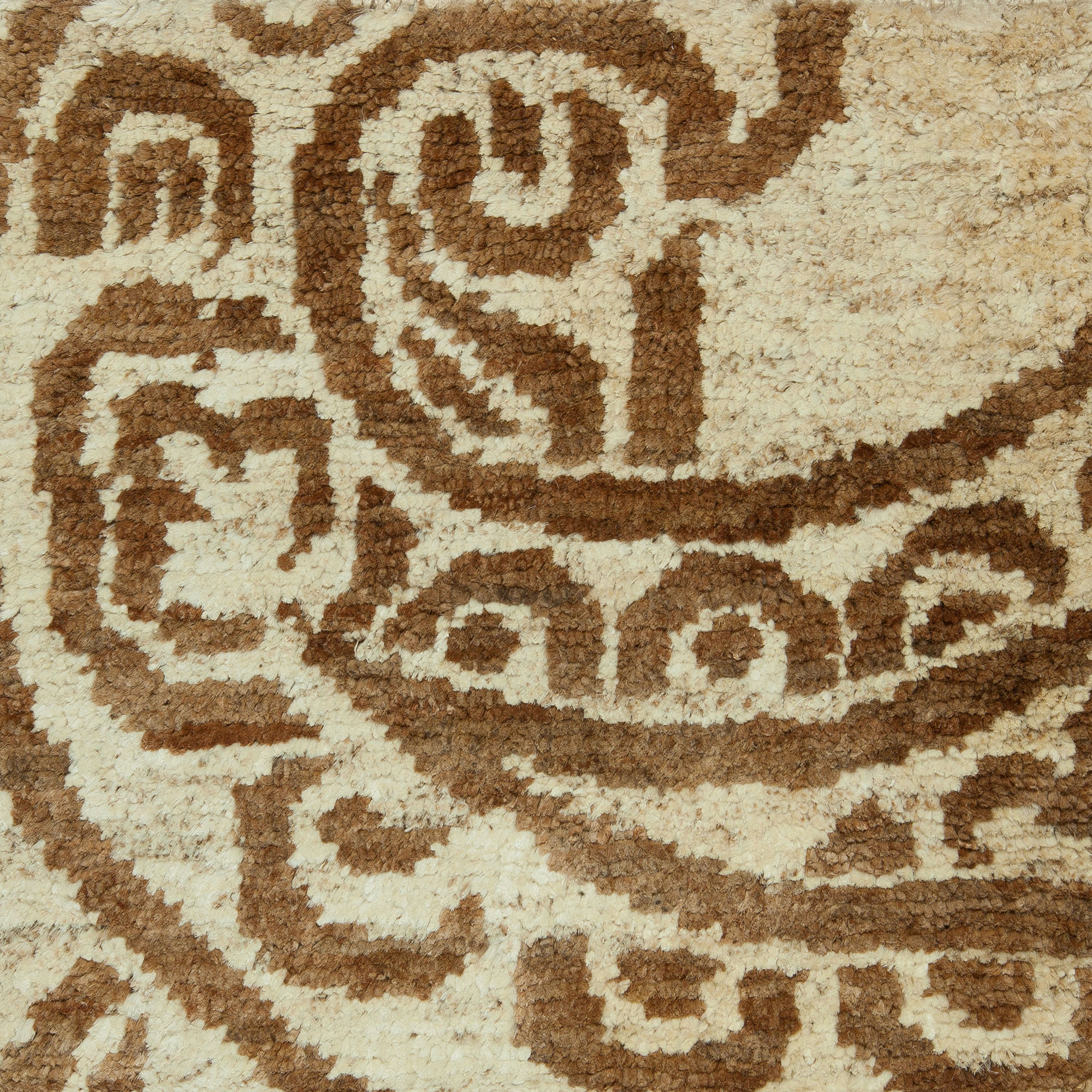
When people compare custom rugs, they often focus on color, pattern, or fiber and overlook one detail that quietly shapes everything else: pile height. It affects how a rug feels underfoot, how clearly a design reads from across the room, and how much attention it will demand over time. For a living room, dining space, bedroom, or staircase landing, the right pile height is less about a universal “best” choice and more about how the room is used. Understanding the difference between low, medium, and high pile helps turn a beautiful rug into a properly specified one.
Define pile height in clear terms
Pile height is the visible thickness of the rug surface, measured from the backing to the top of the fibers. In practical terms, it is one of the fastest ways to understand how a rug will behave in daily use. Low-pile rugs sit closer to the floor and usually present a tighter, flatter surface, while medium pile offers a modest cushion and a more tactile hand. High pile creates a deeper surface with more loft, which can feel especially soft but also changes how the rug responds to traffic, furniture, and cleaning.
In custom rugs, pile height is never just a comfort decision. It influences the construction method, the appearance of motifs, and even how the edges meet surrounding flooring. A dense flat surface may be ideal for formal rooms where pattern precision matters, while a plusher pile can support a quieter, more relaxed atmosphere. Designers often treat pile height as part of the room’s architecture because it affects sightlines, acoustics, and the transition between hard and soft surfaces.
It is also useful to separate pile height from rug texture, because the two are related but not identical. A rug can be low pile and still have pronounced texture if it uses looped weaving, carving, or contrasting fibers. Likewise, a high-pile rug may feel soft without necessarily appearing highly textured from a distance. For anyone specifying custom rugs, the best results usually come from considering pile height, material, and weave together rather than treating them as separate decisions.
Explain how pile affects pattern clarity and foot feel
Pattern clarity changes significantly as pile height increases. On a low-pile rug, outlines tend to look sharper, especially in geometric motifs, bordered designs, and rugs that rely on fine linework. That is why low pile often suits formal dining rooms, libraries, and contemporary living spaces where the design should read cleanly from multiple angles. The flatter surface also allows color changes to appear more crisp, which can be helpful when the rug is meant to anchor furniture with precision.
As pile becomes deeper, detail softens visually. That can be an advantage when the goal is not to broadcast pattern but to support atmosphere, warmth, and a more layered sense of rug softness. A high-pile rug may blur the smallest motifs, so elaborate pattern is often less effective unless the design is intentionally large-scale or restrained. In bedrooms and sitting rooms, that softened read can be desirable because the rug contributes to comfort first and decoration second.
Foot feel is equally important. Low pile tends to feel firmer, more stable, and easier to move across in shoes or bare feet. Medium pile offers a balanced sensation, with enough cushioning to feel comfortable without becoming visually heavy or physically cumbersome. High pile delivers the softest landing, though the sensation depends on fiber content, knot density, and whether the rug is made with cut pile, loop pile, or a combination. If the room is used frequently, softness should be considered alongside the way the rug supports posture, chair movement, and the general ease of walking.
How pile height changes the room’s visual rhythm
A rug does more than occupy the floor; it establishes rhythm. Low-pile custom rugs create a quieter baseline, allowing furniture forms, drapery, and wall finishes to carry more visual weight. Medium pile introduces a subtle change in elevation that can make the floor feel more finished without drawing attention to itself. High pile creates the most pronounced break in rhythm, which can be useful in rooms that need warmth and softness, but it can also compete with furniture that already has visual mass.
If the room includes strong architecture such as paneled walls, deep crown molding, or a dramatic fireplace surround, a flatter rug often preserves balance. In a more minimal interior, by contrast, a plush pile can supply the tactile detail that keeps the room from feeling too severe. This is why pile height should be specified in relation to the whole composition, not selected as if it were an isolated comfort feature.
Match pile choice to room traffic and furniture
Traffic is one of the most practical reasons to select a lower pile. Entry halls, family rooms, corridors, and other heavily used areas benefit from surfaces that resist matting and make dirt less visible. A low-pile rug generally handles frequent movement more efficiently because it does not trap as much debris and tends to recover its appearance more easily after daily use. In homes with pets or children, that durability can matter as much as color or pattern.
Furniture also has a strong influence on the right pile height. Dining chairs need to move in and out smoothly, which is one reason low pile is usually preferred under a dining table. Office chairs, console tables, and seating that shifts regularly also perform better on a flatter surface. In living rooms, the decision is more nuanced: a medium-pile rug often offers enough softness for comfort while still allowing coffee tables, sofas, and armchairs to sit securely without feeling unstable. High pile can work beautifully in low-traffic lounges or bedrooms, but it is less forgiving when large pieces need to sit level or when casters and chair legs are involved.
Scale and proportion matter here as well. In a large room, a thick rug can visually compress the floor if the pile is too deep relative to the room’s ceiling height or the scale of the furniture. In a compact space, the same pile height can feel luxurious if the palette is light and the furniture is restrained. This is one reason designers working with custom rugs often weigh the rug’s thickness against the room’s volume, not just against a mood board.
For households that need a more exact specification, a custom-made rugs consultation can help align pile height with material, size, and the way the room is actually used. That is especially useful when the floor plan includes mixed functions, such as a formal sitting area that opens into a family zone, or a bedroom where the rug extends beneath heavy case goods and around a seating corner.
Room-by-room guidance
- Dining room: Low pile is usually the most practical because it supports chair movement and keeps spills easier to manage.
- Living room: Low to medium pile often works best, depending on how much traffic the room receives and how substantial the furniture is.
- Bedroom: Medium to high pile can be appealing where softness and comfort are priorities, especially on cold floors.
- Entry or hallway: Low pile is the sensible choice for wear, maintenance, and a cleaner visual line.
- Home office: Low or medium pile offers a better surface for rolling chairs and repeated movement.
Outline care and maintenance differences
Maintenance is one of the clearest places where pile height changes expectations. Low-pile rugs are usually easier to vacuum, because debris sits closer to the surface and the fibers do not trap as much dust. They can be more efficient for homes that prioritize simple upkeep or for rooms that see constant use. That said, low pile can also show wear patterns more visibly in certain materials, so ease of cleaning should not be confused with invulnerability.
Medium pile requires a little more attention, but it often offers the best balance between comfort and care. The surface is still manageable, though it may hold crumbs or fine debris more readily than a flatter weave. Regular vacuuming with an appropriate setting is usually enough to keep it looking composed, and the extra loft can help disguise some everyday compression. This makes medium pile especially useful in rooms where the rug needs to be welcoming without becoming maintenance-heavy.
High pile is the most demanding when it comes to cleaning. Its fibers can trap more dust, require slower vacuuming, and show traffic lanes in a way that flatter surfaces do not. Rotating the rug may help distribute wear, but the real question is whether the room can support that level of upkeep. In a formal bedroom or a low-use sitting area, high pile can be a rewarding choice; in a busy family room, it may create more work than comfort. The best care strategy is always connected to the room’s rhythm, not just the rug’s appearance on delivery day.
Material matters here as well. Wool often performs well across a range of pile heights because it has natural resilience and a good ability to recover from compression. Silk or silk blends may enhance sheen and detail, but they also make pile height feel more delicate and require greater care. Synthetic fibers can be practical in some settings, yet they do not automatically solve the issues associated with deeper pile. The right answer depends on both the weave and the purpose of the room, which is why material and weave guides are worth consulting before the final specification.
How to think about pile height when ordering custom rugs
Choosing pile height for custom rugs is easiest when you begin with the room’s function and only then move to appearance. Ask how the floor will be used from morning to night, whether chairs need to slide easily, how visible pattern needs to be from a doorway, and whether softness is meant to be a primary experience or a secondary benefit. From there, compare the pile to the furniture’s scale and to the surrounding finishes. A rug should support the architecture of the room, not create friction with it.
For a formal dining room with strong pattern in the wallpaper or drapery, a low-pile rug keeps the floor calm and practical. For a primary bedroom with soft light and a restrained palette, a medium- or high-pile rug can contribute to the room’s sense of ease. In a family living room, medium pile is often the most adaptable because it balances rug texture, comfort, and resilience without dominating the layout. These are not rules so much as sound specification habits that help avoid regret after installation.
It can also help to think about what the rug needs to do visually. If it is meant to define a seating group, a modest pile can improve clarity at the edges and keep the floor plane disciplined. If it is meant to soften a hard, echo-prone room, a deeper pile may contribute both physical and acoustic comfort. When a design calls for restraint, low pile often disappears in the best possible way, allowing proportion, materials, and light to do the work.
Practical examples of pile height in real rooms
Consider a long dining room with a polished table, upholstered chairs, and a chandelier centered over the table. A low-pile rug keeps the chair movement clean and prevents the floor covering from competing with the furniture silhouette. The pattern can be more detailed because the rug remains visible as a graphic field rather than a deeply textured surface. In this setting, the rug should feel composed and precise rather than plush.
Now imagine a bedroom with heavy curtains, a deep upholstered headboard, and warm indirect lighting. A medium- or high-pile rug changes the atmosphere immediately by adding visual depth and stronger rug softness underfoot. Here, the goal is not pattern clarity from across the room but a sense of softness when stepping out of bed. A quieter design with larger motifs or subtle tonal variation will usually feel more convincing than a complex, fine-drawn pattern.
In an open-plan living area, pile height can also help with zoning. A low-pile rug under the main seating arrangement keeps circulation paths clear and the room visually calm, especially if there are already many materials in play. If the room is acoustically hard, a medium pile may be more useful because it softens sound without making the room feel heavy. The point is to choose the rug based on the whole floor plan, not just the square footage of the rug itself.
When pile height should not be the only deciding factor
It is tempting to treat softness as the final test, but that can be misleading. A rug that feels plush in the showroom may prove inconvenient in a home with heavy traffic, bright sun, or frequently moved furniture. Likewise, a low-pile rug is not automatically more durable in every respect; fiber quality, knot density, backing, and construction all affect how it performs. Durable custom rugs are the result of a specification that respects both the aesthetic brief and the conditions of the room.
Color and construction can also shift how pile height reads. Darker colors may hide some compression, while pale colors can reveal irregularities more quickly. Hand-knotted rugs and carefully finished woven pieces often behave differently from tufted or machine-made options, even when the measured pile height is similar. The visual and tactile outcome depends on the total structure, which is why designers rarely isolate pile height from the rest of the brief.
If your project involves unusual dimensions, mixed-use rooms, or a need to coordinate several finishes, the safest path is to review pile height as part of the broader design conversation. That is where heritage rug collections, material guidance, and preservation knowledge become useful, because they allow the selection to be both beautiful and realistic. In that sense, pile height is not a small technical note; it is one of the core decisions that makes custom rugs function well over time.
FAQ
Is higher pile always softer?
Not always. Higher pile usually feels plusher, but softness also depends on the fiber, knot density, and construction. A well-made medium-pile wool rug can feel more comfortable and supportive than a high-pile rug made from a less resilient material.
What pile height is best for a dining room?
Low pile is generally the best choice for a dining room because chairs move more easily and the rug is simpler to maintain. It also keeps the table and chairs visually grounded without adding unnecessary bulk beneath the furniture.
Does low pile always wear better?
Low pile often handles traffic well, but wear performance depends on the quality of the rug as much as the pile height. A dense, well-constructed rug in a suitable fiber can perform better than a flatter rug made with weaker materials or poor finishing.
Can a high-pile rug work in a living room?
Yes, but it is best in lower-traffic living rooms or spaces where comfort is the priority and furniture movement is limited. In a more active family room, medium pile is usually a safer balance of softness and practicality.
How does pile height affect rug texture?
Pile height affects how texture is perceived, but it is not the same thing as texture. A low-pile rug can still have strong surface interest through looping, carving, or fiber contrast, while a high-pile rug may feel soft without reading as visually textured from far away.
For a rug that feels intentional in the room rather than simply attractive on its own, pile height deserves the same attention as size, material, and pattern. Doris Leslie Blau can help guide those choices with the kind of gallery expertise that turns technical detail into a better-fitting interior.