

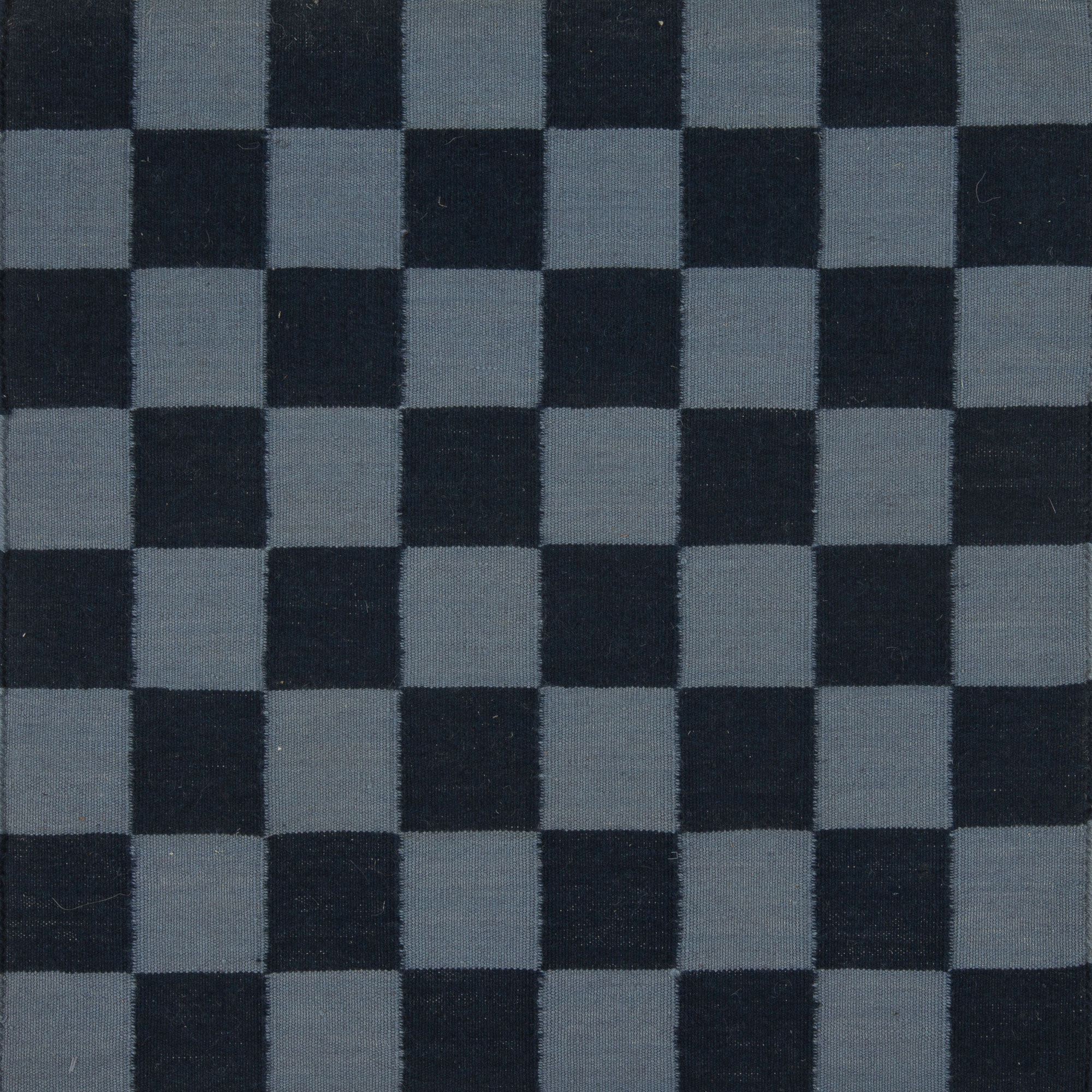
To pair antique and modern rugs successfully, the goal is not to make them identical. It is to make them read as part of the same design logic, even when they come from different periods. In connected rooms, that usually means deciding which rug carries the visual weight, which one calms the composition, and how the two can share a palette, scale, or material language without feeling overly matched.
When designers pair antique and modern rugs, they are usually solving a spatial problem rather than decorating for contrast alone. One room may need the depth, softness, and history of an antique piece, while the next benefits from a quieter surface that lets architecture or furniture take the lead. The best combinations feel intentional because they answer the same questions about proportion, traffic, and sightlines, even if their answers look different. That is why the conversation often begins with the room plan, not the rug pattern.
Decide which rug should lead and which should support
Every interior with mixed periods needs a hierarchy. If both rugs compete for attention at the same volume, the result is visual noise, especially in open-plan spaces where the eye takes in several rooms at once. A dense Persian antique with strong border definition might lead in a formal living room, while a simpler modern rug in a nearby dining area can support it by repeating one or two quiet notes from the first piece. The pairing works because the two rugs are not fighting for the same role.
Think of leadership in terms of contrast and placement. A room with substantial millwork, artwork, or sculptural furniture often benefits from a rug with patina and complexity, because those details can hold their own against layered pattern. By contrast, a room with low ceilings, architectural restraint, or very streamlined upholstery may need a modern rug with clearer fields of color and less border activity. In that situation, the older rug becomes the accent, and the newer one becomes the stabilizer.
Scale matters as much as style. An antique rug with a busy allover field can feel heavy if it is undersized, because the pattern is compressed and the room loses breathing room. A modern rug with large expanses of color can feel unfinished if it is too small, because the negative space starts to look accidental. When the sizing is right, the visual priority of each rug becomes readable without needing the pieces to resemble each other.
Unify through undertone rather than exact matching
One of the most reliable ways to pair antique and modern rugs is to align undertone instead of literal color. A faded madder ground can sit comfortably with a contemporary rug in warm taupe if both lean red-brown rather than pink, and a blue antique can connect to a modern wool rug that carries the same gray cast. This is a subtler and more durable strategy than trying to match one accent color across rooms, because it respects the way natural dyes, patina, and dye lots behave under different light conditions.
This is especially useful in homes where daylight changes dramatically from room to room. South-facing spaces can intensify warm pigments, while north-facing spaces can flatten them, making the same color appear disjointed if the undertone is wrong. If a hallway connects two rooms, the rug in that corridor should act as a bridge: not the brightest piece, but the one with the most adaptable base tone. A neutral woven ground, a softened charcoal, or a restrained rust can help the eye move without interruption.
Pattern density should also be considered part of the undertone conversation. A richly ornamented antique carpet can be balanced by a modern rug with a low-contrast motif, a linen-like field, or a subtle striation in the pile. For clients who prefer a quieter room, vintage-inspired custom rugs can provide that middle ground: they can echo the cadence of an antique without copying its motifs. That is often the most practical solution when one room needs history and another needs clarity.
Use room function to guide the balance of old and new
Function changes how a rug should behave. In a formal living room, an antique rug may introduce gravitas, acoustic softness, and a sense of collected permanence, especially when paired with tailored upholstery and limited accessory clutter. In a family room, however, a modern wool rug may be the better workhorse because it can handle traffic, vacuuming, and daily rearrangement without asking the rest of the room to accommodate a fragile visual center. The point is not that one era is better than the other, but that each room asks for a different kind of discipline.
Dining rooms introduce another layer of practical thinking. Chairs need to move cleanly, which means pile height, construction, and border placement matter more than many people expect. A very deep antique pile can be luxurious, but if it catches chair legs or creates instability at the edges, it is not the right choice for the task. A flatter modern rug, or a custom-designed piece with antique references and a more controlled surface, may preserve the desired look while performing better under daily use.
Bedrooms often offer the easiest environment for mixing periods because traffic is lighter and the visual pace is slower. Here, an antique rug at the foot of the bed can bring age and texture, while a quieter modern rug under the bed can keep the room from becoming too ornate. In adjacent rooms, this strategy can help one space feel intimate and the other feel disciplined. The balance is less about matching style categories than about matching the emotional volume of the space.
A practical example
Imagine a long apartment sequence with a living room, a small study, and a dining area. The living room might feature an antique room-sized carpet with warm fading and a restrained border, while the study uses a modern rug in a similar clay-gray family with a simpler weave. The dining area could then take a made-to-order piece that borrows the antique rug’s softened palette but keeps the field cleaner for chairs and circulation. The three rooms would not look uniform, but they would feel as though they were edited by the same hand.
Explain when a custom piece is the better counterpart
There are moments when the right companion to an antique rug is not another antique rug, but a custom one. This becomes especially relevant when the room requires a very specific size, an unusual proportion, or a quieter interpretation of a historic palette. If an antique carpet has the ideal color but the wrong dimensions for a modern room layout, custom rugs can solve the problem by translating the essential qualities of the older piece into a format that fits the architecture and furniture plan.
Custom rug design is also useful when the antique side of the pairing is visually dominant. Suppose a century-old rug brings intricate floral pattern, visible wear, and a strong border. The adjacent rug does not need to imitate it; it needs to stand beside it with enough restraint to let the antique breathe. A bespoke carpet can be designed with a related field color, a border width tuned to the room, or a texture that nods to hand-made tradition without introducing another heavy pattern competition.
Material selection matters here as much as pattern. Wool offers clarity, resilience, and a forgiving surface for active rooms, while silk accents or blended constructions can introduce sheen where a space needs a little lift. In a home with strong natural light, too much gloss can make a modern rug feel disconnected from an antique companion, so a matte wool ground often reads more comfortably. In lower-light rooms, a slight luster can prevent the newer rug from fading into the background and losing its role in the composition.
For designers specifying across multiple rooms, the value of custom rugs is not simply that they can be made to size. It is that they can be tuned for tone, edge detail, pile height, and visual density so they cooperate with an existing antique rather than competing with it. That kind of precision is especially helpful when the antique piece is non-negotiable, whether because it is a family heirloom, a collected object, or the one rug that already anchors the architecture. In those cases, the custom counterpart is often the cleanest route to balance.
Look at material, construction, and pile as part of the conversation
Antique rugs and modern rugs can differ dramatically in how they wear, reflect light, and frame furniture. A hand-knotted antique may have a dense, compact foundation and a softly aged surface that absorbs color in a nuanced way, while a contemporary flat-weave or lower-pile rug may present color more evenly and with less visual texture. Neither is inherently superior; what matters is whether the room needs depth, softness, or crispness. In mixed-period interiors, material contrast can be just as effective as color coordination.
Construction also affects how the rugs read in relation to each other. A thick pile in one room can make a neighboring rug feel visually lighter, even if the colors are similar. That can be helpful if you want the eye to land on one room and move past another without friction. It can also be a problem if the transition feels abrupt, which is why designers often consider thresholds, flooring color, and the height of adjacent furniture legs when planning the pair.
Durability should not be ignored just because the topic is aesthetic. If one rug sits beneath a heavily used seating area and the other is in a lower-traffic room, the visual story should still respect the realities of wear. A carefully chosen modern wool rug can protect the more delicate antique from being overused in the wrong location, while the antique can be placed where its beauty is protected rather than sacrificed. Good rug planning is often an exercise in preservation as much as presentation.
Pattern and visual rhythm across connected rooms
When two rugs are visible at the same time, the eye starts reading rhythm. Large medallions, small-scale repeats, broken borders, and open fields all create different beats, and those beats either complement or interrupt each other. A room with active upholstery and patterned drapery may need a rug with a quieter cadence, while a pared-back room can afford a denser antique or a more articulate modern motif. The best pairings often alternate intensity rather than stacking it.
It helps to think about what the viewer sees from the main approach. If the first view is of the antique rug, the neighboring modern rug should not introduce a competing border that feels louder than the original. If the sequence is reversed, a cleaner modern rug can create a measured lead-in that allows the antique to feel like a destination rather than a surprise. Sightlines, especially in apartments and townhouses, often decide whether the mix feels composed or accidental.
Pattern can also be used to connect periods without literal imitation. A geometric modern rug can borrow the structure of a historic field layout while leaving ornament behind, and an antique with faded motifs can echo the same geometry in a softer register. This is where vintage-inspired custom rugs can be especially effective, because they allow the designer to reference a period language while adjusting contrast, repetition, and border width to suit a contemporary room sequence. The result feels edited rather than nostalgic.
When contrast works, and when it starts to feel too heavy
Contrast is useful when it clarifies the room’s architecture. An antique rug can bring complexity to a minimalist interior, and a modern rug can create relief in a layered, maximal setting. Trouble begins when both rugs demand equal attention for different reasons: one through intense color, the other through overscaled pattern, or one through ornate wear, the other through high-gloss finish. If the room starts to feel visually crowded, the issue is usually not the mix itself but the absence of hierarchy.
The easiest way to test whether contrast is too heavy is to remove one variable at a time. First look at the palette: do the rugs share a family of warmth or coolness? Then examine scale: does one piece have enough open ground to rest the eye? Finally, consider texture: are both surfaces asking to be noticed at once, or does one support the other? When at least two of those three categories are aligned, the pairing generally reads as intentional.
In rooms with strong architectural detail, too much rug contrast can pull attention away from the space itself. This is especially true around fireplaces, paneled walls, arched openings, or carefully proportioned built-ins. In those interiors, the rug should not become a competing focal point unless that is the explicit design strategy. Often the most successful solution is to let the antique provide depth in one zone and the modern rug supply calm in the next, so the architecture remains legible throughout.
Designer checklist for mixing antique and modern rugs
- Choose a lead rug and a support rug before selecting colors or motifs.
- Match undertone first, not just the obvious surface color.
- Check the rugs from the main sightline, not only in isolation.
- Balance pile height and construction with the room’s traffic level.
- Adjust pattern density so one rug can breathe beside the other.
- Use custom rug design when the size, tone, or texture needs to be more precise than an off-the-shelf solution allows.
For connected interiors, the most successful pairings are rarely the most obvious ones. The goal is to create continuity through judgment: the right hierarchy, the right undertone, the right scale, and the right material response for each room. That is where antique and modern rugs stop feeling like separate purchases and start functioning as part of one thoughtful interior strategy.
Frequently Asked Questions
Should antique and modern rugs share one color family?
They do not need to match exactly, but they should usually live within the same temperature range. A warm antique rug often looks best beside a modern piece with warm or neutral undertones, while a cooler antique pairs more comfortably with slate, gray-blue, or softened neutrals. Exact color matching can look forced; shared undertone tends to feel more natural and more durable across changing light.
Can they sit in adjacent rooms without clashing?
Yes, provided the transition is planned. The easiest way to avoid clashing is to connect them through at least one of these elements: undertone, pile height, pattern density, or border language. If the rooms are open to each other, the rug that sits in the visual foreground should usually be quieter or more grounded so the second room can be introduced gradually.
When does contrast become too heavy?
Contrast becomes too heavy when both rugs compete for attention in the same way. That usually happens when they are both highly patterned, highly saturated, or highly textured without a clear hierarchy. If the eye cannot decide where to rest, the pair likely needs more restraint in one of the two pieces, or a custom rug adjustment to reduce visual density.
Are custom rugs useful when one rug is antique and the other is new?
Very much so. A custom piece can be sized to the architecture, adjusted to the room’s lighting, and tuned to echo the antique rug without copying it. That makes it especially useful in open-plan homes, formal entertaining spaces, and rooms where a standard size would leave the composition feeling unresolved.
For more nuanced pairing decisions, it helps to work with specialists who can judge rugs not just as objects, but as parts of a larger interior sequence. Doris Leslie Blau approaches that kind of selection with the eye of a collector and the practicality of a design studio, which is exactly what mixed-period rooms tend to require. If you are weighing an antique against a contemporary counterpart, expert guidance can turn a difficult choice into a clean, confident composition.