

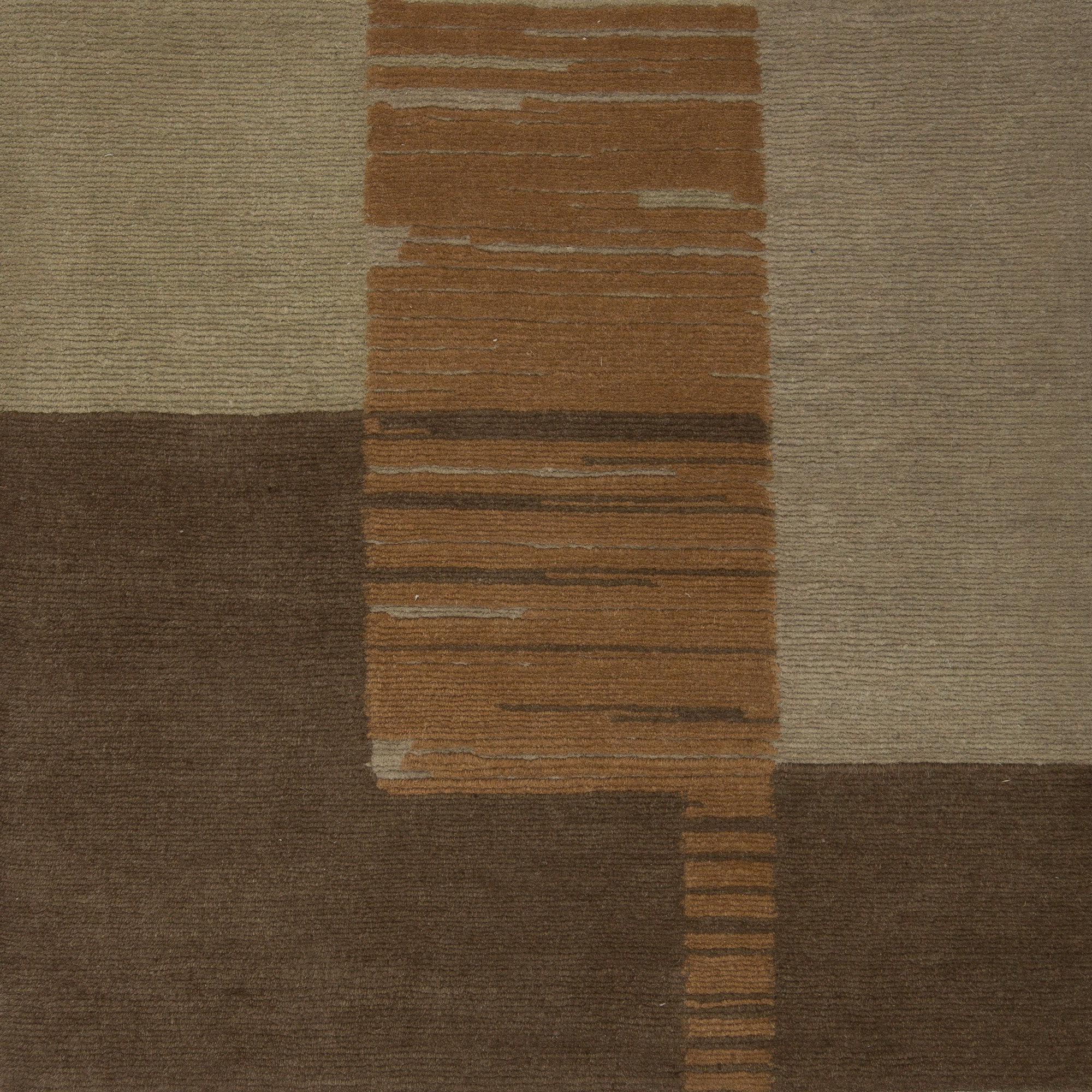
When a room is built to be photographed, toured, and dissected by design professionals, the rug cannot behave like a decorative afterthought. In showhouses, custom rugs need to support the architecture, flatter the camera, and still feel believable under real furniture, real foot traffic, and real light. The best results come from treating the rug as part of the editorial structure of the room, not merely the soft surface beneath it. That means balancing narrative, proportion, and material choices with unusual precision.
Designing rugs for showhouses asks for a different mindset than designing for a private residence. A home can tolerate a rug that becomes apparent only after repeated use, but a showhouse is judged in an instant, often from the threshold or through a lens. The rug must establish scale immediately, clarify circulation, and help the furnishings read as a composed story rather than a group of sponsored objects. For designers specifying custom rugs, that usually means editing away anything that competes with the room’s architecture or the exhibitor’s intent.
Showhouses also place a strange burden on materials. The room may look pristine during install, yet it must survive open-to-the-public traffic, changing shoes, equipment, and repeated photography with flash or intense natural light. A successful rug therefore has to be visually refined and structurally disciplined at the same time. That is where the value of designer custom rugs becomes obvious: they can be tailored to the room’s dimensions, palette, and viewing conditions instead of forcing the room to adapt to a stock size or generic pattern.
Decide whether the rug should support or stage a vignette
The first question is not what pattern to choose, but what role the rug should play. In some rooms, the rug should disappear just enough to let the architecture, art, and furniture arrangement carry the narrative; in others, it should act as the visual anchor that makes an otherwise fragmented sponsor-heavy space feel intentional. This distinction matters because showhouses often contain multiple design voices, and the rug can either calm those voices or amplify them. A room with a lot of objects, finishes, and product placements usually benefits from restraint, while a quieter room can handle a more expressive floor plane.
For example, imagine a library vignette with a strong fireplace surround, brass lighting, two club chairs, and several branded accessories. A dense pattern on the rug might compete with the mantel and crowd the eye, especially if the room is photographed straight on. A more measured custom rug with a nuanced border or tonal field could frame the seating arrangement without introducing another loud graphic element. By contrast, a dressing room or salon with relatively plain millwork may need a more articulated design to give the space a stronger point of view.
That is why the brief for a showhouse rug should always define the visual hierarchy. Is the floor meant to be background, frame, or focal point? Once that answer is clear, construction and pattern decisions become easier to make. A flat, quiet wool ground may support a furniture vignette; a carefully scaled motif in hand-knotted wool and silk may help a room feel more authored. The wrong choice is not “too decorative” or “too plain” in the abstract, but mismatched to the role the room needs the rug to perform.
Balance photography needs with lived-in realism
Showhouse rooms are photographed aggressively, which changes how a rug should be designed. On camera, small shifts in sheen, pattern density, and pile height can make a room look either flat or chaotic. A rug that appears beautifully balanced in person may read muddy under bright daylight or overly contrasty in a wide-angle shot. Designers specifying rugs for this environment should think in terms of image capture as much as interior experience, because the room will often be seen first in photography and only later in person.
At the same time, the space cannot feel like a set piece with no relationship to real use. If a rug looks too precious, too low-pile to the point of austerity, or too fragile in construction, the room can feel staged rather than designed. The goal is to find a believable middle ground: a surface with enough visual refinement for editorial photography, but enough substance to support actual circulation and furniture weight. That is where the rug sampling process becomes especially useful, because texture and tone can be judged against the room’s specific materials instead of on a showroom floor alone.
Sampling should be tested against the actual conditions of the room: window exposure, ceiling height, wall color, upholstery fabric, and the finish on nearby metal or wood pieces. A warm neutral wool may glow under afternoon light but flatten under cool LEDs; a silk-rich blend may look crisp in the corner and glare in the center of the room. Designers who treat samples as working tools rather than color chips can make more confident decisions about pattern clarity, fiber mix, and edge definition. That process is particularly important when the room includes multiple sponsors with different material languages.
Coordinate rug color with lighting and camera angles
Color in a showhouse is never just color; it is color under a specific lighting plan and a specific lens. A rug that feels softly olive in daylight may skew gray under warm artificial light, while a pale ivory field can wash out if the camera angle catches too much direct sun. Before finalizing custom area rugs for a showhouse, designers should examine how the room will be lit in the morning, afternoon, and evening, and from which directions it is most likely to be photographed. The best rug color choices preserve depth without becoming overcomplicated.
Room orientation matters as much as hue. South-facing rooms can intensify warm tones and reveal subtle shifts in wool and silk more clearly, while north-facing rooms often need more chromatic warmth to avoid feeling underexposed in photographs. A rug with layered neutrals, restrained contrast, or a controlled accent color tends to travel better across these conditions than one that depends on a single dramatic shade. If the surrounding scheme already contains strong wall color, reflective surfaces, or patterned upholstery, the rug should usually move one step quieter rather than trying to win the visual competition.
Texture also affects color performance. A cut pile can soften transitions and create a velvet-like depth, while a looped or flatwoven structure may read more graphic and architectural. In editorial rooms, that distinction can be decisive: a high-luster construction may pick up too much glare, whereas a matte hand-knotted rug can ground the composition and keep the camera from chasing highlights across the floor. For designers, the practical task is not simply to pick a pretty color, but to control how that color behaves under pressure.
Keep the design coherent across multiple rooms
Showhouses rarely involve a single room, and one of the most difficult tasks is making each space distinct without losing continuity. A floor treatment that works beautifully in one room may feel disconnected in the next if scale, border logic, or tonal temperature changes too sharply. The designer’s job is to create a thread that can run through the house, even as each room has its own sponsor mix and personality. That thread might be a shared fiber family, a repeated proportion, a consistent border language, or a palette that moves gradually from one room to another.
Coherence becomes especially important in houses where the layout pushes visitors from intimate rooms into larger entertaining spaces. A small sitting room with a restrained rug can prepare the eye for a bolder dining room, but only if the change feels intentional rather than arbitrary. The same principle applies when multiple custom carpets are specified for a single project: the design should acknowledge the house as a sequence, not a collection of isolated moments. This is where scale and proportion are as important as motif, because a strong visual rhythm can hold the entire presentation together.
A practical way to approach this is to map the house before choosing surface treatments. Mark the sightlines from entry, staircase, and major thresholds, then identify where the eye needs rest and where it can absorb detail. In one room, the rug may need a quiet field to give a gallery-like sense of pause; in the next, it may require a border or medallion that helps gather furniture into a more conversational grouping. The point is not repetition for its own sake, but a controlled progression that keeps the story legible as the visitor moves through the house.
Material and construction decisions matter more than they first appear
Showhouses reward rugs that look effortless but are specified with real rigor. Hand-knotted construction is often the safest path when the room needs finesse, because it allows for dense detail, controlled scale, and a refined edge that holds up well in photographs. Wool remains a practical foundation for many of these projects because it offers resilience, depth, and a relatively forgiving surface under changing light. Silk can be used selectively to sharpen contrast or add quiet sheen, but it should be introduced with intention rather than as a default marker of luxury.
Pile height should be decided in relation to furniture, not only style. A deep pile may feel sumptuous in an empty room, but it can visually swallow chair legs, create awkward transitions at doorways, or complicate the reading of layered textiles. A lower, more disciplined pile often works better where the room already has heavy visual content, because it lets the architecture and upholstery stay crisp. If the room contains delicate antiques or sculptural contemporary pieces, the rug should support them with enough surface detail to feel complete, but not so much texture that it introduces visual noise at floor level.
Edge treatment matters as well. In a showhouse, bound edges, borders, and finish details are not minor issues; they affect how the rug frames the room and how finished the installation appears in photographs. A border can quietly define a seating arrangement, while a slightly softened perimeter may make a room feel more organic and less overdesigned. The best choices are rarely the most obvious ones. They are the details that disappear into the composition while still doing the structural work of keeping the room coherent.
Use custom sizing to solve the room, not just fill it
Showhouses are full of unusual room proportions, awkward alcoves, and furniture plans shaped by sponsorship as much as by architecture. This is one reason stock dimensions often fail: they leave gaps where the composition needs certainty or force an arrangement to float without enough visual grounding. A proper sizing strategy should be based on the seating plan, circulation path, and the amount of floor that needs to remain visible for balance. In these rooms, a rug is not just a surface covering; it is a tool for setting the room’s geometry.
That is why an experienced specification process often begins with a measured drawing and ends with a full-scale review. Designers should check whether front furniture legs sit comfortably on the rug, whether the border aligns with architectural details, and whether the rug’s silhouette supports the room’s main axis. In a narrow room, a slightly extended rug may help the space feel calmer; in a wide room, a more centered placement might prevent the furniture from looking stranded. For projects that require tailored dimensions, custom area rugs give the designer room to solve these spatial problems rather than merely decorate around them.
Custom sizing also prevents one of the most common showhouse mistakes: decorative insufficiency at the edges. When a rug is too small, the room can look like the furnishings were placed on a landing pad rather than composed within a unified field. When it is too large, the floor loses definition and the room can feel heavy or overfurnished. Getting the size right is not a matter of convention but of proportion, especially in a house where every inch is being evaluated by visitors who work in design.
How to keep sponsor-heavy interiors from feeling fragmented
Showhouses often include product placements that are individually strong but not inherently harmonious. One room may contain a statement sofa from one sponsor, sculptural lighting from another, and art with its own visual agenda. The rug has to act as a stabilizer in that environment, giving the eye a place to land without flattening the individuality of the pieces. This is one of the places where thoughtful rug design becomes architectural problem solving rather than surface decoration.
A neutral does not have to be bland, and a pattern does not have to be loud. The real issue is whether the rug can mediate between competing textures, finishes, and visual weights. A softly abrash field can bridge antique wood and polished metal; a disciplined geometric motif can bring order to a mix of curved and rectilinear furniture. The goal is to create a floor plane that supports the room’s argument without becoming the loudest speaker in the conversation.
Designers who regularly work with custom rugs know that a house can become fragmented when each room tries to make a separate, isolated statement. Instead, the rug can quietly repeat a material logic from one room to another: a similar wool quality, a shared tonal depth, or a recurring border proportion. That subtle continuity helps the visitor understand the showhouse as a designed sequence rather than a list of sponsored moments. In a project like this, restraint is not a lack of ambition; it is the discipline that lets the whole house read clearly.
A practical specification checklist for showhouse rugs
Before approving a rug for a showhouse, it helps to test the design against a few non-negotiables. The room should be measured from the primary sightline, not just from wall to wall. The lighting plan should be reviewed alongside samples, because tone and sheen can shift dramatically once the room is installed. And the rug should be evaluated in context with upholstery, drapery, art, and architectural details, since no showhouse floor exists in isolation.
- Confirm the rug’s role: background, frame, or focal point.
- Check scale against the furniture layout and primary camera angle.
- Test colors under the actual lighting temperatures used in the room.
- Review pattern density for both close viewing and wide shots.
- Balance tactile richness with a construction that can handle traffic.
- Make sure the rug connects logically to the other rooms in the house.
If a room still feels uncertain after those checks, the issue is usually not the rug alone. More often, it is a mismatch between the floor treatment and the room’s intended hierarchy. In that case, adjusting border scale, ground color, or fiber composition can solve the problem without rewriting the entire design. That is the value of working with a specification-minded rug partner: the solution can be calibrated rather than improvised.
FAQ
What makes a showhouse rug successful on camera?
A successful showhouse rug photographs with clarity, not confusion. It should hold its pattern or texture at a distance, avoid glare under the planned lighting, and reinforce the room’s geometry without drawing attention away from the furnishings. Rugs with well-controlled contrast, deliberate scale, and a finish suited to the room’s light often perform best.
How much pattern is too much for staging?
There is no single threshold, but pattern becomes excessive when it competes with the architecture, art, or furniture silhouettes. In a heavily styled room, the floor often works better with a restrained motif or tonal variation. If the space already contains multiple strong finishes and sponsor pieces, the rug should usually be quieter so the room remains legible.
Should showhouse rugs be more durable than they look?
Yes. Even when a room is meant to feel refined, it still has to stand up to repeated traffic, installation activity, and photography equipment. Durable construction, stable fibers, and a pile height suited to the room’s use help preserve the look throughout the showhouse period. The best rugs are the ones that appear delicate while remaining structurally dependable.
How does the rug sampling process help in a showhouse?
The rug sampling process allows designers to compare color, texture, and sheen directly against the room’s actual finishes and lighting conditions. That matters because showhouse environments can distort both warm and cool tones, especially in rooms with large windows or reflective surfaces. Sampling in context reduces the risk of a rug that looks perfect in the workroom but misbehaves in the finished space.
For showhouse projects, the right rug is rarely the loudest element in the room, but it is often the one that makes everything else make sense. Doris Leslie Blau approaches these decisions with the same care used for private commissions: measured proportions, material intelligence, and design guidance rooted in how the space will actually be seen. If you are shaping a room that needs editorial presence without losing its story, a specialist consultation can help refine the rug specification before the rest of the composition is locked in.