

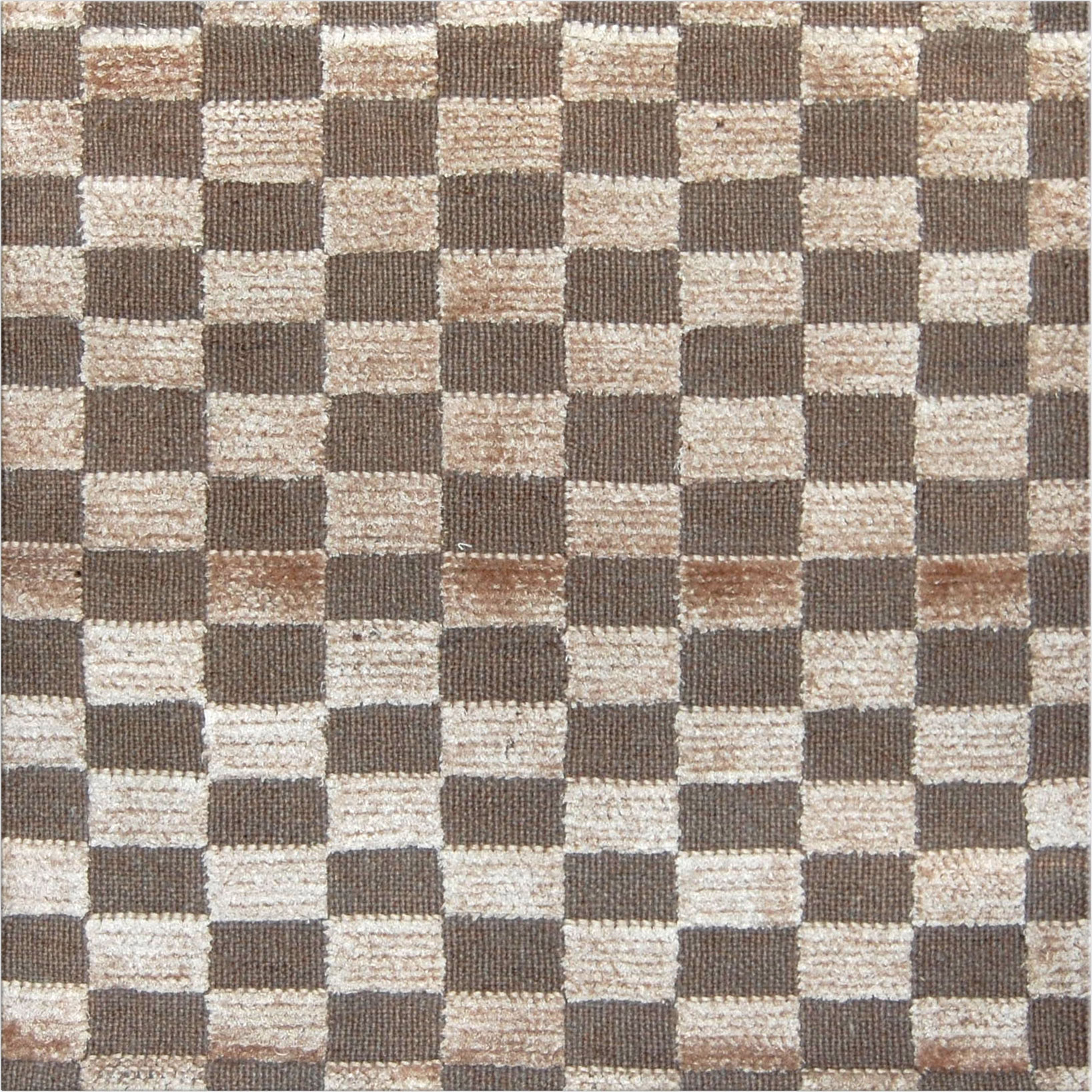
When a living room feels slightly off, the cause is often not the sofa, the paint, or the art. It is usually the rug. The right custom rugs do more than soften a floor; they establish the room’s scale, clarify circulation, and make seating look intentionally arranged rather than placed at random. In a room built around conversation, proportion matters as much as color or pattern.
Size decisions become especially important in living rooms because the rug has to work with multiple objects at once: sofa arms, chair legs, coffee tables, side tables, lamps, and frequently a fireplace or television wall. A rug that is too small can make even generous furniture feel compressed, while one that is properly scaled gives the eye a place to rest and the room a sense of order. That is why custom rug design is often the right answer when standard dimensions force awkward compromises. The goal is not simply to fill the floor, but to shape the room so the furniture reads as one composition.
Why living room rug sizing matters more than most people think
Living rooms are judged at a glance. If the rug ends too close to the sofa, or if chairs hover off the edge, the proportions feel unsettled even when the furnishings themselves are beautiful. In practice, a rug does three jobs at once: it anchors the seating arrangement, connects pieces that should belong together, and helps the room read as larger by organizing visual boundaries. This is why custom rugs are often specified for rooms with unusual layouts, generous square footage, or furniture that does not fit standard proportions.
There is also a material consequence to scale. A fine hand-knotted rug with a dense weave can carry a large room visually because the details hold up under close view, while a simpler flatweave can keep a room feeling lighter and less visually heavy. Pile height, pattern density, and border treatment all affect how large a rug appears once it is installed. For that reason, sizing should be considered alongside fiber and construction, not after them.
Show the three most common living room rug layouts
1. All major seating legs on the rug
This is the most enveloping layout and often the best choice for larger living rooms or spaces where the seating area is meant to feel collected and calm. In this arrangement, the front and back legs of sofas and chairs sit fully on the rug, creating a complete frame around the conversation zone. It works particularly well with custom oversized rugs because the rug needs to extend beyond the furniture group by a meaningful margin rather than stopping under only the coffee table. The effect is generous and grounded, but it requires enough floor area to avoid crowding the perimeter of the room.
2. Front legs only on the rug
This is the most flexible layout and the one most often used in medium-sized living rooms. The front legs of the sofa and chairs rest on the rug, while the back legs remain on the floor, which gives the arrangement visual continuity without demanding an extremely large rug. When executed correctly, this layout keeps the room open and avoids the tightness that can happen when a rug extends too close to the walls. It is often a smart solution when the room includes circulation paths on one side or when the seating area must coexist with an adjacent dining or reading zone.
3. Furniture floating around the rug
In this layout, the rug sits beneath the coffee table and acts as a central anchor, while the surrounding furniture remains off the edge. It can work in compact rooms or in spaces where the rug is intended to provide color and texture rather than fully define the seating group. The risk is that the room can start to look fragmented if the rug is too small relative to the sofa and chairs. This layout succeeds only when the rug is proportionate to the furniture and when the negative space around it feels deliberate rather than accidental.
How much rug should sit under sofas and chairs?
A practical rule is to let the rug extend far enough beyond the front edge of the seating pieces to make the relationship look stable, not tentative. For many living rooms, that means a minimum of 6 to 8 inches under the front legs of a sofa or chair, though larger rooms often benefit from substantially more. If the rug is part of a formal seating arrangement, the eye usually prefers a deeper overlap, especially when the furniture has strong arms or broad proportions. A narrow strip of rug under a sofa can look under-scaled even when the measurements are technically correct.
Chairs deserve the same attention. If a lounge chair sits on the edge of the rug with only one leg touching, the composition can feel unfinished. In most cases, either both front legs should land clearly on the rug or the chair should be fully outside the rug’s perimeter with enough buffer to look intentional. That buffer matters because furniture needs breathing room; when chairs are too close to the rug edge, the whole setting can appear squeezed. A thoughtful designer will test the layout on the floor before ordering, especially when specifying handmade rugs that should align precisely with the room’s circulation.
Coffee tables can help determine sizing as well. A rug should generally extend well beyond the table on all sides so the table does not look stranded in the middle of a small island. If the table is oversized, a rug that barely clears it can make the room feel pinched; if the rug is scaled generously, the table becomes the center of a grounded seating field. This is one reason many designers prefer to size the rug from the furniture grouping outward rather than from the room walls inward.
Open-plan versus enclosed living rooms
Open-plan living rooms ask rugs to behave like architecture. They need to define one zone without interrupting the sightline to the dining area, kitchen, or adjacent hall. In these spaces, a rug should usually be large enough to establish a clear perimeter around the seating group, while still leaving enough floor visible to preserve the openness of the plan. Pattern can help here: a restrained motif or tonal ground often reads more cleanly than a highly busy design, particularly when the rug is one of several large visual planes in the room.
Enclosed living rooms have a different task. Because the room already has defined boundaries, the rug can be more intimate and more concentrated in its role as an anchor. Here, a rug that reaches closer to the seating edges can make the room feel more settled, especially in rooms with lower ceilings or strong architectural enclosure such as paneling, millwork, or a fireplace wall. The challenge is to avoid overfilling the space. When every piece is pushed too close to the walls, the room loses the sense of depth that makes it feel comfortable.
Open-plan rooms often benefit from custom rug design because the exact dimensions matter more than they would in a closed room. A rug may need to stop before a circulation path, align with a window wall, or sit squarely under a sectional while still leaving visual room for a dining table nearby. Standard sizes rarely solve all of those conditions at once. Tailor-made rugs can be proportioned to the furniture group and the architecture together, which is usually what makes the layout feel resolved.
How to size a rug for a sectional
Sectionals are deceptively difficult because they combine one long horizontal line with a turning corner that changes the shape of the room. The safest starting point is to treat the sectional and coffee table as one footprint and then choose a rug that extends beyond that footprint on all exposed sides. The corner return should not look like it is crowding the rug edge, and the chaise, if present, should not dominate the entire layout. If the sectional is substantial, custom oversized rugs are often the cleanest solution because standard rectangles can fall short of the needed length or width.
For L-shaped seating, the rug should generally be wide enough that the longer run of the sofa does not appear to spill off it. A rug that is too narrow will make the room feel lopsided, especially if the chaise projects into the center of the room. In smaller rooms, a sectional can still work with a rug if the rug is placed to anchor the main conversational zone rather than chase every inch of upholstery. The key is to keep the arrangement legible: the rug should clarify the sectionals shape, not compete with it.
Mistakes that make rooms look smaller
- Choosing a rug that is too short under the sofa. Even a beautiful design can look underwhelming if it stops before the furniture has enough visual support.
- Leaving every major piece off the rug. This breaks the seating group into separate objects and makes the room read as smaller and less cohesive.
- Letting the rug float in the center with too much empty border around it. A small rug surrounded by a large amount of floor can shrink the perceived room size rather than expand it.
- Using a dense, high-contrast pattern in a cramped layout. Strong pattern can be excellent, but if the room is already tight, too much visual activity can feel crowded.
- Ignoring circulation paths. If people step around the rug constantly, the layout will feel awkward no matter how attractive the rug is.
- Assuming the wall-to-wall room size should determine the rug. Furniture placement, not just the room dimensions, should guide the final measurement.
Material, pile, and pattern: the details that change perception
Scale is not only about inches and feet; it is also about how the rug behaves visually. A low-pile wool rug can help a room feel crisp and architecturally controlled, while a more substantial pile adds softness and acoustic absorption, which is useful in large or echo-prone living rooms. Hand-knotted rugs in wool and silk blends can give a room depth without visual heaviness because the surface detail remains refined even across a large expanse. If the room receives strong daylight, subtle changes in sheen may matter as much as color, since silk highlights can either sharpen a space or make it feel more luminous.
Pattern should be selected with the furniture arrangement in mind. A highly regular border can reinforce symmetry in a formal living room, while an allover pattern can help disguise the asymmetry that often comes with open-plan layouts or offset fireplaces. In rooms with minimalist furniture, a rug with more texture than contrast may be the better choice because it adds richness without overpowering the setting. In rooms with substantial upholstery, a simpler ground often gives the eye enough rest. The best rugs support the room’s architecture rather than compete with it.
A realistic sizing example
Consider a living room with a sofa, two lounge chairs, and a rectangular coffee table arranged around a fireplace. If the sofa is placed several feet from the hearth and the chairs angle inward, a rug sized only to the coffee table may make the seating group feel disconnected from the architecture. A larger rug that reaches under the front legs of the sofa and chairs can visually pull the fireplace, seating, and table into a single conversational field. In a room like this, the rug is not decoration added at the end; it is the device that organizes the room’s geometry.
That same principle applies in a smaller apartment living room, though the proportion changes. A modest room does not need an oversized rug that touches the walls, but it does need enough presence to support the main seating pieces. Often, the best result is a rug that keeps the front legs of the sofa and chairs on the field while preserving clear floor margins around the perimeter. This keeps the room from feeling boxed in and allows the furniture to sit with intention rather than crowding the boundaries.
When custom sizing is the right answer
Standard rugs are useful when the room is conventional and the furniture arrangement is straightforward. But once the living room has an unusual width, an elongated shape, a corner sectional, or a circulation problem, made-to-order rugs become far more practical. They allow the exact relationship between sofa, chairs, and table to be resolved without compromise, which is especially valuable when the room is a primary gathering space. For homeowners comparing custom rugs to ready-made options, the distinction often comes down to whether the room needs a generic solution or a composition built for its specific proportions.
At Doris Leslie Blau, that kind of design thinking is part of the process. A well-chosen rug should not simply fit the room; it should strengthen the layout, support the material palette, and age gracefully with the furniture around it. For those shaping a living room from the ground up, a custom rugs consultation can help translate measurements, lifestyle needs, and design intent into a finished piece that feels properly scaled from the first day it is installed.
FAQ
Should all seating legs sit on the rug?
Not always. In larger living rooms, placing all major seating legs on the rug creates a more unified and formal composition. In medium-sized rooms, front legs only is often the better balance because it anchors the furniture without demanding an oversized rug. The right answer depends on the room’s circulation, the scale of the furniture, and whether the seating area needs to feel enclosed or more open.
How do I size a rug for a sectional?
Measure the full footprint of the sectional and coffee table as one group, then choose a rug that extends beyond that footprint on the exposed sides. The goal is to avoid making the chaise or corner return look as though it is hanging off the edge. If the sectional is substantial or the room is wide, custom oversized rugs are often the most efficient way to achieve proper proportion.
Can a living room rug define zones in an open plan?
Yes, and this is one of the rug’s most useful roles in open-plan interiors. A rug can distinguish the seating area from a dining or kitchen zone without building physical partitions or interrupting sightlines. The most successful layouts usually rely on a rug that is large enough to hold the furniture together, but restrained enough in pattern and color to work with the neighboring zones.
What if my room is small but I want a large look?
Focus on proportion rather than sheer size. A rug with a quieter pattern, a low to medium pile, and enough extension under the front legs of the seating can make a small room feel composed without overwhelming it. Avoid choosing a rug that is too small, because that usually has the opposite effect: it makes the room look tighter and less resolved.
Living room rug sizing is ultimately about clarity. When the dimensions are right, the room feels easier to move through, easier to read, and more comfortable to inhabit. If you are weighing material, weave, or layout decisions alongside measurements, Doris Leslie Blau can offer design guidance that respects both the architecture and the way you actually live in the room.