

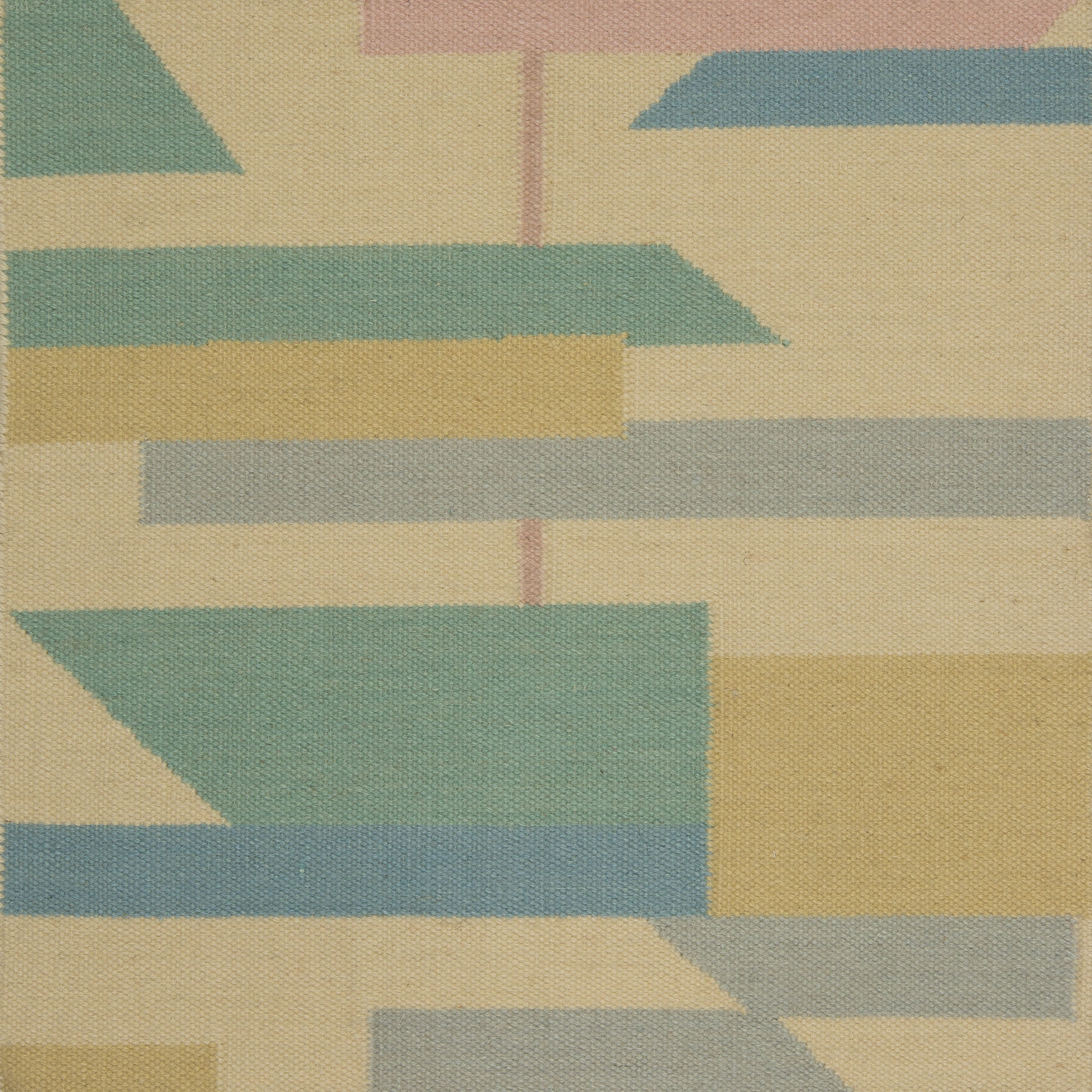
Matching rugs to fabrics is rarely about exact correspondence. The stronger interiors usually come from restraint: a rug that speaks to the upholstery, drapery, and wall finishes without repeating them too literally. With custom rugs, that balance becomes easier to control because the scale, color, material, and pattern can be tuned to the room instead of pulled from a fixed size or palette. The goal is not symmetry for its own sake, but visual agreement with enough variation to keep the space alive.
When a room feels too coordinated, it is usually because every soft furnishing is delivering the same message at the same volume. If the sofa, curtains, and rug all share the same tone, texture, and pattern intensity, the eye has nowhere to rest. A better approach is to assign each element a role: one may lead with color, another with texture, and another with structure. That hierarchy creates depth, and depth is what keeps a scheme from reading as staged.
Choose one material family to lead
The easiest way to avoid overmatching is to decide which material family should carry the main visual weight. In a room with linen upholstery and brushed oak cabinetry, for example, a wool or wool-silk rug can reinforce the softness of the furniture while adding enough definition to keep the floor plane grounded. If the room already contains a lot of polished or reflective surfaces, a rug with a matte hand can act as a stabilizer. The point is not to echo every finish, but to let one family set the tone while the others support it.
This is especially useful when clients bring in several fabric references at once. A velvet chair, a mohair sofa, and a textured drapery fabric may all feel luxurious, but they are not asking for the same rug. One room may benefit from a quieter ground with subtle abrash and low-relief patterning, while another can handle a more graphic field because the fabrics are already soft and diffuse. For designers specifying designer custom rugs, that distinction matters: the rug should clarify the room’s material hierarchy, not flatten it.
In practice, this also helps with circulation and zoning. A dining area that sits next to a lounge may share upholstery tones, but the rug can be more architectural in one zone and more tactile in the other. That difference allows the eye to read each area without needing a dramatic color shift. When the room is large or open-plan, the rug becomes one of the few tools that can organize function while preserving continuity.
Balance undertones across soft and hard finishes
Color coordination becomes more precise when you stop looking only at surface color and start looking at undertone. A cream rug can lean warm, cool, or neutral; the same is true of a stone wall, a painted millwork finish, or even an upholstered fabric that reads beige at first glance. Matching rugs to wall finishes works best when the undertones are compatible, not identical. A warm sand rug can sit beautifully against a cool off-white wall if the room also includes a bridging material, such as oak, tobacco leather, or aged brass.
Rooms fail when the undertones are technically close but emotionally disconnected. For instance, a pink-beige rug paired with a green-gray fabric can create a slightly strained result even if both are muted. The solution is not to force a perfect match, but to insert a third note that clarifies the relationship. In some interiors that note is architectural, such as plaster or limestone; in others it is textile-based, such as a striped pillow, a tonal throw, or one of Doris Leslie Blau’s custom-made rugs that can be calibrated to the exact warmth or coolness the room needs.
Hard finishes deserve the same scrutiny. Marble, metal, lacquer, and stone often read cooler and more reflective than textiles, even when the color appears similar on a sample board. A rug that is too close in hue can disappear beside these materials, which is why a slight shift in depth or saturation is usually more effective than a literal match. Think of the rug as the element that absorbs light while the architecture reflects it; that contrast gives the room contour.
Use texture to prevent visual sameness
Texture is often what rescues a coordinated scheme from feeling flat. Even in a restrained palette, a rug can introduce movement through pile height, weave density, fiber blend, or the degree of surface irregularity. A hand-knotted rug with a subtle abrash will behave differently from a uniformly woven flatweave, just as a silk blend will catch light differently from pure wool. When the upholstery is already smooth, a more tactile rug can keep the floor from disappearing into the rest of the scheme.
Texture matters even more when color is intentionally quiet. Many clients want a soft, tonal room, but tonal does not have to mean inert. A rug with carved details, a low-relief medallion, or an understated border can create enough visual rhythm to support a tailored interior without turning it busy. In that sense, texture becomes a kind of line drawing: it defines the space with subtlety rather than bold contrast. That is one reason hand-knotted rugs remain so useful in refined residential interiors; the construction itself contributes nuance before pattern even enters the conversation.
Durability should also influence texture decisions. A high-traffic sitting room, family room, or hallway wants a surface that keeps its clarity under use, while a formal living room may allow for a finer hand or more delicate fiber mix. If the upholstery is heavily textured, a smoother rug may be the better counterpoint. If the furniture is clean-lined and pared back, a rug with more visible construction can add the tactile interest the room needs.
Think in terms of visual rhythm, not identical pattern
Pattern is where overmatching becomes most obvious. A floral drapery with a floral rug and a floral chair can feel crowded unless the motifs vary in scale and register. Designers often get better results by pairing different pattern types that share a pace rather than a shape. A rug with an open field and a quiet border can hold its own against a patterned pillow fabric because the two elements are speaking in different sentences. That difference lets the room read as layered instead of themed.
Pattern density should also respond to the room’s sightlines. If the rug is viewed from across an entry or through a doorway, it needs enough structure to register at a distance. If it is placed in a smaller sitting area, the details can be more intimate because the user encounters them up close. This is where scale and proportion become central to the specification process. A large room can support broader pattern repeats or a more generous border, while a compact room often benefits from quieter motifs and stronger negative space.
For clients who want a cohesive but not matchy result, a useful explanation is to compare the room to a wardrobe. The fabrics do not need to be identical; they need to belong to the same style logic. A textured jacket, a crisp shirt, and a matte shoe can all work together because their finishes vary while their tonal family remains related. The same principle applies to rugs and upholstery. The rug should converse with the fabrics, not repeat them line for line.
How to present the relationship to clients
Clients often ask for “something that matches,” when what they really want is confidence that the room will feel resolved. It helps to explain that a successful scheme usually combines one or two shared traits with one deliberate difference. The shared trait might be undertone, material temperature, or pattern scale; the difference might be texture, value contrast, or motif direction. Framing the decision this way gives clients a clearer way to understand why an exact fabric-to-rug copy is rarely the best solution.
A useful workflow is to review the room in layers. Start with fixed architectural elements, then compare the upholstery, drapery, and rug as a sequence rather than as isolated samples. Ask what needs to recede, what needs to anchor, and what needs to provide relief. If the walls are already strong, the rug may need to soften the composition. If the furniture is simple, the rug can bring in a little more character. This method also makes it easier to specify made-to-order options without losing sight of the room as a whole.
When presenting custom rugs, it can be helpful to show at least two directions: one that is closer to the fabrics, and one that is slightly more contrasted. Many clients choose the more restrained version at first glance, but the second option often proves more lasting because it has room to breathe. That is particularly true in homes where textiles will change over time. A rug with enough independence from the upholstery can stay relevant even as pillows, throws, or accent chairs are refreshed seasonally.
For interiors that rely on multiple soft finishes, the design conversation should include maintenance and use. A family room with pets, bright daylight, and frequent traffic will need different decisions than a formal salon or a private study. Color value, pile height, and fiber choice all influence how forgiving the rug will be once the room is lived in. Those practical realities should be part of the presentation, because a beautiful match that looks fragile on day one is not a good design decision.
Examples of workable pairings
Consider a room with oatmeal linen sofas, pale oak paneling, and blackened metal details. A rug in a slightly deeper flax tone with a gentle tonal pattern would feel connected without blending into the upholstery. The rug would anchor the seating area while allowing the walls and furniture to remain distinct. The result is calm, but not static, because each surface contributes a different kind of emphasis.
In another setting, imagine a velvet settee in muted sage, cream drapery, and travertine flooring. Matching the rug to the sofa exactly would make the room feel overly literal. A better answer might be a rug with soft ivory ground, subtle sage striation, and a denser hand that holds the floor visually against the stone. The rug would repeat the color story without duplicating the fabric, and the room would feel edited rather than matched.
In more expressive interiors, pattern can do the work of coordination. A room with striped upholstery and plain walls may accept a rug with a quieter geometric rhythm, especially if the colors share the same depth. The key is to avoid multiple strong patterns of equal scale competing for attention. One pattern can lead, another can support, and the third surface should usually be quieter to preserve balance.
Why restraint usually reads as more luxurious
Restraint does not mean neutrality. It means knowing which elements should align and which should remain slightly apart. Interiors feel expensive when the materials appear considered, not when they appear identical. A rug that echoes a fabric too closely can make the room seem overdesigned, while a rug that understands the room’s values, textures, and proportions can make the whole scheme feel effortless. That is the real value of customization: not novelty, but precision.
Custom specification gives designers room to solve for both beauty and function. A bespoke palette can be softened for a quiet bedroom, deepened for a formal sitting room, or adjusted to address a wall finish that changes in different light. The same is true of weave and construction. Whether the brief calls for a subtle handwoven field, a more defined border, or a custom rug design sized to furniture placement, the right rug should support the architecture instead of competing with it.
FAQ
Should rugs match upholstery exactly?
No. Exact matching often makes a room feel flat and overcontrolled. It is usually better to share a color family, undertone, or material mood while allowing one element, often the rug, to introduce a different texture or value. That variation gives the room depth and helps the fabrics read as intentionally layered rather than copied.
How do I avoid a scheme that feels too coordinated?
Limit the number of elements that share the same finish or pattern intensity. Let one surface lead with color, another with texture, and another with structure. If the upholstery is soft and tonal, consider a rug with a bit more definition; if the rug is highly patterned, keep the other textiles quieter. Small shifts in scale and surface quality usually make the biggest difference.
What matters more: color or texture?
Both matter, but texture often carries more weight than people expect. A rug and fabric can be close in color and still feel very different if one is matte, dense, or low-pile and the other is reflective or plush. When the palette is restrained, texture becomes especially important because it provides the contrast that keeps the room from blending together.
Can matching rugs to wall finishes work in a neutral room?
Yes, but the undertones need to be handled carefully. Neutral rooms can become muddy if the rug, walls, and upholstery all sit at the same depth without a clear relationship. A slight contrast in warmth, value, or texture usually makes the composition clearer. In many cases, a custom rug can be tuned to bridge the walls and the fabrics without disappearing into either one.
If you are refining a room where the fabrics are already established, the right rug can act as the final layer that makes everything feel resolved without seeming overworked. Doris Leslie Blau’s gallery expertise and design guidance can help translate samples, finishes, and proportions into a rug that belongs to the room on first glance and still rewards a second look.