

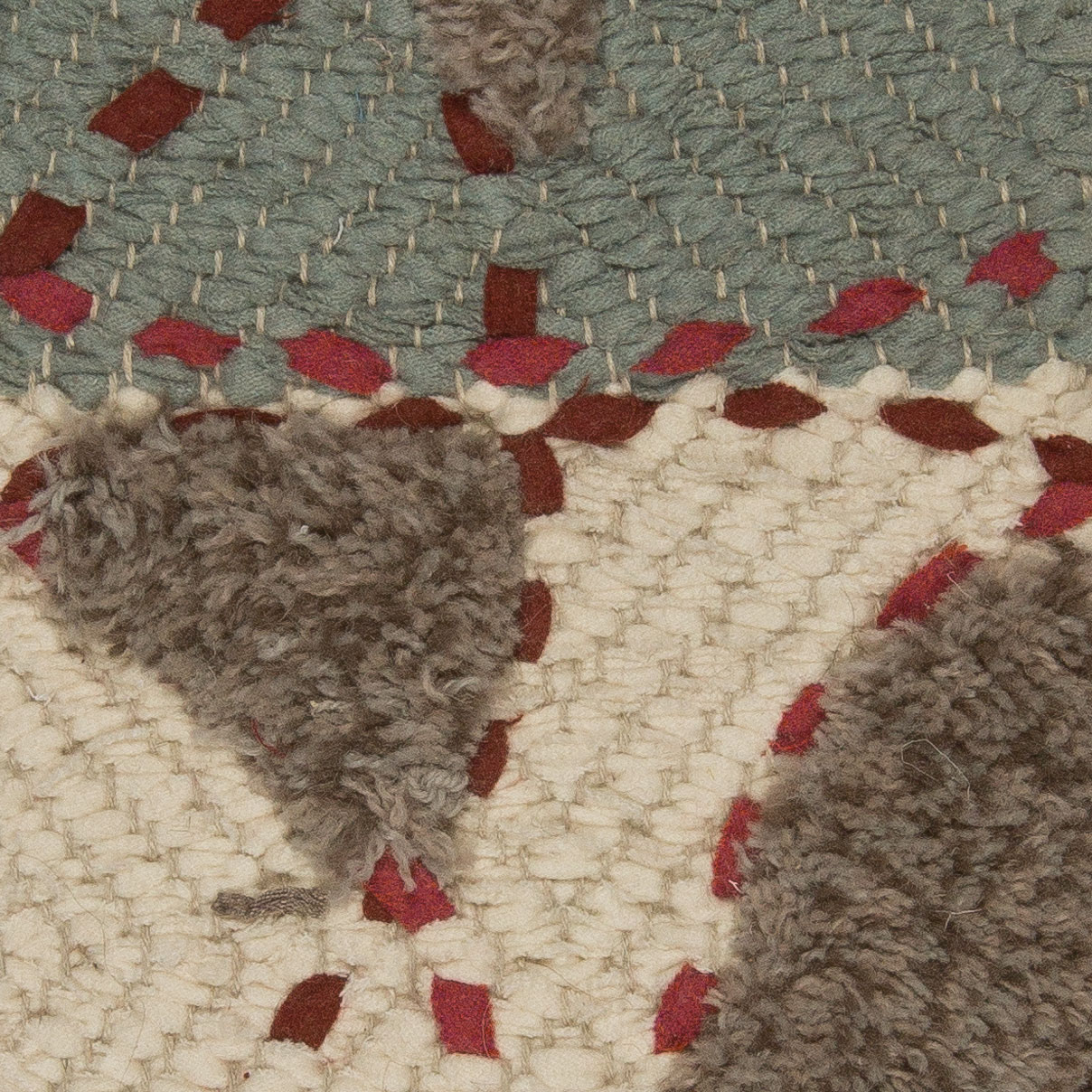
Selecting custom rugs for a room that already has strong artwork, sculptural furniture, or layered upholstery is less about finding “something beautiful” and more about establishing visual hierarchy. The right rug should either calm the field beneath the room’s activity or act as a disciplined counterpoint, but it should not compete for attention on the same terms as everything else. In spaces with many focal points, pattern becomes a structural tool: it can clarify circulation, steady a seating arrangement, and give the eye a place to rest without flattening the room’s personality.
When a space feels busy, the instinct is often to choose the rug with the least pattern possible. That can work, but not always. A nearly plain rug may still feel loud if its color temperature clashes with the art, or if its weave and pile create more texture than the room can comfortably absorb. The better question is not whether the rug is patterned, but whether its pattern has the right density, scale, and rhythm for the visual noise already present in the room.
Doris Leslie Blau often works with rooms where the furniture has strong silhouettes and the walls carry a mix of framed works, collected objects, and architectural detail. In those settings, custom-made rugs allow the pattern to be calibrated rather than guessed. You can decide how much movement belongs underfoot, how much contrast is necessary, and whether the rug should quietly stabilize the composition or introduce a controlled secondary layer. That decision is what separates a room that feels intentionally composed from one that simply contains a lot of good pieces.
Assess which elements should lead visually
Before choosing a pattern, identify the visual leader in the room. If the art collection is the strongest element, the rug should usually support it rather than echo it too closely. If the furniture is the focus—say, a pair of richly upholstered chairs, a dramatic sofa, or a distinctive vintage table—the rug can be quieter and more textural, providing a grounded plane beneath those forms. In either case, the goal is to avoid giving every surface equal volume, because that removes the hierarchy that makes a room readable.
Think in terms of sightlines. What do you see first when you enter, and what do you see when you sit down? A rug sits in both of those views, which means its pattern affects the room at multiple distances. From across the space, large blocks, borders, and strong directional motifs are most legible. From a seated position, smaller repeats, nuanced weave changes, and subtle color shifts become more apparent. A successful choice performs well in both reading distances without becoming restless.
In a gallery-like living room with a dense arrangement of framed art, the safest move is often a rug with restrained contrast and an organized structure, such as a fine geometric, a tonally layered field, or one of the more subdued contemporary abstract rugs. In a room with comparatively calm walls but lively upholstery and expressive chairs, the rug can carry a slightly more assertive pattern, provided it keeps the linework disciplined. The point is not to erase interest; it is to assign it carefully.
Decide whether the rug should anchor or recede
A rug can do one of two primary jobs in a busy room: it can anchor the composition or recede into the background. Anchoring means the rug has enough presence to define the seating area and visually collect disparate elements into a single zone. Receding means it gives the room a composed surface without demanding attention away from the more important objects above it. Both approaches are valid, but mixing them creates confusion, because a rug that is almost hidden yet still highly patterned tends to feel unresolved.
If the room needs a stronger sense of order, look for a motif with clear edges, perimeter control, or a strong central frame. This is where bordered rugs are especially useful: the border can create a visual container around a busy interior field, giving the room a sense of architecture even when the upholstery and artwork are highly active. A border does not have to be traditional; it can be narrow, broken, tonal, or abstracted. What matters is that it creates a readable boundary, especially in open-plan interiors where furnishings can otherwise float.
If the room already has enough structure and simply needs softness, choose a rug that recedes through tone-on-tone pattern or through material subtlety rather than through total blankness. A wool field with a low-contrast design can hold a conversation with patterned chairs and vivid art without adding a new accent. In these cases, texture matters as much as motif. A hand-knotted surface may offer dimensional interest with very little visual interruption, which is often better than a flat, obviously “quiet” rug that still feels underdesigned.
Compare small-scale, large-scale, and border-led motifs
Pattern scale is one of the most important decisions in a room with lots of visual competition. Small-scale motifs tend to read as texture from a distance and as detail up close, which can be useful when the room already contains bold forms. Large-scale motifs create stronger statements and can help a spacious room feel grounded, but they need room to breathe; otherwise, they can collide with furniture legs, upholstery patterns, and framed art. Border-led motifs occupy a middle ground by defining the edge of the rug while leaving the center more open.
Small-scale pattern works well when the room has several loud elements that cannot be simplified. Think of a sofa in a patterned fabric, a pair of lacquered side tables, and a collection of mixed-media art. A tight repeat or soft allover pattern can unify those pieces without introducing another dominant shape. The risk is monotony if the repeat is too timid or the color contrast too low, so the weave, fiber, and finishing become essential. A subtle grid in wool, for example, can be more convincing than a plain field because it introduces order without visible agitation.
Large-scale pattern can be the right answer when the room needs a strong base and the other design elements are varied but not oversized. A broad abstraction, painterly movement, or oversized medallion can create a deliberate counterweight beneath cleaner-lined furniture. This is where contemporary abstract rugs are often effective, especially in interiors that combine modern art with simpler upholstery. The caution is proportion: if the motif is too large for the room, it can look cropped and awkward; if it is too busy, it will compete with the walls instead of supporting them.
Border-led designs are especially practical in dining rooms, libraries, and living rooms where the furniture arrangement has a clear perimeter. The border can help define the seating group while keeping the center visually calm enough for coffee tables, sculptural objects, or a central chandelier to remain legible. In rooms with strong artwork, a border can also prevent the rug from blending into the wall composition by giving it a distinct frame. Among the many options available in custom rugs, this approach is often the most effective when the room needs discipline more than drama.
Use color temperature to reduce visual friction
Pattern does not work independently of color. A rug can appear busy simply because its undertones fight the room, even if the motif itself is restrained. Warm ivory, tobacco, sand, and muted terracotta tend to sit comfortably with wood, brass, and oil painting palettes, while cooler grays and mineral tones can balance rooms with stronger contemporary art or chrome accents. What matters is not matching every element, but creating a palette relationship that feels intentional under different kinds of light.
In rooms with multiple patterns, low-contrast color relationships usually make better long-term choices than high-contrast ones. The eye needs a place to settle, and a rug that is too bright, too crisp, or too chromatically loud can interrupt that rest. That is particularly true in north-facing rooms or spaces with cool artificial lighting, where certain blues and grays can sharpen unexpectedly. Testing the rug against both daylight and evening light is worth the effort because a rug that behaves beautifully at noon may feel entirely different after dark.
Material also affects color perception. Wool typically softens the edges of a pattern and makes tonal transitions feel more forgiving, while silk accents or silk blends can sharpen contrast and reflect more light. In a room already filled with glossy frames, polished surfaces, or reflective art glass, a highly lustrous rug may add unnecessary glare. A matte hand-knotted construction often provides the best balance because it carries pattern without making the floor feel visually hard.
Match the rug to the room’s function, not just its style
A room with a lot of visual activity usually has a strong social purpose as well. A living room needs circulation and conversation; a dining room needs clarity around chairs; a bedroom needs quiet underfoot, even if the headboard wall is expressive. The rug pattern should support how the room is used. For example, in a family room where art, toys, and varied upholstery already create energetic layering, a slightly more forgiving pattern can mask daily life better than a perfectly flat field.
Pile height is part of that decision. A lower pile tends to show pattern with greater precision and works well in formal rooms where movement is controlled. A medium pile can soften the effect and absorb a little more visual information, which is useful in rooms with mixed materials. If the room is already texturally rich, avoid a shaggy or highly tufted surface unless it is intentionally being used as a counterbalance; otherwise, the floor may feel as busy as the walls.
For dining areas, pattern should also accommodate chair movement and the view from all sides. A broad motif that aligns poorly with the table can look fragmented when chairs are pulled out, so a more stable ground—often a border, a subtle repeat, or a design with a clear center—usually performs better. In a seating area, on the other hand, the pattern can be slightly more expressive because sofas and chairs frame it rather than interrupting it. Those differences matter, and they are one reason designer-specification work often begins with the plan rather than with a single sample image.
Use sampling to avoid overcomplicating the room
Sampling is not a formality; it is how a room reveals whether the rug belongs. A pattern that looks balanced in isolation may become too insistent when placed beside a vivid painting, a printed chair, or a carved table. Physical samples let you study contrast, scale, and texture against the actual finishes in the room, which is essential when you are trying to preserve calm hierarchy. You should test the sample where the rug will live, not only in the brightest part of the house, because floor color and wall color alter perception.
If possible, look at more than one size of sample. A small swatch can suggest color, but it will not fully communicate how the motif repeats across a larger surface. This is especially important for more directional designs, where a line that feels subtle at hand may become assertive when expanded across the floor. It is also useful for understanding whether the pattern works at the boundaries, since furniture often obscures portions of the rug and can create awkward crops if the repeat is too rigid.
When specifying custom rugs, this stage is where restraint becomes visible in a practical sense. You may discover that the room does not need a stronger motif at all; it may need a cleaner border, a softer dye lot, or a different scale of repeat. You may also realize that the original “quiet” option is actually too flat and that a more structured design gives the room the composure it was missing. Good sampling does not merely confirm a choice; it prevents a costly mismatch between intention and atmosphere.
Practical pattern strategies for common busy-room scenarios
- When the art is the hero: choose a rug with low-contrast structure, subtle texture, or a border that frames rather than competes.
- When the furniture is highly patterned: reduce motif density on the floor and favor tonal wool or a disciplined geometric repeat.
- When the room is open-plan: use a rug with a clear perimeter so the seating zone reads as intentional architecture.
- When the palette is mixed but not chaotic: a broad abstract or softened allover design can link disparate pieces without adding clutter.
- When you need a room to feel finished, not loud: select a pattern that has rhythm at close range and calm from across the room.
How to read pattern in relation to scale and proportion
One of the most common mistakes in busy interiors is choosing a rug pattern based on the room’s style while ignoring its actual proportions. A large living room can handle a bolder repeat because the floor becomes a substantial visual field. A smaller room with a dense art arrangement needs more caution because the rug occupies a larger percentage of the visual plane than you may expect. The same motif can therefore feel elegant in one setting and overdesigned in another.
Furniture placement should also guide scale. If legs are visible and the rug edge is exposed, the border or repeat must hold up at the perimeter because that is where the eye reads the transition between objects and floor. If the seating is deeper and the rug is partially hidden, the center field matters more than the edge. This is why made-to-order work is so valuable: it allows the design to respond to the room’s actual geometry rather than to a generalized idea of what should look luxurious.
A useful rule of thumb for busy interiors
If a room already contains multiple strong forms, let the rug solve a problem instead of introducing one. That may mean giving the room a frame, calming the color temperature, or introducing a pattern that reads as texture rather than image. It may also mean choosing a design with enough character to feel intentional, but not so much that it competes with the art or upholstery for the final word. The best rug in a complex room is rarely the most obvious one; it is the one that quietly organizes everything else.
FAQ
Should the rug be the quietest element?
Not necessarily. In a room with busy art or layered furniture, the rug should usually be the most disciplined element, but that does not always mean it must be plain. A rug can have pattern, border detail, or texture as long as its visual rhythm supports the room instead of competing with it. Quietness is about hierarchy, not minimalism.
What pattern scale works best with art collections?
Art collections often pair well with medium or small-scale patterns because these read as texture from a distance and avoid fighting the wall display. If the art includes large, colorful, or highly expressive works, a restrained rug pattern helps maintain focus. If the room has more subdued art, a broader motif can work, provided the palette remains controlled.
Can stripes or borders help in busy rooms?
Yes, when used thoughtfully. Stripes can add direction and a sense of length, while borders can define the seating area and make open-plan rooms feel more orderly. The key is to keep the linework proportionate to the room and avoid a pattern that is so strong it becomes another major focal point.
Are bordered rugs a good choice if the furniture is already highly patterned?
They can be, especially if the center field is calm. A border gives the eye a frame and can prevent the room from feeling visually scattered. In highly patterned rooms, a restrained border is often more effective than a busy allover motif because it introduces structure without adding clutter.
How do I test whether a rug pattern is too much for the room?
Place a sample where the rug will sit and view it in daylight and evening light. Then look at it from several distances, including the main entry and the seating area. If your eye keeps returning to the floor instead of moving comfortably across the room, the pattern is probably too assertive or the contrast is too high.
For rooms that already carry a lot of visual weight, the right rug is one that clarifies rather than shouts. If you are weighing scale, border, or material choices for a difficult space, Doris Leslie Blau can help you think through the options with the same care used in a designer specification review—so the rug earns its place through proportion, craftsmanship, and restraint.