

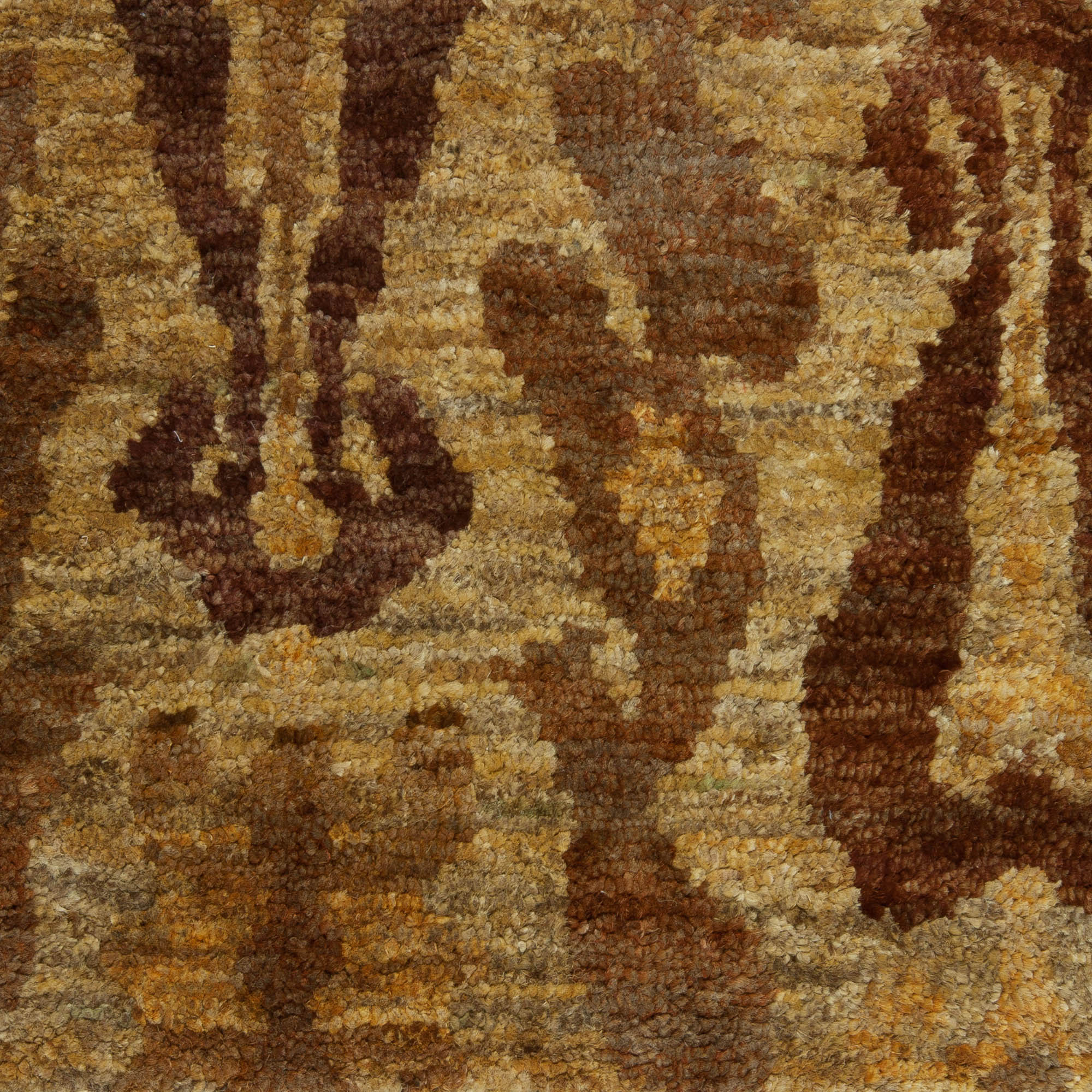
Hallway runners do more than protect a floor; in a long corridor, they set pace, define proportion, and decide whether the passage feels considered or merely covered. When a standard size stops short of the architecture, custom rugs can solve the problem with length, pattern placement, and edge balance tailored to the room rather than forcing the room to adapt to the rug.
Corridors are unforgiving spaces. They compress perspective, exaggerate asymmetry, and expose every small miscalculation in length or width. A runner that is a few inches too short can make a generous hallway feel chopped up, while one that is too wide can crowd baseboards, door swing clearances, or wall-mounted art. The best hallway runners work with the architecture as if they were part of the original drawing: they guide the eye, preserve circulation, and create a measured rhythm from one end of the passage to the other.
That is why hallway decisions should begin with proportion, not décor. Before selecting color or motif, study where the corridor visually changes: doorways, turns, stair landings, niches, and shifts in ceiling height all act as breaks. These points matter because a runner can either bridge them gracefully or emphasize them awkwardly. In gallery-style hallway rugs, the objective is often to keep the floor plane continuous enough that art, millwork, and lighting read clearly, while still giving the passage a distinct identity.
Determine the visual break points in a long corridor
A long hall rarely reads as one uninterrupted line. Doors interrupt it, shadows shorten it, and trim details divide it into segments whether you intend that or not. The first step is to identify the places where the eye naturally pauses, because those are the points where the runner can either support the architecture or fight it. In many residential halls, the most useful layout is not simply centered from end to end, but measured against the locations of door casings, stair thresholds, or a change in flooring at an adjacent room.
Think of the runner as a pacing device. If it begins and ends too close to doors, it can look pinched and accidental. If it extends through a series of openings without acknowledging them, it can feel blunt and overcommitted. A successful layout usually leaves a consistent reveal of flooring at the perimeter, so the rug appears suspended rather than shoved into place. That border is particularly important in narrow spaces, where the eye needs a quiet margin to understand the corridor’s true width.
For very long passages, repetition becomes part of the design language. Repeated sconces, framed works, or paneling can create a cadence that the runner should echo rather than challenge. A striped or bordered composition may reinforce this sequence, while a more open field with controlled pattern spacing can keep the hall from feeling visually busy. The right choice depends less on trend than on the architecture’s own rhythm and how much visual movement the surrounding elements already provide.
Choose a runner length that supports doors and transitions
Length is where many hallway runners succeed or fail. Standard runners often assume a generic corridor, but real homes rarely offer generic proportions. A runner that ends before the hall’s natural resting points can make the space feel awkwardly abbreviated, while one that runs too far can disrupt transitions into adjacent rooms. The goal is to establish a length that respects the full journey through the hall while leaving breathing room at both ends.
As a practical matter, measure the usable floor area between the most important architectural stops, not just the wall-to-wall dimension. If there is a doorway at one end and a visual destination such as a staircase, console, or niche at the other, the runner should be planned with those elements in mind. In some homes, a short reveal at each end is enough to keep the composition elegant. In others, especially where the corridor serves as a primary circulation route, the rug may need to extend farther to avoid looking like an afterthought.
It is also worth considering how the runner interacts with door clearances. A beautiful wool pile means little if a frequently used door catches the edge. Lower pile height can help in tight transitions, and precise binding or finishing is essential where the rug sits near repeated swing paths. This is one reason many designers look to custom oversized rugs when a corridor’s proportions do not align with off-the-shelf dimensions. A tailored size allows the rug to support circulation while still reading as intentional and refined.
Use pattern to create pace rather than clutter
Pattern in a hallway should operate like tempo, not decoration for its own sake. A narrow passage magnifies every repeat, so large-scale motifs can quickly become overwhelming if they are too dense or too contrasted. On the other hand, a runner with no visual interest at all can leave the hall feeling flat, especially if the corridor is long and the surrounding architecture is restrained. The best balance comes from choosing a pattern density that creates movement without stealing attention from the rest of the interior.
Directional patterns can be useful, but they need careful handling. A linear border can sharpen the sense of length and establish a neat frame, while a central medallion may feel too static or too compressed depending on the room’s proportions. Repeats with generous spacing often work well because they allow the eye to travel comfortably down the hall. If the corridor already has strong visual elements, such as paneled walls or a sequence of art, a quieter field with subtle abrash or tonal variation may be the more disciplined choice.
Color matters just as much as motif. High-contrast patterns can energize a passage, but they can also make every seam, doorway, and asymmetry more noticeable. Softer tonal rugs tend to support quiet luxury and work especially well when the hall receives natural light that shifts throughout the day. In more expressive interiors, a stronger palette can be successful if the rest of the corridor remains controlled. The key is to let the runner establish rhythm without turning the hallway into a visual obstacle course.
For a useful internal resource on sizing decisions, designers often pair corridor planning with a custom rug design conversation when the dimensions, circulation, or pattern placement demand precision beyond standard offerings.
Explain why custom sizing often solves awkward hallways
Many hallway problems are not really style problems; they are dimensional ones. A corridor might be too long for a conventional runner, too narrow for a broad design, or broken by multiple openings that make standard proportions look misaligned. In those cases, custom sizing is less about indulgence than problem solving. The rug can be extended, narrowed, or proportioned to account for thresholds, wall spacing, and the way the hall is actually used.
Custom construction also allows the design itself to respond to the space. Borders can be widened or reduced to preserve balance. Medallions can be shifted or removed if the hall needs clearer flow. Pattern repeats can be adjusted so the most active motifs land in the visible center of the passage rather than disappearing under furniture, doors, or shadow lines. This becomes especially important in custom rugs for hallways that are long enough to read almost like architectural galleries rather than simple passages.
Consider a hallway that stretches past three bedrooms and a linen closet before opening toward a stair landing. A standard runner might cover the middle section but leave the ends feeling disconnected, while a custom piece can be planned to align with the hall’s strongest visual markers. The result is not only better coverage but a more coherent experience as you move through the space. The rug becomes part of the route, not just something placed on top of it.
Material and construction details that matter in a corridor
Hallways experience concentrated wear, so material choice should be practical as well as beautiful. Wool remains a strong option because it offers resilience, stable texture, and a surface that can handle traffic without looking harsh. Hand-knotted rugs are especially valued in these settings because the construction supports long-term use and allows for precise tailoring when the proportions need to be exact. In a narrow room, the quality of the edge finish is also critical, since fraying or bulky binding becomes more noticeable than it would in a larger area.
Pile height should match the corridor’s demands. Low to medium pile often performs best where doors swing nearby or where vacuuming and daily maintenance need to be uncomplicated. Higher piles can be sumptuous, but in a passage they may feel visually heavy or interfere with frequent movement. Silk can add luminous detail in a hallway if used selectively, though it is usually more effective as an accent within a wool ground than as the dominant fiber in a highly trafficked passage. Material should always be chosen with both touch and traffic in mind.
Light exposure also affects how a hallway runner will age visually. A corridor with strong natural light may benefit from fibers and dyes that hold tone gracefully as the day changes, while a more enclosed hall may welcome a warmer palette or subtle sheen to prevent the space from feeling subdued. Acoustic performance is another overlooked factor. A well-made rug can soften footsteps and make a long corridor feel calmer, which is valuable in family homes, apartments, and any interior where sound travels easily from room to room.
Design details that make a hallway feel resolved
Small decisions often have the largest impact in corridors because the eye has so little else to distract it. A runner should generally be centered, but not blindly centered if the architecture is off-axis. If one side of the hall carries more visual weight because of trim, millwork, or a row of openings, the rug may need a slight adjustment to preserve balance. That is not a flaw in the layout; it is the difference between mathematical alignment and visual alignment, which are not always the same thing.
Where possible, coordinate the runner with the hallway’s broader palette rather than treating it as an isolated object. If the surrounding rooms are quiet, a slightly more defined border can give the passage structure. If the home already uses strong color or pattern elsewhere, a restrained hallway rug can act as a pause between more expressive interiors. The best hallway runners do not compete with the rooms they connect. They act as a measured transition, helping the home feel coherent from one threshold to the next.
In some projects, the corridor itself becomes a design opportunity for custom oversized rugs that extend beyond what a standard runner can handle. This is especially useful in elongated foyers, apartment galleries, or upper-floor halls where the span is too long for a typical size and too important to compromise. The larger format creates a continuous visual plane, which can make artwork, lighting, and architectural detailing feel more deliberate. It is a straightforward way to avoid the patchwork look that can happen when multiple smaller pieces are used as substitutes.
How to specify the right runner with a designer’s mindset
Specification begins with measurements, but it should not end there. Note the usable width, the locations of all doors, the direction of traffic, and any fixed elements such as radiators, consoles, or wall treatments. Then consider the corridor from both standing and moving perspectives. A hall that looks balanced when viewed from one end may feel compressed in motion if the runner’s pattern, length, or border is not properly scaled. Designer specification is really the process of anticipating those lived experiences before the rug is made.
If the hallway connects very different rooms, the runner can also serve as an architectural mediator. It may borrow a color from one room and a texture from another, or use a border to bridge two styles without leaning fully toward either. This is where gallery-style hallway rugs become especially useful: they can be quiet enough for a refined passage, but still specific enough to feel tied to the home’s overall identity. A good runner should never seem like a compromise chosen in haste.
FAQ
How long should a hallway runner be?
The ideal length depends on the hall’s usable floor area, the placement of doors, and the visual endpoints of the space. In most cases, the runner should leave a measured reveal at each end rather than running flush from wall to wall. That spacing helps the hall feel intentional and prevents the rug from looking cramped or cut off. For long corridors, a custom length is often the most successful solution because it can be adjusted to the architecture rather than forced into a standard proportion.
Should a runner run wall to wall?
Usually, no. A wall-to-wall runner can make a corridor feel overfilled and may interfere with door swing or baseboard detail. A small border of exposed flooring on both sides typically reads more elegantly and gives the runner room to breathe. The exact margin depends on the width of the hall and the overall design language, but leaving some floor visible is generally better than filling every inch.
What pattern works best in a narrow space?
Patterns with controlled spacing tend to work best because they create movement without visual congestion. Borders, tonal repeats, and subtle directional motifs can all suit a narrow hall if scaled carefully. Very dense or high-contrast patterns can feel busy in a confined corridor, especially if the space already includes active millwork or multiple doorways. The most effective choice is the one that supports the hallway’s rhythm rather than interrupting it.
Are custom rugs worth it for an awkward hallway?
Yes, especially when the hallway has unusual dimensions, multiple transitions, or a circulation pattern that standard runners cannot accommodate cleanly. Custom rugs allow the length, width, border treatment, and pattern placement to be tailored so the result fits both the room and how it is used. For hallways, that precision often makes the difference between a runner that merely fills space and one that genuinely resolves it.
If a hallway keeps resisting standard sizes, that is usually a sign the space deserves more careful specification. Doris Leslie Blau approaches these projects with attention to proportion, materials, and the way a corridor reads in motion, so the final rug supports the architecture rather than competing with it. For a passage that needs clarity, restraint, or a more exact fit, specialist guidance can make the difference between adequate and truly well resolved.