

Selecting custom rugs for a room that already has pronounced stone, wood, upholstery, or artwork is less about finding a “matching” color than about deciding which surface should lead the conversation. When the architecture is already assertive, the rug has to work as a mediator, a pause, or a counterpoint. The right choice can quiet a busy room, sharpen a beautiful one, or give a strong palette enough structure to feel intentional rather than accidental.
That decision gets harder when the room includes multiple finishes with their own undertones. A veined marble fireplace may pull cool, a walnut floor may read reddish, and a sofa in textured linen may sit somewhere in between. The rug must acknowledge those tones without competing for attention, especially if the room is already carrying substantial visual weight. For anyone asking how to choose rug color, the most useful approach is to read the room as a composition rather than a shopping list.
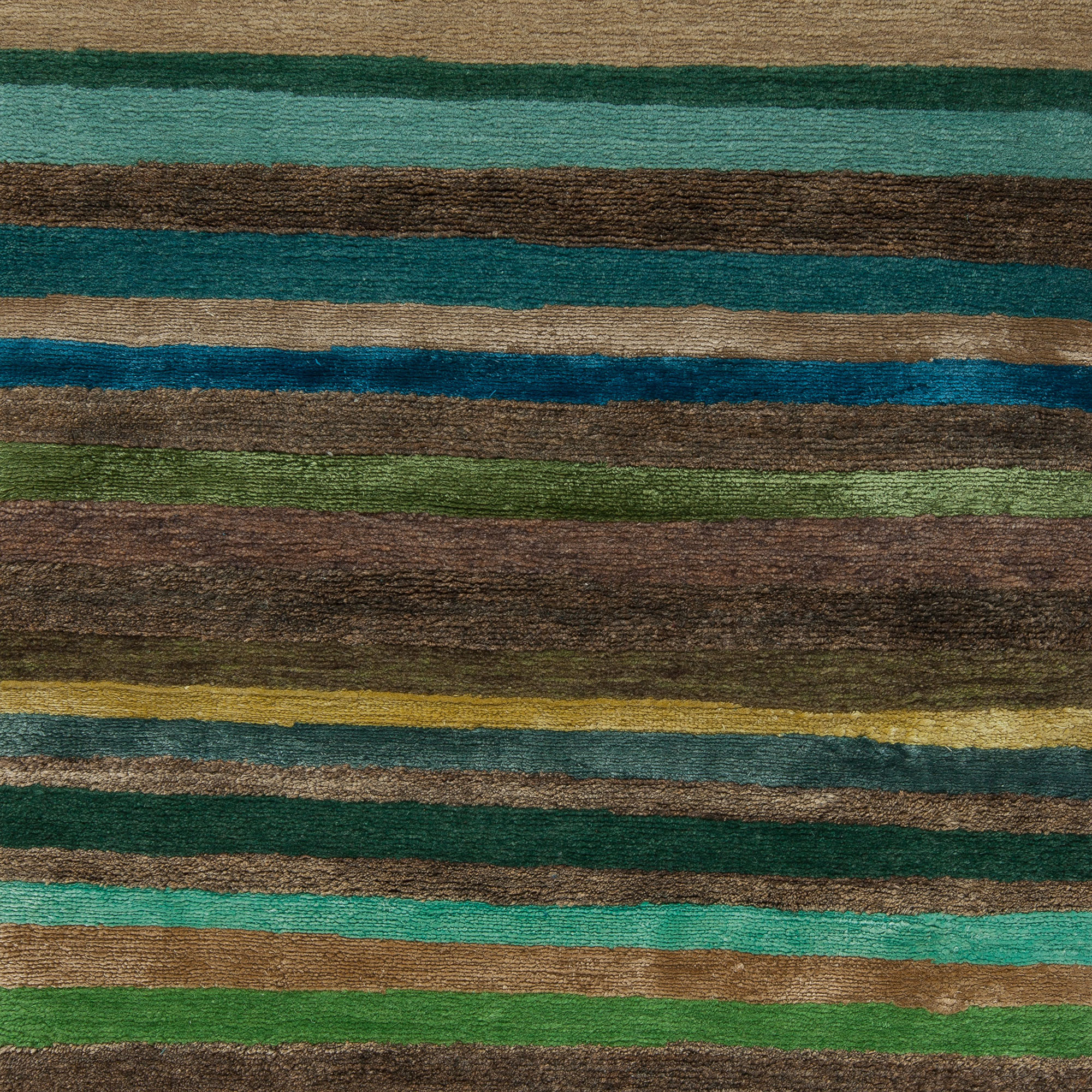
In practice, this is where custom rugs offer a real advantage. A made-to-order palette can be calibrated to the exact undertones in the space, whether the goal is a subdued foundation or a more expressive accent. Instead of forcing a standard colorway to behave, you can specify a nuanced field of muted blues and greens, a restrained neutral, or an earthy palette that feels rooted in the materials already present. The result should feel considered from across the room and coherent up close.
Read the dominant undertones in the room
The first step is to identify the undertone of each major surface, not just its obvious color. Many rooms contain warm and cool notes at the same time, which is why a rug that looks ideal in a showroom can feel strangely off once it is placed beside a particular floor or wall finish. Oak may lean honey or amber, limestone may read creamy or gray, and a painted cabinet can skew green, blue, or yellow depending on light. If you can name the undertones accurately, you can choose a rug color that supports them instead of fighting them.
It helps to look at the room from a distance and notice which finish dominates the eye first. In a room with a dramatic stone surround, the rug often needs to soften that intensity; in a room with dark wood paneling, the rug may need enough contrast to keep the floor plane from collapsing into one heavy mass. Strong finishes are not a problem by themselves, but they do ask for a clear hierarchy. A rug that understands the hierarchy can unify the room without flattening its character.
A useful test is to ask whether the room already has a warm base, a cool base, or a split personality. If the architecture is warm but the upholstery is cool, a rug in earthy color palettes can bridge the gap better than a highly saturated accent. If the room is largely cool and crisp, a rug with muted blues and greens may feel more integrated than a beige that introduces a new temperature. The goal is not sameness; it is tonal coherence.
Decide whether the rug should bridge or contrast existing finishes
Once you know the undertones, decide what role the rug should play. A bridging rug connects several strong elements into one readable field, which is especially useful in rooms with stone, wood, and art all competing at once. A contrasting rug, by comparison, creates a deliberate break and can prevent the room from becoming monotonous. Both strategies can be correct, but they produce very different atmospheres and should be chosen with the furniture layout and architecture in mind.
Bridging is often the safer and more enduring strategy when the room already has substantial pattern or material contrast. For example, a hand-knotted wool rug in softened taupe, olive, smoke, or denim can sit comfortably beneath a sculptural sofa and a marbled table without demanding attention. That kind of rug does not disappear; it creates a visual buffer so the eye can move from one strong surface to the next with ease. In a room with strong finishes, that buffer is often what makes the design feel expensive rather than simply busy.
Contrast works best when the architecture is disciplined and the room needs energy. A pale rug can lighten a dark-paneled library, while a deep rug can anchor a sunlit room with pale stone and light upholstery. The key is to contrast one dimension at a time: color, value, or pattern density, but not all three at once. If the room already has high-contrast finishes, keep the rug’s pattern quieter; if the room is visually calm but tonally flat, the rug can carry a bit more saturation or movement.
This is also where scale matters. A bold color placed in a small rug can feel decorative and underpowered, while the same color in a larger field can read architectural. In open-plan interiors, a rug often has to define a zone without introducing a new “room within a room” that feels unrelated to the rest of the plan. Selecting a color that echoes a secondary note in the architecture can help the rug delineate space without forcing a hard break.
Test color under day and evening light
Color in a rug is not static, and the lighting in the room can change its behavior more than most people expect. Daylight can cool down a warm beige, flatten a dusty blue, or reveal green notes that were invisible in a showroom. Evening light, especially from lamps with low color temperature, can make the same rug appear richer, browner, or more saturated. A room that looks balanced at noon may feel entirely different after dark.
Because strong finishes already reflect and absorb light in distinct ways, the rug should be judged in the actual room and not only under neutral store lighting. Place samples close to the floor, then move them near the sofa, under the table, and beside any major material reference points such as stone, wood, or lacquer. Watch how the sample behaves at different times of day, because some colors become too cold in bright daylight and too warm under lamps. That shift is not a flaw in the rug; it is part of the material reality of interiors.
For rooms that receive a lot of changing natural light, slightly muted colors often prove more forgiving than fully saturated ones. A restrained blue, green, or brown usually absorbs those shifts better than a vivid tone that can become visually loud as the light changes. If the room has strong architectural finishes, subtlety often ages better because it does not rely on perfect lighting to look composed. This is one reason designers frequently favor wool or wool-rich constructions when they want color depth without glare.
Use samples to confirm the rug does not compete with key features
The final test is comparative: the rug should be measured against the room’s key features, not just admired on its own. Lay a sample beside the most visually important elements, such as the sofa, the floor, a major artwork, or a fireplace surround, and ask which object should remain primary. If the rug has a pattern, pay attention to how dense it feels from a standing view and whether it begins to imitate the rhythm of the art or upholstery. A rug can repeat the logic of the room without copying it literally.
This is especially useful when working with artwork or upholstery that already carries strong color. If a painting includes deep rust and olive, a rug does not need to reproduce those exact notes. It can instead sit in a related family, perhaps with softened moss, clay, or slate, so the eye recognizes the connection without sensing repetition. That is usually more refined than trying to match a dominant brushstroke or fabric thread too closely. Precision in proximity matters more than literal duplication.
There is also a structural question to consider: does the rug frame the room or vanish beneath it? In some spaces, the right answer is a subdued field that lets the architecture lead. In others, a rug with a controlled amount of contrast gives the room a necessary boundary and keeps the furniture from floating without definition. Doris Leslie Blau often approaches custom rug design as a balance of color, scale, and texture, because those three elements decide whether a rug feels integrated or imposed.
Material affects color perception as much as dye choice does. A wool pile usually reads softer and more matte, which can make a complex color easier to live with beside stone or wood. Silk content introduces sheen and can make undertones appear brighter or more changeable, which is useful in formal rooms but less forgiving if the surrounding finishes are already assertive. Pile height matters too: a cut pile may present color more evenly, while a textured or mixed-pile construction can break up a single hue enough to prevent it from feeling flat.
A practical method for rooms with stone, wood, art, or upholstery
If the room feels visually loaded, it helps to follow a simple sequence rather than making the decision intuitively and hoping for the best. Start with the dominant undertone, then identify whether the rug should bridge or contrast, then verify the color in changing light, and finally compare it against the room’s most important surfaces. That process is especially useful in rooms where a single material is doing a lot of work, such as a dramatic stone floor or a richly grained wood wall. The more authoritative the architecture, the more disciplined the rug color should be.
- Identify the room’s warmest and coolest notes.
- Decide whether the rug should soften, anchor, or energize the space.
- Check the sample in daylight and evening light.
- Compare it to the sofa, floor, art, and millwork together.
- Choose the version that supports the whole room, not just one finish.
A realistic example might be a living room with walnut paneling, a pale limestone hearth, and a linen sofa in a soft gray-beige. In that setting, a rug in earthy color palettes with quiet brown, green, and stone notes can bring the room into alignment without making the floor feel heavy. If the same room included a large abstract painting with icy blue passages, a rug with muted blues and greens might be the better bridge because it would acknowledge the cooler notes without turning the space into a monochrome composition. The difference is subtle, but subtlety is often what makes the room feel resolved.
For designers and homeowners alike, the safest mistake is not choosing a rug that is too quiet; it is choosing one that ignores the room’s existing logic. Strong finishes deserve a rug that can read the structure beneath them. If you are weighing options for a challenging interior, a specialist can help you compare undertones, construction, and proportions before a rug is made. That kind of guidance is often what turns a good palette into a fully coherent one.
Frequently Asked Questions
Should a rug match the sofa or the floor?
Usually neither exactly. A rug should relate to both surfaces, but it does not need to duplicate either one. If the sofa and floor are already in conversation, the rug can act as a mediator by picking up a secondary note from each. In rooms with very strong finishes, an exact match can make the scheme feel over-assembled, while a related but distinct color tends to feel more natural.
How do I avoid a color that feels too cold or too warm?
Compare samples beside the room’s actual materials under both daylight and evening light. A color that appears balanced on a screen or in a showroom may shift once it is next to stone, wood, or upholstery in your home. If the room already skews warm, choose a rug with a cooler balance only if you want visible contrast; otherwise, stay within the same temperature family and vary saturation instead of temperature. The same principle applies in reverse for cool interiors.
Can a rug repeat the art without looking forced?
Yes, if it echoes the art’s secondary colors or tonal range rather than copying the most obvious hue. The most successful approach is usually indirect: pull a softened version of a color from the artwork, then place it in a rug field that also relates to the room’s architecture. That way the rug supports the art visually without turning the room into a literal match set. Repetition should feel like rhythm, not duplication.
What if the room has both warm wood and cool stone?
Look for a rug that contains a controlled blend of warm and cool notes, or choose one temperature and let the rug bridge through undertone rather than brightness. Mixed-material rooms often benefit from colors that are slightly muted, because the restraint helps unify the competing finishes. A rug in a softened neutral, a nuanced olive, or a layered blue-green can often connect the two extremes better than a pure warm beige or a stark gray.
When a room already has strong finishes, rug color is a design decision, not a decorative afterthought. The right choice brings order to complexity, respects the architecture, and gives the room a stable visual base. If you are weighing options for a particular interior, Doris Leslie Blau can help you think through the palette, material, and proportion with the level of detail a serious space requires.