

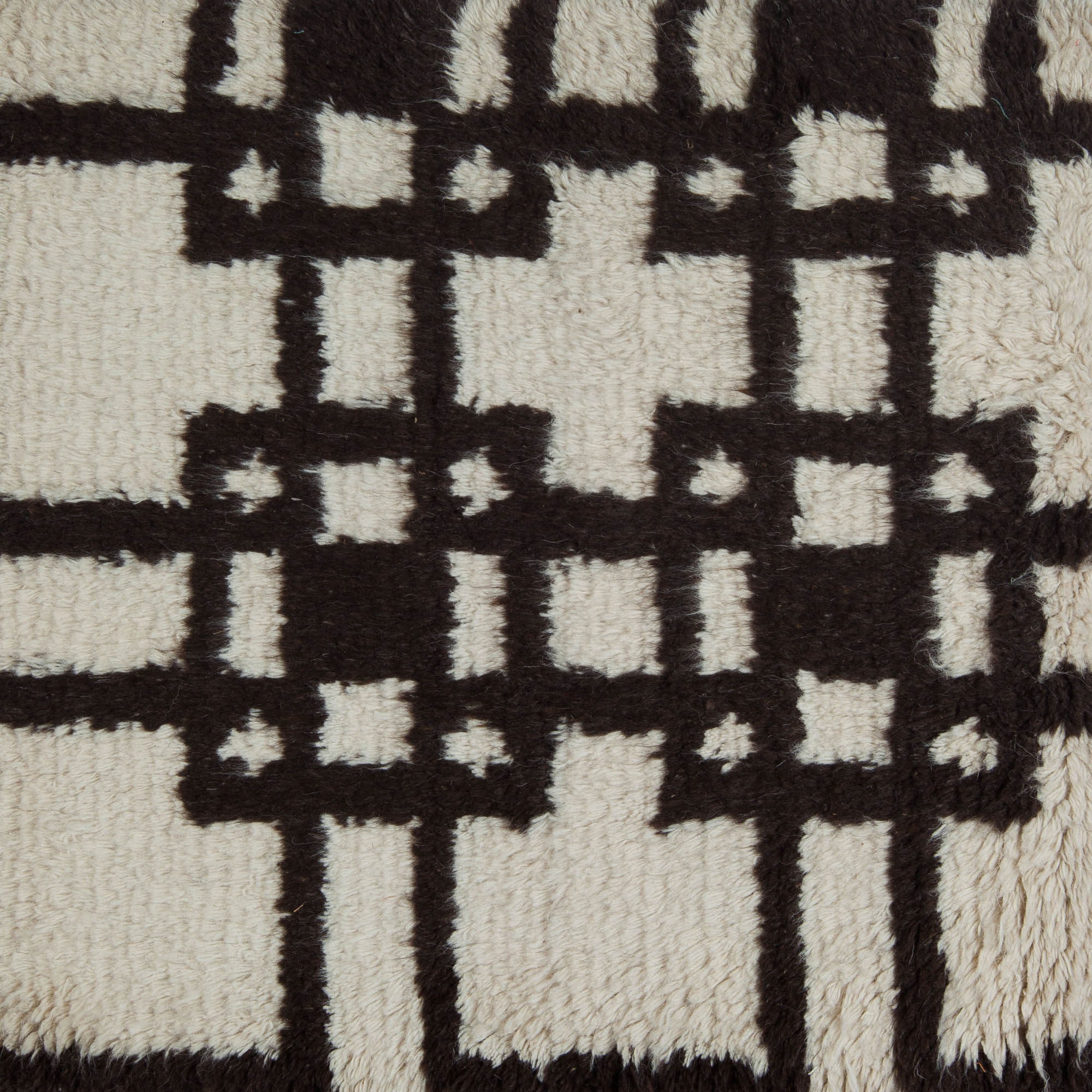
If stone, wood, upholstery, or artwork already defines the room, selecting custom rugs becomes less about finding a pretty color and more about editing the palette with precision. The right rug should either bridge the existing materials or create a controlled contrast, so the room reads as composed rather than crowded. For anyone wondering how to choose rug color in a space with firm architectural cues, the answer begins with undertone, light, and proportion.
Strong finishes can be helpful because they establish a framework, but they also narrow the margin for error. A Calacatta marble fireplace, walnut millwork, saturated velvet sofa, or a large-scale painting may already set the tone before the rug enters the conversation. In that situation, custom rugs are especially useful because the color can be calibrated to the room rather than borrowed from a showroom sample that was never meant to live with your specific materials. The goal is not to compete with the strongest element, but to give the eye a place to rest and move.
Think of the rug as the largest horizontal color field in the room. Its job is rarely to shout; more often, it holds the composition together by repeating a note that already appears somewhere else at a lower volume. That repetition can be subtle, such as a warm taupe rug under pale oak and limestone, or slightly more directional, such as muted blues and greens used to temper a room with heavy bronze, dark wood, or cool stone. When chosen well, the rug does not look like an afterthought. It reads like the final decision that makes everything else make sense.
Read the dominant undertones in the room
Before you compare rug colors, identify the undertones already present in the space. Stone may lean blue-gray, green-gray, or cream; wood may read golden, reddish, tobacco-brown, or nearly neutral; upholstery may carry a cool blue cast or a warmer beige base; and artwork may introduce a chromatic direction that influences the whole room. Many color mistakes happen because the eye notices surface color first and undertone second. A rug that looks ideal in isolation can feel jarring if its undertone fights the floor, the millwork, or the large upholstered anchor in the room.
This is where designer specification becomes practical rather than theoretical. If a room has warm limestone, honeyed wood, and a camel sofa, a rug with similarly warm undertones will usually create cohesion, especially if the palette is restrained. If the room already runs warm but needs relief, a rug with a cooler note can help sharpen the composition without introducing a harsh contrast. In rooms built from quieter materials, earthy color palettes often work well because they allow variation in texture and tone without making the space feel busy.
One useful test is to ask whether the room feels fundamentally cool, warm, or mixed. Mixed rooms are common in contemporary interiors because stone, metal, natural fiber, and lacquer rarely share the same temperature. In those cases, a rug that borrows from both ends of the spectrum can be especially effective: a neutral field with a warm border, a soft mineral tone with a sandy undertone, or a layered pattern that contains a bridge color repeated in the upholstery and the art. That kind of color logic is often easier to achieve with custom rugs than with a standard off-the-shelf size and palette.
Decide whether the rug should bridge or contrast existing finishes
There are only two responsible starting positions: the rug either bridges the room or it contrasts the room. Bridging means the rug absorbs several existing tones and helps them belong to the same visual family. Contrast means the rug introduces a new note that clarifies the room’s structure, usually by separating the floor plane from the furniture or by interrupting a palette that feels too monotone. The decision depends on whether the room is already visually calm or already highly resolved.
Bridging is often the safer choice when the room has bold finishes and a lot of visual weight. A space with veined stone, dark wood, and strong upholstery may benefit from a rug that softens the transitions and prevents each material from competing for attention. In these rooms, a quiet field with nuanced pattern can be more effective than a bright solid color, because the pattern gives depth without adding another hard focal point. Hand-knotted rugs are especially useful here because their weave and surface variation keep muted colors from feeling flat.
Contrast, by comparison, works best when the architecture is beautiful but the palette needs definition. A room with pale plaster walls, restrained millwork, and an understated sofa may welcome a rug with richer tone or more pigment because it anchors the furniture group and gives the seating area clearer boundaries. This is particularly useful in open-plan interiors where the rug has to do visual zoning. In that context, the rug color can tell the eye where the conversation area ends without relying on extra furniture or decorative clutter.
For rooms with art as the dominant visual force, the rug should usually support the artwork rather than echo it exactly. Repetition can feel too literal if the same color appears in both places at the same intensity. Instead, translate the artwork into a softer register: a painting with ultramarine and olive might inspire a rug with weathered blues, moss, and mineral gray rather than a direct blue-and-green replica. That approach creates continuity while preserving the independence of each element.
If you are weighing options for a made-to-order piece, the broader custom rug design process is useful because color, weave, scale, and border treatment can all be adjusted together. That matters when a room already has strong finishes, since a successful rug is rarely about a single swatch. It is about how the color performs at full size, with the furniture placed on top, under real light, and against real materials.
Test color under day and evening light
Light changes rug color more dramatically than many people expect. A tone that looks balanced in a north-facing room at noon may become cool and washed out by evening, while a richer color can deepen and become more saturated under warm artificial light. If the room includes polished stone, glass, or lacquer, reflected light can further shift the appearance of the rug, making the same sample read cleaner or more muted depending on the hour. This is why rug color should never be approved from a single photograph or a small sample under one light source.
Move the sample to the exact position where the rug will live and observe it at different times of day. Stand back, because color judgments change when the eye is no longer focused on the swatch itself. Look at how the sample interacts with the sofa base, the edge of the wood floor, and any stone veining or inlay nearby. If a color feels right only when held in isolation, that is a warning sign. A rug must work at room scale, not just sample scale.
Evening light deserves special attention in rooms finished with strong materials because those materials often gain warmth after sunset. Brass, walnut, and amber lighting can push a neutral rug toward beige or gold, while cooler LED light can make blues and grays feel more severe. If your room already contains a strong finish, the rug color should remain legible under both conditions. That does not mean it has to look identical all day; it means the color should still feel intentional when the light changes.
For that reason, many designers prefer nuanced colors over pure ones in complex rooms. A gray with a green cast, a brown softened by charcoal, or a blue tempered with slate can adapt better than a flat primary shade. These moderated tones are especially successful in custom rugs because the weaving method can deepen or soften color through texture. A looped or hand-knotted surface with slight tonal variation often holds up better than a perfectly uniform field when the surrounding finishes are already assertive.
Use samples to confirm the rug does not compete with key features
Samples are not just for approving color; they are for checking hierarchy. Place the rug sample near the strongest feature in the room, whether that is a sculptural fireplace, a large artwork, a dramatic sofa, or a prominently grained floor. Then ask a simple question: does the sample support that feature, or does it pull equal attention? A good rug usually clarifies the room by reinforcing its structure, while a competitive one creates visual noise.
Pattern density matters as much as color. A room with rich finishes can often handle a rug with subtle movement, but it may not need a dense motif unless the rest of the space is unusually spare. When the palette is already active, a low-contrast design with readable borders or softened medallion shapes can be enough to organize the room. On the other hand, if the room is architecturally quiet but materially rich, a more defined pattern can provide the missing rhythm without adding unnecessary color complexity.
Scale should be judged at the same time. A color that feels modest in a small sample can appear much stronger once repeated over a large area, especially if the rug occupies a central position in the room. This is one reason custom rugs are so effective for rooms with strong finishes: the dimensions can be planned in relation to furniture placement, so the edge of the rug lands where the composition needs it most. The right size helps the color read as grounded rather than accidental.
Consider a dining room with dark walnut chairs, a travertine table, and a bronze chandelier. A saturated rug could compete with the table, while an overly pale one might vanish against the stone. A better choice might be a warm mineral ground with restrained pattern, perhaps carrying one muted accent that echoes the metal or the chair upholstery. That keeps the room coherent without turning the floor into another primary event.
Material, pile height, and color perception
Color is never separate from construction. Wool absorbs light differently from silk, and a dense pile behaves differently from a flatter surface. A plush rug will often appear a touch deeper because the fibers create shadow, while a low-pile hand-knotted piece may read more precise and graphic. If the room already has strong finishes, texture can help moderate the color so it feels integrated instead of loud.
Wool is often the most forgiving material in these situations because it balances clarity and softness. It can carry earthy color palettes beautifully, especially when the room needs warmth without heaviness. Silk or silk-blend details can be effective for adding luminosity to an otherwise subdued rug, but they should be used carefully if the surrounding materials are already reflective. Too many shiny surfaces can make a room feel restless, particularly when stone and polished wood are also in play.
Pattern and weave can also shift how a color is perceived. A color woven into a nuanced, handmade structure will usually feel more dimensional than the same color printed or uniformly dyed. That dimensionality helps in rooms with strong finishes because it gives the rug depth rather than flatness. The result is a surface that can sit beside expressive materials without trying to outshine them.
A practical color method for rooms with strong finishes
- Identify the warmest and coolest materials already in the room.
- Decide whether the rug should connect those materials or set a boundary against them.
- Choose a color family that repeats one undertone already present in the space.
- Test the sample in morning, afternoon, and evening light.
- Check the sample against the largest fixed element, not only against the sofa.
- Confirm that the full-size rug will not overpower art, stone, or wood grain.
This method is especially useful when the room mixes modern and antique elements. A weathered Persian-inspired palette, for example, can work beautifully in a contemporary room with strong finishes because it already carries tonal complexity. Likewise, a more tailored custom area rug in a restrained field can provide order in a room with sculptural furniture and dramatic materials. The point is to make the rug behave like part of the architecture, not like a decorative overlay.
Many homeowners instinctively look for the “safe” answer, but safety in rug color is often about precision, not neutrality. A beige that is too yellow can clash with cool stone; a gray that is too blue can make wood seem ruddy; a taupe that is too pink can distort the room’s balance. Better to choose a color with a clear undertone and enough softness to coexist with the strongest finish in the room. That is where good rugs earn their place: they manage tension without broadcasting it.
FAQ
Should a rug match the sofa or the floor?
Usually neither exactly. A rug performs better when it relates to both the sofa and the floor without copying either one. If the sofa is the dominant upholstery piece, the rug can borrow a quieter version of that color or shift one step warmer or cooler. If the floor has a strong grain or a striking stone pattern, the rug often works best when it creates a soft visual counterweight rather than duplicating the same tone.
How do I avoid a color that feels too cold or too warm?
Start by identifying the undertone of the room’s largest fixed finishes, then compare samples in the actual light of the space. A color can feel too cold if it sits beside warm wood or amber lighting without any balancing pigment, and too warm if it pulls yellow next to gray stone or chrome. Moderated tones, such as softened blues, mineral greens, and grounded neutrals, often solve the problem because they bridge temperature instead of exaggerating it.
Can a rug repeat the art without looking forced?
Yes, if the repetition is translated rather than literal. Instead of matching the artwork’s exact color, echo its value range, undertone, or one supporting hue at a softer intensity. A painting with deep green and blue can inspire a rug with weathered versions of those shades, which feels more natural than an exact match. That approach keeps the room layered and prevents the floor from looking like it was designed to imitate the wall.
What if my room already has several strong materials?
Then the safest move is usually a rug with restrained pattern, controlled contrast, and a color that connects multiple finishes at once. In rooms with stone, wood, metal, and art competing for attention, custom rugs can be tailored to hold the composition together without creating another focal point. The best result is often a piece that looks quietly inevitable once it is installed.
Choosing rug color for a room with strong finishes is ultimately an exercise in visual editing. When the stone, wood, upholstery, or artwork already speaks clearly, the rug should refine the conversation rather than start a new one. If you want help translating those materials into a coherent palette, Doris Leslie Blau can guide the process with specialist design expertise, from custom rugs and hand-knotted rugs to scaled solutions that suit the room as it is built.