

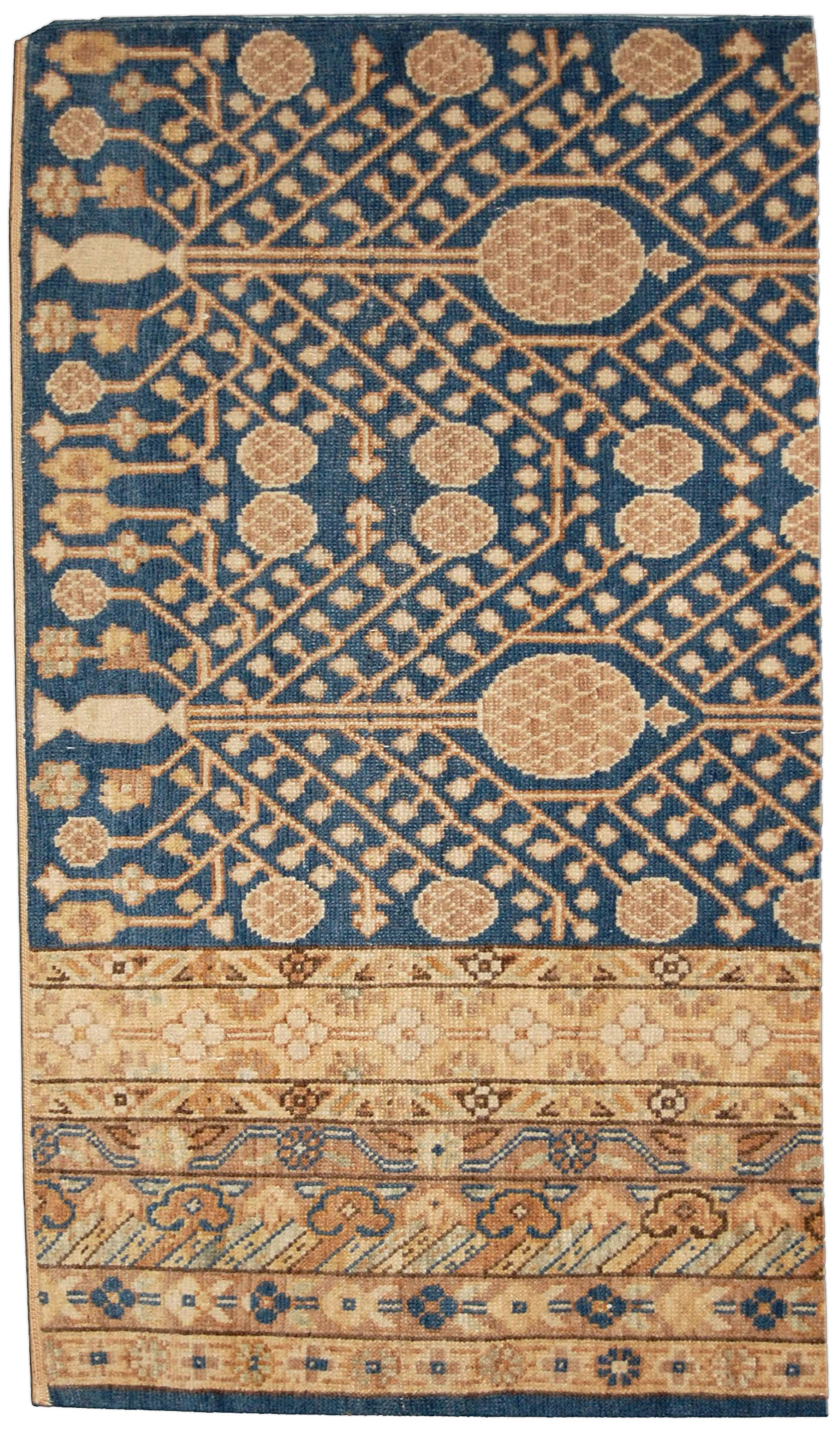
A formal dining room asks a rug to do more than soften footsteps. It must establish scale, support chair movement, frame the table with precision, and still preserve the visual discipline that makes the room feel composed. For Doris Leslie Blau, the most successful custom rugs for dining room settings are the ones that disappear into the architecture just enough to let furniture, finish, and light take center stage. The best result comes from exact dimensions, intelligent pile selection, and a pattern language that respects the table silhouette rather than competing with it.
When clients search for the best rug size for dining table arrangements, they are usually trying to solve a practical problem with design implications. The rug must extend far enough beyond the table edge to keep chairs on the textile even when pulled out, yet not so far that it overwhelms trim, door openings, or adjoining circulation paths. In formal interiors, those inches matter because the room reads as a single composition, not a casual vignette. A properly specified rug creates chair glide clearance, protects the floor, and defines the dining zone with the kind of clarity that a beautifully tailored suit brings to a silhouette. That is why custom rugs are often the most effective answer: they can be sized to the room, the furniture, and the exact way the space is used.
Why dining rooms demand exact rug dimensions
Dining rooms are unforgiving because the furniture moves. Unlike a living room arrangement, where most pieces remain relatively fixed, chairs are repeatedly pulled back, angled, and returned, which changes the effective footprint of the table during every meal. If the rug is too small, chair legs catch the edge and the composition looks cramped; if it is too large, the textile can erase the intended proportions of the room or complicate transitions to surrounding flooring. The right dimensions should account for chair glide clearance on all sides, plus a margin that keeps the rug’s border visually stable once the chairs are in use. In formal interiors, a rug that looks generous when empty but awkward when occupied is not a success, even if its material is luxurious.
The starting point is the table, not the room alone. A dining rug should generally extend at least 24 to 30 inches beyond every side of the tabletop, and more if the chairs are oversized, upholstered, or used for long dinners. This buffer lets the chair legs remain on the rug after someone sits down, which is essential to comfort and to a clean visual line. For larger rooms, a broader perimeter may be appropriate because the rug can act as a grounding field beneath the ensemble rather than a tight frame around it. This is where custom sizing becomes especially valuable, since standard dimensions often miss the precise relationship between table, chairs, and architecture. If the room calls for custom rugs, the goal is not novelty; it is proportion that feels inevitable.
There is also a psychological effect to correct scale. A rug that fits the dining group with confidence makes the room feel deliberate, while a marginal size can make even expensive furnishings seem temporary. In luxury dining room rug ideas, the textile should read as part of the room’s structure, much like paneling or a carefully chosen chandelier. That means thinking about sightlines from the entry, the distance between rug edge and wall, and the way the border relates to baseboards and drapery hem lines. The most refined dining rooms tend to use a rug size that balances all of those relationships at once, so the table feels centered not only physically but visually. This is one reason custom area rugs remain the most reliable design tool for formal dining rooms with unusual footprints or architectural constraints.
Choosing pile, fiber, and weave for daily use
The dining room is one of the few elegant spaces where performance is inseparable from aesthetics. A beautiful rug under a table must tolerate traffic, occasional spills, chair friction, and frequent vacuuming without losing its face. For that reason, low-pile wool remains one of the strongest choices: it has resilience, natural soil resistance, and enough structure to maintain a crisp edge under weight. A cut pile that is too plush can trap crumbs and make chair movement sluggish, while a thick shag or deeply textured construction can introduce instability around the legs. In practical terms, the right fiber and weave are what allow custom rugs to look formal without becoming fragile.
Wool is not the only option, but it is often the most balanced one for formal interiors. Fine wool can be woven tightly enough to support a clear motif, while still offering enough spring to recover after chairs are moved repeatedly across the same areas. In some projects, a performance finish can be added to increase resistance to staining and simplify maintenance, especially in households that entertain often. That said, finish should never be the first decision; the weave, yarn quality, and density must already be appropriate for the room. If the rug will be placed under a large rectangular table used for dinners and events, a dense flatweave or very low loop construction may outperform a more decorative pile because it keeps the surface level and the chair glide clean. The result is a dining rug that feels tailored rather than merely durable.
Fiber choice also affects the way light behaves across the room. Wool tends to absorb and diffuse light in a way that flatters mahogany, walnut, lacquer, brass, and polished stone, which is why it is often preferred for formal dining rooms. A stronger sheen can sometimes work in a very specific scheme, but too much reflectivity may make the rug compete with table settings and reflective furniture finishes. Clients often focus on stain resistance first, but in refined spaces the more important issue is how the textile performs over time in relation to the architecture and the table silhouette. A rug should hold its composure under use, not announce every footprint or crease. That is the difference between a practical floor covering and a true design element.
Matching rug geometry to round, oval, and rectangular tables
Geometry is one of the most important decisions in dining-room planning because the rug must reinforce the table shape rather than contradict it. A round table usually benefits from a round rug if the room itself can support that form, since concentric curves create a calm, centered composition. In a square or nearly square dining room, a round rug can soften corners and make the room feel more intimate, especially when paired with a circular pendant or chandelier. An oval rug can be particularly effective beneath an oval table because it preserves the flow of the table silhouette while offering a more relaxed edge than a strict rectangle. The key is alignment: the outer contour of the rug should feel intentional in relation to the furniture, not arbitrarily chosen from a catalog.
Rectangular tables present the broadest range of possibilities and, in many cases, the most exacting standards. A rectangle rug should generally echo the long lines of the table and room, especially when the dining area is framed by a runner-like circulation path or formal architectural bay. If the table is especially long, the rug should be extended enough to hold the chairs on all sides without creating a visually narrow strip that looks compressed. Some designers use a slightly larger rectangle than the table to create a more generous field, while others prefer a sharper fit that reads as disciplined and contemporary. The right answer depends on how much negative space the room needs around the ensemble and how the rug border will register against floors, millwork, and adjacent furniture. In every case, custom rugs can be cut to the precise geometry that the table demands.
For oval tables, the challenge is often avoiding a mismatch between softness and structure. An oval rug can mirror the table and create a fluid presentation, but it must be proportioned carefully so it does not look elongated or too narrow. A round rug beneath an oval table can work if the room is generous and the goal is to introduce contrast, though that approach requires greater discipline in placing the chairs and side furnishings. The safest principle is to let the rug reinforce the table’s longest axis while giving the chairs enough room to move without crossing the edge. In practice, that means measuring the fully extended chair footprint, not the table alone. When that happens well, the dining area feels custom-made rather than adapted.
Color, motif, and border strategies for formal settings
In formal dining rooms, color does not merely decorate the floor; it establishes how the room will feel after dark, by candlelight, and during long evenings of use. Deep neutrals, restrained jewel tones, aged ivories, and complex earth shades are especially effective because they support fine tableware, floral arrangements, and warm metallic accents without visual noise. A rug with too much contrast can make the dining group feel busy, while one with too little depth may vanish under furniture and lose its architectural role. The best luxury dining room rug ideas usually rely on tone-on-tone patterning, subtle abrash, or muted coloration that reveals itself gradually. This approach keeps the room formal while allowing the rug to contribute atmosphere rather than spectacle.
Motif selection should respect the pace of the room. Large, open patterns can help a dining room feel expansive, but they need enough scale to remain visible beneath the table and chairs. Small, dense ornament can add refinement, yet if the design is too intricate it may become visually cluttered once the dining set is in place. Borders are particularly useful in formal interiors because they provide a controlled perimeter that reads well under a table, especially when the field is occupied by chairs. A well-proportioned border can also help define the rug’s edge from a distance, which matters in rooms where the dining area opens to another space. For clients considering custom rug design, border width is often the detail that turns a good composition into an elegant one.
Pattern direction also deserves attention. A medallion-centered layout works beautifully when the table is centrally placed and the room is symmetrical, because it reinforces the idea of a single formal axis. Stripes, linear geometrics, or subtle all-over motifs can be effective in narrower rooms, where they help elongate the space and maintain order. What should be avoided is any pattern that fights the rhythm of the chairs or distracts from the table silhouette. A formal dining room is rarely the place for overly energetic motifs unless the rest of the architecture is exceptionally quiet. In this context, custom luxury rugs offer a major advantage: they can be designed so the visual center lands exactly where the table demands it.
Placement rules that keep chairs moving cleanly
Proper placement is about choreography as much as measurement. The rug should sit so that every dining chair remains fully supported when pulled out for use, which means the textile must anticipate the motion of the meal, not just the static arrangement. If the rug is placed too close to a wall, chairs may drift off the edge and create uneven wear or an awkward tipping point. If it is centered without regard to the actual seating footprint, the front legs may remain on the rug while the rear legs slip off, producing instability and a poor tactile experience. A dining rug should feel like a platform, not a patch. This is one of the reasons specialists often recommend measuring from the outermost point of the extended chair, then adding a modest buffer to ensure consistent support.
Flooring type changes the equation as well. On stone, wood, or polished surfaces, an underlay or pad can improve grip and prevent shifting, which is especially important in dining rooms where chairs are constantly in motion. A flat or low-pile rug works best because it allows the chair legs to move without resistance, making the room more comfortable for guests and easier to maintain. In some projects, the rug edge should also account for nearby cabinetry, fireplaces, or architectural thresholds, since a strong formal line can be weakened by a poor transition at the perimeter. The room is most successful when the rug, table, and surrounding elements are arranged as a single spatial sentence. That is the real measure of custom rugs in a dining context: not simply that they fit, but that they facilitate use with grace.
Maintenance should be considered during placement planning, not after the fact. A rug that sits under a dining table will inevitably require frequent vacuuming, prompt attention to spills, and periodic rotation if the room receives uneven sun exposure. Choosing the right position from the start helps reduce stress on the same areas of pile or weave and supports more even aging. For households that entertain regularly, a performance finish can be helpful, but it should complement, not replace, a sensible placement strategy. In formal interiors, longevity comes from design discipline as much as from material strength. The most elegant dining rugs are those that preserve their form because every practical detail was considered before installation.
Why custom solutions outperform standard sizes
Standard rug sizes can work in casual rooms, but dining rooms often reveal their limitations immediately. A fixed dimension may be too short by a few inches, leaving chair legs stranded on the edge, or too narrow to balance the room’s architecture. Because dining tables come in so many proportions, and because chair styles vary dramatically in depth and sweep, a standardized textile frequently forces compromises that are visible from every angle. Custom rugs solve this by allowing the dimensions to follow the actual use pattern rather than an abstract norm. They also permit precise choices in border width, motif scaling, and color placement so the design remains coherent from the entry as well as from the table.
For rooms with unusual layouts, the benefits are even clearer. A formal dining room may need a rug that aligns with a bay window, a cased opening, an off-center chandelier, or an irregular wall line. In those situations, custom-made rugs make it possible to preserve symmetry where the architecture cannot provide it naturally. The same is true when mixing antique furniture with newer pieces, because the rug can be calibrated to bridge eras without visual conflict. Doris Leslie Blau often approaches these rooms as complete compositions, considering the furniture, the circulation, and the light before determining the textile dimensions. That process is what makes custom carpet solutions so effective for dining spaces that require both precision and atmosphere.
Another advantage of custom work is control over scale in relation to material pattern. A motif that appears balanced on a sample can look too busy beneath a large table, or too quiet in a room with high ceilings. When a rug is made to order, the repeat, border, and field proportions can be adapted so the composition reads correctly once the chairs are in place. This is especially important for formal interiors where the rug should support the table rather than compete with it. Clients who are comparing bespoke area rugs with standard options often discover that the real value is not only size flexibility, but the ability to unify design and use. In a dining room, that alignment is what makes the room feel finished.
FAQ
How much larger should a dining room rug be than the table?
A dining room rug should usually extend at least 24 to 30 inches beyond the table on every side, and sometimes more for larger chairs or deeper seating. The goal is to keep the chair legs on the rug when the chairs are pulled back, which preserves comfort and prevents the composition from feeling tight. For very formal settings, a slightly greater margin can make the table feel more anchored and the room more generous. The most accurate measurement comes from the fully extended chair footprint rather than the table alone. If the dining set is unusually large or the room has a complex layout, custom sizing is often the best solution.
Is wool the best material for a dining room rug?
Wool is often the best all-around material because it combines resilience, natural soil resistance, and a refined surface that works well in formal interiors. Low-pile wool is especially effective under dining tables because it supports chair glide clearance and cleans more easily than high-pile constructions. It also presents color and pattern beautifully, which matters in rooms where the rug must contribute to the overall visual line. That said, the best choice depends on use, maintenance expectations, and the style of the room. A tightly woven construction with a performance finish can also be appropriate when additional protection is needed.
Should a dining rug match the floor or the upholstery?
Neither match should be literal. The rug should instead relate to both surfaces in a controlled way, creating balance without becoming repetitive. If the floor is visually active, the rug may need to be quieter; if the upholstery is neutral, the rug can introduce depth, border detail, or a more complex motif. In formal settings, it is usually best for the rug to bridge the architecture and the furnishings rather than echo one element exactly. That approach gives the room a more layered and sophisticated finish.
For a dining room that feels measured, elegant, and genuinely livable, the rug should be selected with the same seriousness as the table itself. The right custom rug clarifies the room, supports the motion of chairs, and maintains a disciplined visual frame that suits formal dining without stiffness. If you are refining a project and want expert guidance on size, weave, and pattern, a specialist consultation can help translate your room’s proportions into a rug that performs beautifully for years.