

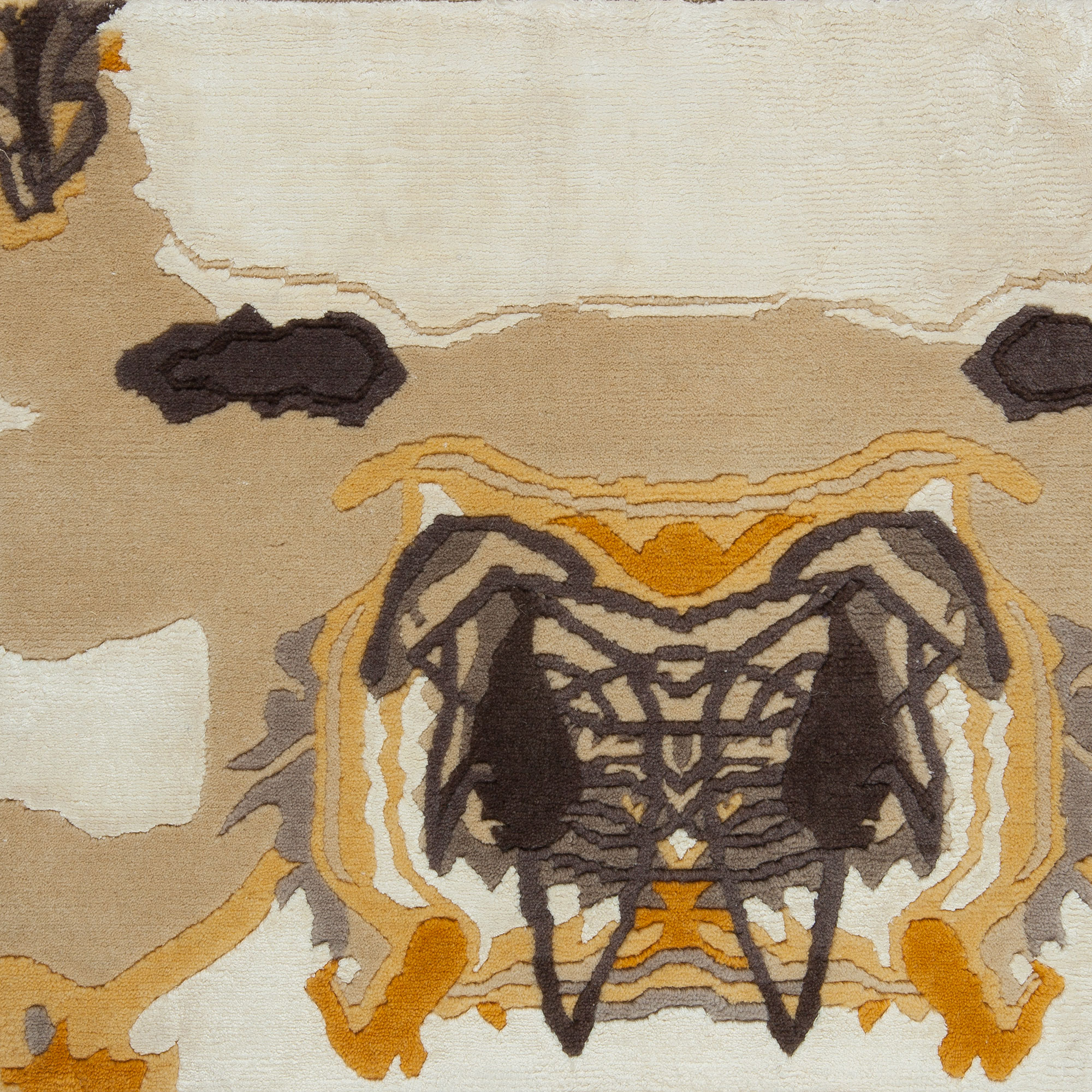
In a well-composed entry sequence, a rug does more than soften a floor. It establishes scale, directs movement, and sets the visual temperature for the rooms that follow. For foyers, stair halls, vestibules, and landings, the right rug behaves like architecture underfoot: measured, quiet, and precise.
When designers specify custom rugs for grand entryways, they are solving several problems at once. The floor must withstand relentless footfall, but it must also hold a line of sight from the front door to the next threshold without visual interruption. In high-impact spaces, the rug becomes the first controlled surface guests encounter, which means it has to manage proportion, traffic patterns, and light reflection with the same rigor as millwork or lighting. A successful entry rug should not merely decorate; it should clarify how the house wants to be read. That is why luxury foyer rug ideas begin with architecture rather than pattern. The rug must suit the width of the opening, the length of the approach, and the placement of doors, stairs, and neighboring galleries. In that sense, the best choice is rarely a standard-size solution. It is a tailored one that respects the room’s geometry and the pace at which people move through it.
The entry sequence: what a rug must do in the first 10 feet
The first ten feet of an entry define the entire interior experience, so the rug has to perform with almost editorial restraint. It should establish an architectural axis without creating clutter, and it should invite movement rather than interrupt it. In a formal foyer, this often means selecting a rug that frames the central sightline from the door toward a staircase, artwork, console, or distant window. The surface needs enough presence to register as intentional, but not so much pattern that it competes with paneling, stonework, or a dramatic stair rail. For custom rugs for entryway applications, this balance is especially important because the area must absorb weather, grit, and friction while still looking polished after constant use. A dense construction, a disciplined border, and a scale that matches the room’s proportions all matter more here than novelty. The rug is not a decorative afterthought; it is part of the circulation plan. When that is done well, the entry feels composed before the rest of the house has even been revealed.
Traffic patterns should be read before a single size is proposed. In many grand homes, the entry behaves like a crossroad, with arrivals turning toward the stair hall, the library, the gallery, or the main circulation spine. The rug must support that motion by offering enough surface to land on, pivot across, and exit without forcing awkward steps. A narrow vestibule may call for a runner that elongates the path and reinforces the architectural axis, while a broader foyer can support a centered field rug that anchors the room as a destination. The wrong proportion will immediately expose itself, either by floating too small in the space or by crowding thresholds and baseboards. Luxury foyer rug ideas should therefore begin with measurements taken from door swing, wall breaks, stair landings, and the distance to adjacent furnishings. Once those are set, the rug becomes a calibrated tool for movement and first impression design. In luxury interiors, precision is not a preference; it is the difference between a room that feels composed and one that feels improvised.
Sizing rules for foyers, galleries, and stair landings
Sizing in these spaces is less about a single formula than about reading the room’s proportions in layers. A foyer rug should generally leave a purposeful border of exposed flooring around it so the perimeter reads as architecture rather than an edge condition. Too little reveal can make the room feel cramped and diminish the clarity of the walls and moldings, while too much can cause the rug to feel adrift. In a gallery-like entry, longer rugs are often more effective because they track the room’s direction and support a strong visual axis. Stair landings present a different challenge: the rug must relate to the turning point of the stair while also giving the landing enough visual weight to feel complete. This is where custom sizing becomes essential, because standard dimensions rarely align with the exact length of a landing or the rhythm of nearby balusters. The goal is to create a finish that looks inevitable, as if the floor plan dictated the rug from the beginning. For clients considering custom area rugs, the advantage is not only fit but the ability to refine border width, motif placement, and end proportions to suit the architecture precisely.
Stair hall rug placement also depends on how the eye travels through the space. If the staircase is a principal visual feature, the rug should support that ascent rather than compete with it. A runner that begins cleanly at the bottom landing and continues with disciplined spacing up the stair run can make the entire vertical sequence feel more resolved. At the top, a landing rug must feel like a transition rather than a stop sign, which means avoiding sizes that bunch around doorways or obscure the geometry of the turn. In very large foyers, an area rug can be paired with smaller rugs or runners in adjoining passages, but each piece has to speak the same design language. That may mean matching border structure, repeating a tonal palette, or using the same weave family in different formats. Consistency across the entry sequence helps maintain high-traffic luxury without making the floor feel repetitive. The best result is one in which every rug understands its role in the room’s choreography.
Materials that hold up to footfall without losing elegance
Durability in an entry does not require visual heaviness, but it does require technical discipline. Dense hand knotting, resilient fibers, and a weave that can resist compression are all valuable in spaces where shoes, luggage, pets, and daily arrivals are unavoidable. Wool remains a particularly strong choice because it balances elasticity with a refined surface, and it can age with dignity when properly constructed. In some cases, a wool-silk blend can add subtle sheen to an otherwise restrained composition, but the placement must be considered carefully because too much luster in a bright vestibule can intensify glare. Natural fibers should be chosen with the room’s use in mind, not simply for their reputation. A grand entry may need a lower-profile pile to keep doors moving freely and to avoid collecting debris at the edges. In stair hall settings, stability and edge finishing matter as much as softness underfoot. A well-made rug in this category should look quiet from a distance and reveal craftsmanship upon closer inspection, which is one reason designers often turn to custom luxury rugs for demanding circulation zones.
Construction details matter more than many clients expect. A firm foundation, precise binding, and balanced density help the rug keep its shape even when traffic concentrates along a center path. If the area receives direct sunlight, colorfastness and fiber response should be reviewed so the rug does not fade unevenly at the threshold or along sidelights. If the floor is stone or polished wood, the rug should also be evaluated for grip and underside compatibility, because a beautiful textile is a liability if it shifts at every arrival. In an entry or stair hall, elegance is never just visual; it is tactile, structural, and behavioral. A rug that slides or buckles breaks the illusion immediately, no matter how beautiful its pattern may be. For that reason, material selection should be paired with underlay, maintenance planning, and a clear understanding of how often the space is vacuumed, rotated, or professionally cleaned. Luxury is most convincing when it survives daily use gracefully. That is the real standard in high-traffic luxury interiors.
Pattern placement for symmetry and directional movement
Pattern placement can make an entry feel either composed or disoriented, and the difference usually comes down to where the eye is meant to go. In a formal hall, a centered medallion may reinforce symmetry, but only if the room actually supports that axis with equal walls, a centered door, or a staircase aligned to the middle. If the architecture is asymmetrical, a rigid central motif can feel forced. In those cases, a border-led composition or a more directional field often works better because it respects the room’s natural movement. A striped or elongated pattern can also guide visitors through a vestibule, especially when the goal is to visually lengthen a narrow space. For stair landings, the motif should be positioned with precision so that turns, thresholds, and viewing angles do not chop the design awkwardly. Every motif has a relationship to the body moving through the space. If the design is aligned well, it feels calm. If not, the room reads as visually restless.
This is where the custom word becomes especially important, because pattern placement on a made-to-measure rug can be engineered with the architecture itself in mind. Instead of adapting the room to the textile, the textile is adapted to the room, which allows motifs to land exactly where they are most effective. A border can be widened on one end to compensate for a vestibule’s depth, or a central medallion can be shifted to align with a stair opening or console. Even subtle adjustments alter how the room feels from the front door. In a house with strong moldings, paneled walls, or a staircase that dominates the entry view, pattern should respect those vertical and horizontal lines rather than compete with them. This is why many designers prefer custom rugs when the goal is both symmetry and a sense of ease. The result is not overtly decorative; it is calibrated. That calibration gives the entry its authority.
Using runners and area rugs together in connected spaces
Connected circulation zones often benefit from a layered rug strategy rather than a single oversized piece. A foyer might call for an area rug that establishes the first arrival moment, while a stair hall or adjoining passage continues the visual rhythm with a runner. When these elements are designed together, the transition feels deliberate and seamless. The key is to preserve a shared vocabulary of scale, color, and edge treatment so the sequence reads as one composed experience. Runner proportions should relate to the width of the corridor and the pace of movement, with enough flooring visible at the sides to maintain a crisp architectural line. In larger homes, this approach also helps break down expansive stone or hardwood surfaces without fragmenting the design. The area rug establishes the room’s center of gravity, and the runner extends that logic through the axis of movement. This is especially effective in stair halls where the landing acts as a hinge between levels and the floor plan benefits from a consistent visual thread.
To keep the composition coherent, the runner and area rug do not need to match exactly, but they should feel as though they were developed from the same design brief. A border motif can echo from one piece to the next, or a shared palette can carry from a more formal foyer into a quieter passage. In some projects, the entry rug is more expressive while the runner is restrained, which helps manage the shift from public to private zones. In others, both pieces are intentionally understated so the architecture remains the primary focus. The important point is that the collection of rugs supports the house’s spatial rhythm instead of interrupting it. For clients refining a connected entry sequence, custom rug design allows each piece to be scaled and detailed for its exact position. That level of control is what makes a transition feel expensive without feeling overdesigned. It is also what allows a home to maintain continuity from the vestibule to the stair hall and beyond.
FAQ
What rug shape works best in a grand entryway?
The best shape depends on the architecture, but rectangular rugs are usually the most adaptable because they reinforce the geometry of doors, halls, and stair runs. In a square foyer with a centered chandelier or staircase, a square rug can also feel appropriate if it preserves balanced margins on all sides. Round rugs can be effective in oversized rotundas or softened entry rooms, though they are less common in formal circulation spaces because they do not always support an architectural axis as clearly. The most important consideration is not shape alone, but how the shape interacts with thresholds, furniture, and sightlines. In a grand entryway, the rug should feel as if it belongs to the room’s plan, not merely to its decoration.
How do I keep an entry rug from shifting?
Shifting is usually prevented by a combination of proper sizing, a quality underlay, and appropriate construction. If the rug is too small, it tends to skate more easily because foot traffic catches the edges; if it is properly scaled, it sits with more authority and less movement. A dense pad matched to the floor surface is important, especially on polished stone or hardwood, where traction can be minimal. The rug should also be finished cleanly at the edges so it does not curl or compress unevenly near doors or stairs. For stair halls, professional installation is often worth considering because the geometry can be more demanding than in a standard room.
Can one rug coordinate a foyer and adjoining stair hall?
Yes, but the relationship should be planned as a sequence rather than a single gesture. One rug can visually anchor the foyer while a runner or secondary piece carries the same design language into the stair hall, especially if both share border logic, color temperature, or motif scale. In some homes, a single large rug can bridge multiple zones if the floor plan is open enough and the circulation path is uncomplicated. In more complex entries, separate pieces usually perform better because each area has different traffic and viewing conditions. The coordination works best when the rugs are designed together so the transition feels intentional from every angle.
When an entryway, vestibule, or stair hall is treated with this level of care, the rug becomes a structural part of the home’s first impression. It steadies the room, clarifies the route, and gives the architecture a refined base from which to speak. For projects that require exact dimensions, tailored proportions, and a finish suited to heavy use, a specialist consultation can help align material, scale, and placement with the realities of the space. The result is an entry sequence that feels precise from the moment the door opens.