

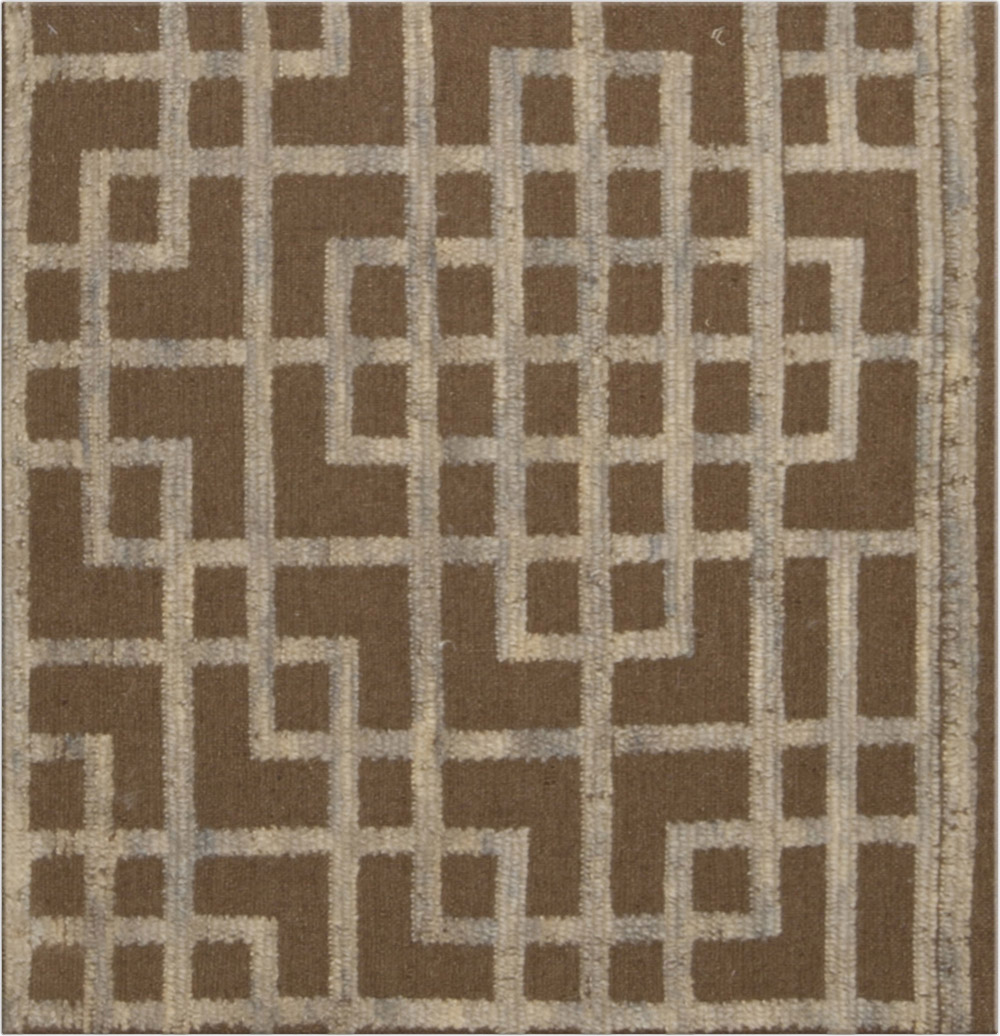
When evaluating custom rugs, the eye is often drawn first to color, scale, and pattern. Yet the final impression is just as often determined by the finishing: the edge treatment, the presence or absence of fringe, the definition of rug borders, and the way the perimeter is resolved. These details are not decorative afterthoughts; they affect how a rug sits in a room, how it wears over time, and how refined it looks once furniture, lighting, and architecture are in place.
For designers and homeowners working at a high level, rug finishing is where craftsmanship becomes visible. A well-conceived finish can sharpen a pattern, calm a busy layout, or make an oversized room feel more composed. It can also prevent premature edge wear, flatten visual tension around a strong border, and give the carpet a cleaner relationship to adjacent materials such as stone, oak, plaster, or polished concrete. In other words, the edge is not simply the end of the rug; it is part of the design language.
Describe the visual role of borders, edges, and fringe
Every finish changes how the eye reads the rug. A bordered design creates a visual frame, which can reinforce symmetry, anchor a seating arrangement, or help a patterned field settle within a larger room. In contrast, a no-border construction tends to feel more open and contemporary, especially when the pile, weave, or color field already carries enough interest. For custom rugs, this choice is often tied to the architecture of the space: a strong border can echo moldings and paneling, while a restrained edge can support minimal interiors with cleaner sightlines.
Edges matter because they define how complete the rug feels when it meets the floor. A hand-finished binding or overcasting line can read as discreet and tailored, especially on quieter pieces where the edge should disappear rather than announce itself. A more substantial edge treatment may be appropriate when the rug needs to hold presence in a large room or protect a delicate construction. The most refined results usually come from making the edge look intentional, not simply secured.
custom-made rugs offer the advantage of choosing these relationships deliberately rather than accepting a standard finish. That matters when the rug must work with furniture placement, traffic flow, and the proportions of the architecture. A border that is too narrow can look timid in a grand room; a fringe that is too heavy can compete with a contemporary sectional or sculptural chair. Good finishing supports the design without pulling attention away from the whole.
Fringe adds another layer of visual tone. On some hand-knotted rugs, fringe is part of the structural ending of the warp threads, so it contributes to the sense of authenticity and traditional craftsmanship. On others, fringe is applied as a decorative finish, which changes the mood entirely. A long, soft fringe tends to feel more classic and formal, while a short, neat fringe can appear lighter and less ornate. In both cases, the condition of the fringe should be evaluated as carefully as the pile itself, because it is one of the first places where use and handling show.
Explain how finishing affects longevity and appearance
Finishing is not only about style; it is a practical defense against wear. The perimeter of a rug takes stress from foot traffic, vacuuming, shifting furniture, and repeated cleaning. If the edge is poorly bound or the fringe is weakly attached, the rug can begin to lose definition long before the field shows significant wear. A strong finish can help a rug maintain its shape, resist curling, and preserve the crisp outline that makes it look composed in the room.
Material choice plays a direct role here. Wool rugs with tightly secured edges often tolerate everyday use very well because the fiber has resilience and the construction can be reinforced without looking bulky. Silk rugs, by contrast, may demand a more exacting finish, since the sheen that makes them beautiful also reveals irregularities at the edge. In high-traffic settings, a finish that is too delicate may degrade visually even if the field remains intact. This is why experienced buyers look beyond the main motif and ask how the rug is terminated.
Border treatment can also affect the way a rug ages visually. A bold rug border can disguise minor wear in the field by giving the eye a clear frame, while an open edge may make small irregularities more noticeable. That does not mean borders are always preferable, only that they can be useful in rooms where longevity and visual order matter equally. In a dining room, for example, a border can keep the composition stable even as chairs move in and out; in a library, a more subdued edge may suit the quiet discipline of the space.
There is also a tactile dimension. Finishing can influence how the rug feels underfoot at the perimeter, whether the edge lies flat, and how the transition behaves where the rug meets hardwood, stone, or carpet. A clean edge that remains flat is not merely better looking; it is safer and easier to live with. In well-made custom rugs, those practical considerations are resolved so carefully that the finish seems almost invisible, which is often the highest compliment.
Show how to choose the right finish for the room
The best finish depends on the room’s use, the architecture, and the visual weight of the rug itself. In a formal living room with strong symmetry, rug borders can echo the room’s geometry and make the furniture plan feel more deliberate. In a modern loft or open-plan apartment, a cleaner perimeter may be preferable because it prevents the rug from feeling too historic or ornate. The goal is not to choose the most decorative option, but the one that best supports the room’s reading from multiple angles.
Scale is critical. A large room with tall ceilings and generous furniture proportions can absorb a deeper border or a more pronounced fringe without feeling crowded. In a smaller room, however, the same features may compress the layout and make the rug seem visually heavy. A narrower border or a restrained edge treatment can preserve breathing room around the furniture, which is especially important when the rug is already anchoring a strong color palette or a dense pattern.
Light also changes the equation. Natural daylight tends to reveal texture, so a finish with handwork and subtle irregularity can look especially rich in a sunlit room. Under warm artificial light, however, a fringe or border may become more visually prominent than expected, which can be useful if the goal is to define the rug at night. Designers specifying custom rugs for rooms used both day and evening often test how the finish behaves under different temperatures of light before settling on the final detail.
Consider a simple scenario: a large sofa, a pair of lounge chairs, and a coffee table are placed on a pale wool rug in a room with oak floors and minimal window treatments. If the rug has no border and a tightly finished edge, the composition may read as calm and contemporary. If the same rug includes a subtle border and a short fringe, the room feels more tailored and slightly more formal. Neither option is inherently better; the correct choice depends on whether the space is meant to feel architectural and restrained or layered and classical.
Highlight details trade buyers should confirm
For trade buyers, finishing should be confirmed with the same rigor as pile content or weave construction. Ask how the perimeter is secured, whether the fringe is structural or applied, and what repair pathway exists if the edge later needs reinforcement. If the design includes rug fringe, clarify length, density, color, and how the fringe will behave after installation and cleaning. These are not minor details; they determine whether the rug will hold its presentation in real use.
Buyers should also verify how rug borders are integrated into the layout. On a patterned custom piece, a border must align cleanly with the field and with the intended orientation in the room. If the rug is being sized around a dining table, bed, or seating group, the border can either guide the eye outward or compress the central motif depending on its width. That means finishing should be considered alongside scale and proportion, not after the design has already been approved.
It is equally important to think about maintenance from the start. A finish that looks elegant in a showroom may be less suitable for a family room, entry, or hospitality setting if it frays easily or shows vacuum marks too readily. Trade buyers should confirm how the rug will be oriented, whether it will sit under furniture, and how often it is likely to be moved. In many cases, the most successful solution is not the most ornate one, but the one that will continue to look resolved after years of use.
- Confirm whether the edge is bound, overcast, hemmed, or left with a structural fringe.
- Check how the finish relates to the pattern scale and any rug borders in the design.
- Ask how the perimeter will behave in relation to vacuuming and everyday foot traffic.
- Review the finish under the room’s actual lighting, not only in neutral studio conditions.
- Match the edge detail to the room’s formality, furniture layout, and expected wear.
Material, construction, and the finishing conversation
Finishing cannot be separated from construction. A hand-knotted rug, for example, may support different edge treatments than a tufted or woven piece, because the structure at the perimeter governs what is possible and what will last. Dense knotting can permit a more precise definition at the edge, while looser constructions may need extra reinforcement to avoid distortion. The same principle applies to pile height: a thick pile can soften the outline, which may be desirable in a relaxed room but less effective when a crisp profile is needed.
Fiber behavior matters too. Wool tends to compress and recover well, making it a reliable base for clean finishing. Silk has a finer hand and a more reflective surface, so tiny irregularities at the edge may become more visible. Blends can introduce useful balance, but only if the finish respects the way each material reacts to tension, trimming, and use. This is why thoughtful specification is never just about appearance; it is about making material, construction, and finish work as one system.
For clients comparing several custom rugs, finishing can become the deciding factor when patterns and colors are otherwise comparable. One piece may have a beautifully executed border but a finish that feels too heavy for the room; another may offer a lighter edge and a more adaptable profile, even if the design is less elaborate. The strongest choice is usually the rug whose finishing aligns most convincingly with the space, not the one with the most visible detailing. That restraint often reads as luxury because it shows control.
How designers use finishing to solve real spatial problems
In practice, finishing often solves problems that are not obvious until the rug is in the room. A strong border can correct the visual imbalance of an irregular floor plan, giving the eye a stable frame to follow. A minimal edge can help a large rug disappear into the architecture so that the furniture, not the floor covering, becomes the focus. Fringe can extend a traditional language in a room that already has paneling, antiques, or classic millwork, while a bound edge can keep the composition cleaner in a contemporary interior.
This is why rug finishing belongs in the same conversation as furniture layout and zoning. In open-plan interiors, the perimeter detail can help distinguish a seating area from adjacent circulation space without adding a physical barrier. In a bedroom, a softer finish may make the rug feel more relaxed underfoot, which matters when the rug extends beyond the bed and into the waking path. In a hallway or transitional space, the edge must be especially disciplined because the eye registers repetition and alignment very quickly.
Designers working with custom-made rugs often treat finishing as a way to calibrate mood. A tailored edge with almost no visible interruption can feel precise and modern. A framed border can make a room feel collected and composed. A measured fringe can signal craftsmanship without becoming theatrical. These choices are subtle, but subtlety is exactly what separates an expensive object from a well-designed one.
FAQ
Does finishing change the way a rug wears?
Yes. Edge treatment, binding, and fringe all affect how a rug handles traffic, vacuuming, and movement across the floor. A well-secured finish helps the rug keep its shape and preserves a cleaner outline over time, while a weaker perimeter can show wear early even if the field remains in good condition.
Are fringed rugs more formal?
Often they are, but not always. Fringe can add a traditional or ceremonial note, especially when it is long or finely detailed, yet the overall effect depends on the rug’s pattern, color, scale, and room context. A short, neat fringe on a restrained design may read as tailored rather than formal.
What edge details look most refined?
The most refined edge is usually the one that feels deliberate and well integrated with the rug’s construction. That may mean a crisp bound edge on a contemporary piece, a discreet overcast finish on a quieter design, or a clean structural fringe on a hand-knotted rug. Refinement comes from precision, not from adding more detail.
Should rug borders always be visible?
No. Some rooms benefit from a distinct frame, while others need the edge to recede so the rug feels more open and architectural. The right choice depends on the room’s proportions, the density of the pattern, and how much visual structure the furniture arrangement already provides.
When a rug is specified thoughtfully, the finish does not compete with the design; it completes it. Doris Leslie Blau approaches that final layer with the same attention given to weave, proportion, and material, because the edge is where daily life meets craftsmanship. If you are evaluating a piece for a project, consult with a specialist who can help match the finish to the room, the use, and the long-term visual goal.