

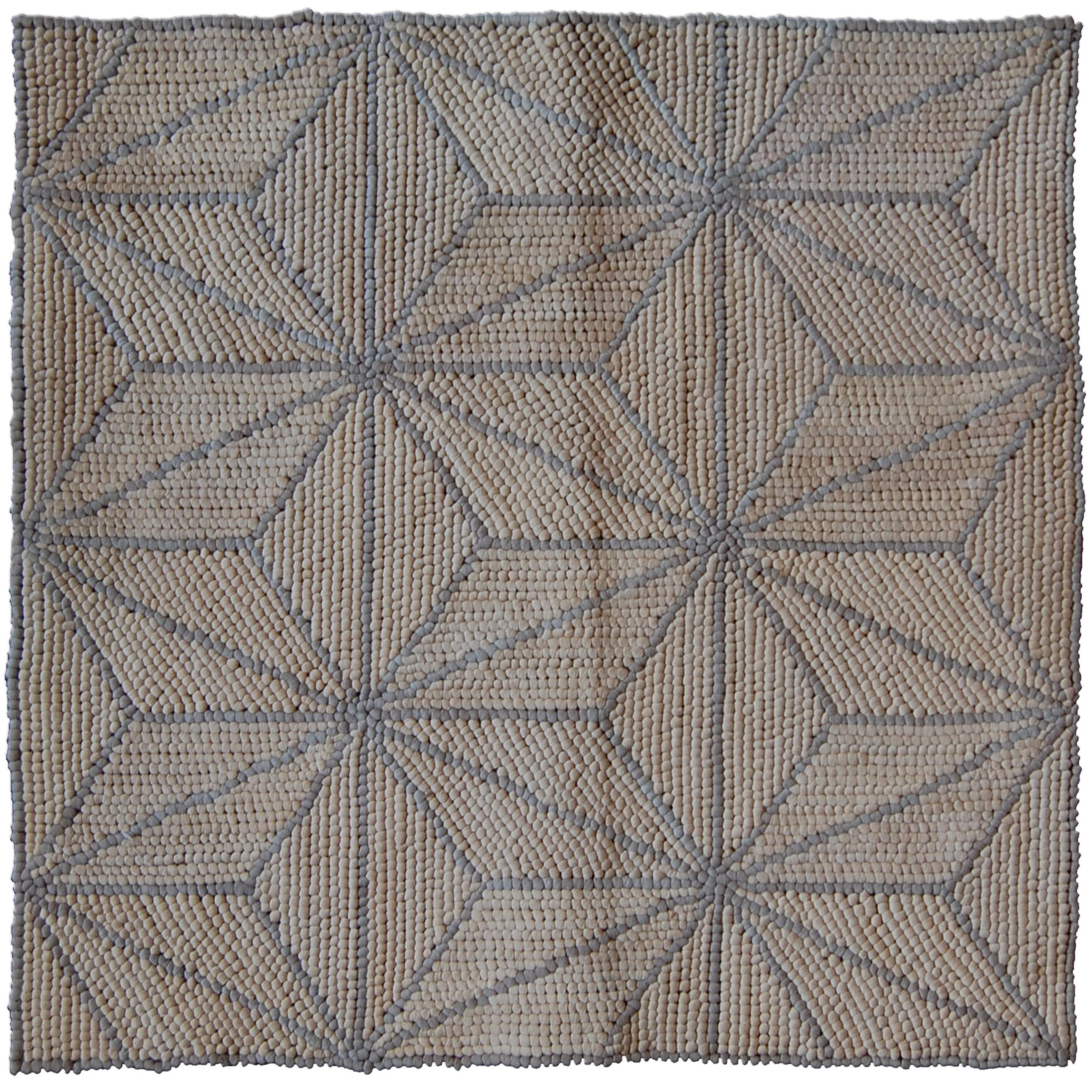
Mid-century modern interiors reward discipline: a clear furniture plan, honest materials, and a palette that feels considered rather than decorated. The right custom rugs can reinforce that order without turning the room into a period pastiche, especially when the design balances restrained geometry with warm, grounded color. For rooms that already contain strong lines in the architecture or furnishings, the rug should organize the composition, not compete with it.
That is why mid-century modern rugs remain so useful in contemporary homes. They can define a seating area, soften hard edges, and lend rhythm to a room that might otherwise feel visually unfinished. The strongest examples are not loud or busy; they use scale, proportion, and tactful pattern to create structure. In practice, that often means geometric rugs with a calm repeat, tonal rugs with subtle variation, or a hybrid of the two.
Identify the mid-century traits that still work today
Mid-century design has endured because its best qualities are practical, not nostalgic. Low-profile seating, open sightlines, slim leg furniture, and an emphasis on material honesty all make sense in current interiors, particularly in apartments and houses where the floor plan carries a lot of visual responsibility. A rug in this setting should support the room’s architecture by clarifying zones and absorbing some of the visual noise created by multiple surfaces and angles. That is especially important when the room includes mixed woods, stone, leather, and upholstery in different finishes.
What translates best today is restraint with purpose. A rug does not need a large motif to feel mid-century; it needs proportionally correct geometry, a palette that understands the surrounding finishes, and a surface that respects the room’s light. A hand-knotted wool rug with a precise border or a softened grid can feel more authentic than an obvious retro pattern. Doris Leslie Blau often approaches this kind of work through custom rug design, because the room usually calls for a measured answer rather than an off-the-shelf solution.
It is also worth distinguishing between mid-century-inspired and mid-century-referential. The first borrows the era’s logic: disciplined lines, useful pattern, and comfort without excess. The second leans on motifs that can quickly feel dated if they are too literal. If your furnishings already include iconic silhouettes, the rug should be the quiet stabilizer in the composition, not another period citation competing for attention.
Use pattern to organize open, low furniture arrangements
Open plans and low furniture arrangements benefit from pattern because they often lack obvious vertical boundaries. A rug can create a visual room within a room, especially when the sofa sits low to the ground and the coffee table is compact relative to the seating. In these cases, pattern should work like drafting lines: directing the eye, reinforcing alignment, and clarifying where the conversation area begins and ends. That is where geometric rugs are most effective, provided the motif is scaled to the furniture rather than chosen as a decorative afterthought.
For example, consider a living room with a low walnut sofa, two lounge chairs, and a long, rectangular coffee table floating in a larger open-plan space. A rug with a centered field and understated linear border can anchor the seating without making the room feel smaller. If the room already has strong horizontal emphasis, such as a long credenza or expansive glazing, a pattern with modest vertical rhythm can restore balance. The goal is not symmetry at all costs; it is legibility.
Pattern density matters as much as pattern type. In a room with several sculptural pieces, the rug should not introduce another busy layer that competes with the furniture. A quieter grid, broken stripe, or architectural repeat keeps the floor plane active without becoming noisy. If the room contains a large solid sectional, a more assertive pattern can add structure and prevent the composition from reading as a single heavy block.
Scale the motif to the room, not to the swatch
A small sample can make a pattern look delicate, but once enlarged to an actual room, the same motif may become visually dominant. This is why scale is one of the most important decisions in selecting custom rugs for mid-century interiors. Large rooms can accommodate broader geometry, while compact rooms often need motifs that move more slowly across the surface. A good rule is to think in terms of sightlines: if you can read the rug from across the room, the repeat should still feel calm rather than busy.
Keep the palette warm and grounded
Mid-century color works best when it feels sunlit rather than saturated for the sake of contrast. Warm neutrals, tobacco brown, clay, moss, ochre, muted rust, and softened charcoal all belong naturally in this language. These colors pair well with teak, walnut, oak, brushed metals, and leather because they avoid the sterility that can come from cooler grays and stark black-and-white combinations. The most successful tonal rugs often use several closely related hues, allowing the surface to read as layered instead of flat.
Warmth is especially important in rooms with a lot of hard material: polished stone, lacquered cabinetry, or glass-heavy architecture. A rug with a wool foundation and subtle tonal variation can introduce visual softness without sacrificing clarity. In deeper colorways, the pile finish matters; a low-sheen surface can keep dark shades from feeling heavy, while a slightly higher pile may help lighter colors look richer and less chalky. These choices are small on paper but decisive in a room.
Color should also respond to the room’s natural light. North-facing spaces often benefit from warmer rug colors so the interior does not drift into coolness, while bright south-facing rooms can support more complex neutrals and mineral tones. If the room already includes saturated upholstery or art, the rug should usually sit one step quieter so the floor does not become a second focal point. The best tonal rugs do not disappear; they hold the room together by staying in dialogue with the rest of the palette.
If the architecture is especially minimal, a rug with layered neutrals can add depth without calling too much attention to itself. This is where texture becomes as important as color. Wool, wool-silk blends, and hand-knotted constructions can provide enough surface variation that the rug looks refined even when the palette is restrained. That refinement is often what keeps a mid-century room from sliding into a theatrical retro mood.
Material and construction should match how the room is used
Mid-century interiors tend to favor clarity, but that does not mean they are fragile. A rug in this setting needs to work as hard as the furnishings around it, especially in living rooms, dining rooms, and family spaces where traffic is steady. Wool remains one of the most practical choices because it is resilient, visually rich, and comfortable underfoot. For rooms where tactile softness is a priority, a wool-silk blend can add sheen and nuance, though it requires a more careful conversation about placement and maintenance.
Pile height has a direct effect on the room’s character. A lower pile usually supports the crisp lines associated with mid-century furniture, keeps chair movement easier, and reduces the visual weight of the floor. A slightly more plush surface can work if the room needs softness, but it should not obscure the clean geometry that defines the style. In many designer specifications, the ideal answer is a finely made hand-knotted rug that combines structure with enough texture to keep the surface interesting.
Construction also affects how the rug interacts with furniture bases. Slim legs, tapered wood frames, and open forms benefit from a rug that feels tailored rather than bulky. If the rug is too thick or visually dense, it can make the furniture seem to sink. For that reason, many mid-century rooms are best served by hand-knotted rugs or other carefully made constructions that preserve the crisp relationship between floor, furniture, and architecture.
For larger projects or rooms with unusual dimensions, custom rugs offer the most precise way to align material, scale, and proportion. A made-to-order piece can account for door swings, circulation paths, fireplace placement, and the exact footprint of the seating area. That level of fit matters in mid-century-inspired interiors because the style depends so heavily on the integrity of layout; a rug that is too small or poorly positioned weakens the whole composition.
Show how to avoid making the room feel retro for its own sake
The easiest way to make a mid-century room feel dated is to use too many references at once. A starburst lamp, boomerang chair, and high-contrast graphic rug can quickly shift the room from composed to costume-like. To avoid that effect, let the rug carry the structural language while the furniture and accessories stay relatively quiet. The result feels more architectural, less thematic.
Another useful strategy is to mix eras thoughtfully. A mid-century-inspired rug can sit comfortably beneath a contemporary sectional, a vintage sideboard, or a pair of modern lounge chairs as long as the proportions are coherent. The room feels current when the rug solves a real layout problem, such as defining a conversation area or softening a long expanse of hard flooring. If the rug’s role is functional first, the style will read as intentional rather than nostalgic.
Color restraint also helps. A room does not need orange, avocado, and brown to register as mid-century; it needs a palette with warmth, depth, and a little mid-tone complexity. Even a more expressive rug can feel contemporary if the rest of the room is edited. A geometric design in softened rust and sand, for instance, can read as disciplined and architectural instead of retro if it is paired with simple upholstery and clean-lined furniture.
Finally, think about visual rhythm across the whole room. If the rug is patterned, keep the drapery, upholstery, or art relatively calm. If the room includes a strong art piece or a highly figured wood finish, a tonal rug may be the better choice. Good design rarely depends on every surface speaking loudly; it depends on the right surface taking the lead at the right moment.
A practical way to specify the right rug
Start by measuring the seating or dining zone rather than the full room, then decide how much floor you want the rug to reveal around the edges. In living rooms, the most stable composition usually lets the front legs of the sofa and chairs sit on the rug, which keeps the arrangement unified. In dining rooms, the rug should extend generously beyond the table so chairs remain on the rug even when pulled out. That practical step does more to improve the room than almost any stylistic choice.
Next, look at the room from the main approach points. Mid-century interiors often rely on long sightlines, so the rug should look composed from the doorway as well as from the seating area. If the rug is too small, the room feels improvised; if it is too large and pattern-heavy, the room can lose its sense of air. This is where a custom rug sizing guide becomes genuinely useful, because proportion is easier to perfect on paper than after the fact.
For interior designers, the specification process usually comes down to three questions: what does the room need to organize, what colors are already doing the work, and how much texture can the architecture tolerate? Answering those questions before selecting a pattern leads to better decisions than chasing a look. The most successful mid-century modern rugs do not merely fit the style; they fit the room’s function, light, and furniture plan.
- Choose a motif that reinforces the layout, not one that competes with it.
- Favor warm, grounded colors over high-contrast novelty.
- Match pile height and construction to traffic, furniture weight, and maintenance needs.
- Use scale to support sightlines across the room.
- Let texture provide interest when you want the palette to stay quiet.
FAQ
What colors suit mid-century rugs?
Warm neutrals, earthy browns, muted greens, clay, ochre, rust, and softened charcoal are all strong choices. These colors echo the wood tones and material warmth common in mid-century interiors without making the room feel themed. If the space gets limited natural light, slightly warmer undertones usually work better than cool grays or icy neutrals.
How geometric should the pattern be?
Geometric patterns work best when they feel measured, not busy. A soft grid, elongated stripe, border, or architectural repeat can be enough to organize the room. If the furniture already has strong lines, a quieter motif usually reads as more sophisticated than a high-contrast graphic design.
Can a mid-century rug still feel subtle?
Yes, and in many rooms it should. Subtlety can come from tonal variation, a low-contrast pattern, or texture rather than bold color. A restrained rug often works better in contemporary interiors because it supports the room’s structure without pulling the eye away from the furniture and architecture.
When a room needs clean structure, the best rug is rarely the loudest one in the selection. It is the piece that understands proportion, respects the furniture plan, and makes the entire interior feel more deliberate. Doris Leslie Blau approaches that balance through expert guidance and carefully considered craftsmanship, helping clients and designers find the right rug language for spaces that need clarity as much as character.