

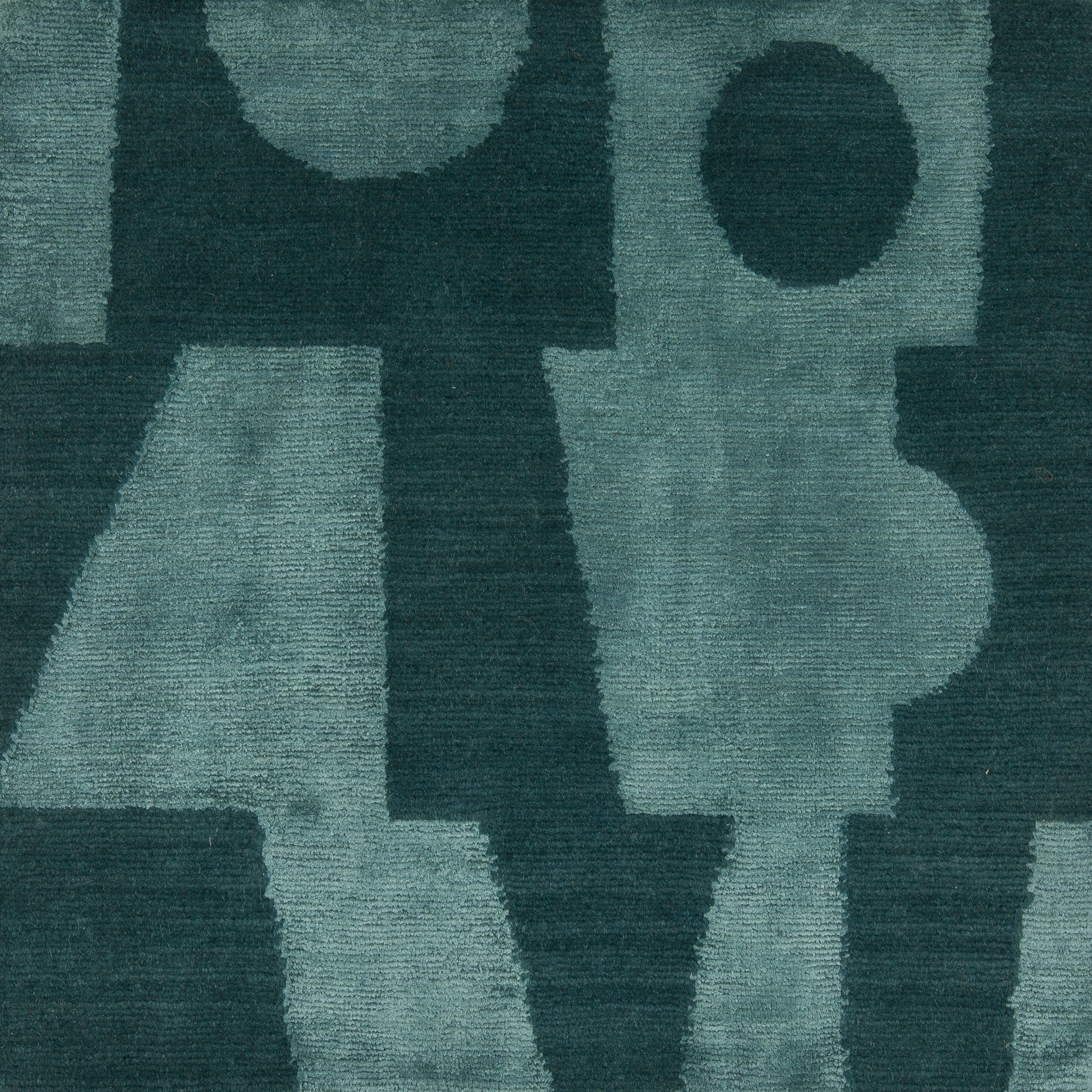
When a client is choosing rugs for presentations, the goal is not to show the most options, but to show the right ones. A strong rug presentation helps clients understand scale, material, border treatment, and color relationship without losing sight of the room as a whole. For custom rugs, that means each sample should perform a distinct design function, not merely offer a different shade. The best presentations feel edited, legible, and tied to the architecture, furniture plan, and intended atmosphere.
Rug selection often goes sideways when every sample is presented as a standalone object. Clients can react to a beautiful motif or a soft color and still miss how it behaves under a dining table, in a long living room, or across a circulation path. A more useful approach is to frame each option as a design answer: one may reinforce symmetry, another may soften a hard-lined scheme, and a third may introduce texture without increasing visual noise. That is especially important when presenting designer custom rugs, because the room is usually asking for more than a decorative surface. It is asking for proportion, zoning, and a material decision that supports the rest of the interior.
Select options that show different functions, not just different colors
Clients usually do not need three versions of the same idea in slightly different neutrals. They need a comparison set that shows how a rug can solve different problems in the room. One option might be a field-forward composition that calms a visually busy sofa arrangement, while another uses a more active border to define a seating group and create a clearer perimeter. A third might be lower contrast and quieter in pattern so the furniture, artwork, and drapery remain dominant. When the alternatives have distinct roles, the conversation becomes about design intent rather than personal taste alone.
This is where scale matters as much as color. A rug with generous negative space can make a room feel larger and more ordered, especially in open-plan interiors where the furniture plan needs anchoring. A denser pattern can help a broad room feel more intimate, but it can also compete with stone veining, millwork, or a patterned wall treatment if the balance is not carefully controlled. In custom rugs, the most useful comparison is often between a composition that expands the room visually and one that concentrates attention at the center. Clients can then choose based on how they want the room to behave, not just how they want it to look at first glance.
It also helps to distinguish options by construction and material character. A hand-knotted wool rug will read differently from a silk-accented piece, even if the palette is nearly identical, because the surface reflection and tactile density are not the same. If the project requires durability for a family room or a high-traffic entry, presenting a quieter wool option beside a more delicate, luminous alternative gives clients a real framework for deciding. For those exploring custom rugs, the presentation should make clear that material is not a finishing detail; it is part of the room’s performance.
Explain each sample in the context of the full room
A rug sample without context can mislead even experienced clients. Color temperature changes under daylight, and a pattern that looks restrained on a tabletop may become much stronger once it is expanded to full room scale. Presenting each sample alongside floor plans, furniture outlines, upholstery swatches, wood finishes, and one or two major textile references gives the client a truer reading of the scheme. This is particularly helpful in rooms with multiple finishes, where the rug must coordinate with stone, metal, timber, and fabric simultaneously.
For example, imagine a living room with a low, tailored sofa, a large coffee table, pale oak flooring, and art with strong geometric composition. If one rug option has a crisp border, it may echo the architecture and reinforce the room’s edges. If another has a faded allover field, it may allow the artwork to lead while still softening the floor plane. In a presentation, those differences should be described in terms of where the eye lands, how far the pattern reaches beyond the furniture group, and whether the rug creates a visual pause or adds momentum. The client is far more likely to commit when the role of each sample is clear.
The same principle applies to smaller spaces. In a bedroom, a rug can act as a quiet frame for the bed or as a more expressive surface that lifts the room above the level of the upholstery and drapery. In a dining room, the rug must answer the table shape, chair movement, and overall circulation, not just the wall color. Explaining each option in the full-room context helps clients see why one design feels composed and another feels crowded. It also makes the selection process more efficient, because objections become specific and solvable instead of vague.
Use visuals to compare scale, texture, and border options
Visual tools are especially effective when the differences are subtle. Side-by-side mood boards can show whether a border should be pronounced or barely perceptible, but a scaled floor plan is often more revealing because it clarifies how much of the pattern is visible beneath furniture. For larger rooms, a simple plan overlay can demonstrate whether the rug should stop short of the wall planes or extend enough to stabilize the entire composition. This is where the rug sampling process becomes more strategic: the sample itself is only one part of the decision, and the visual frame around it does much of the work.
Texture should be compared with the same level of care as color. Clients often know whether they prefer a soft, matte surface or a more luminous one, but they may not understand how pile height, weave density, and fiber blend affect that feeling. A lower pile can read cleaner under sculptural furniture and reduce bulk at chair legs, while a more substantial surface can bring warmth to a room with hard finishes and tall ceilings. If the scheme includes velvet, polished wood, or lacquer, a rug with visible texture may be the right counterpoint; if the room already has abundant tactile interest, a smoother weave may prevent visual overload.
Border options deserve their own comparison rather than being treated as a minor variation. A border can sharpen the outline of a rug, echo millwork proportions, or create a sense of containment in a wide, open room. It can also alter how a client perceives size, because a darker frame may make the field feel smaller while a lighter edge can widen it visually. Designers working with hand-knotted rugs often use border tests to determine whether a room needs structure or softness. The right visual comparison makes those distinctions obvious long before production begins.
Prevent decision fatigue during presentations
Too many choices can flatten a good presentation. When clients are given six or seven options that differ only in minor ways, they begin to compare details that are not driving the design, and the room’s direction gets diluted. A better method is to edit the set to three highly legible solutions, each one clearly tied to a design outcome. One can be the most restrained, one the most structurally defined, and one the most expressive. That structure gives clients confidence because they can evaluate the room through design logic instead of trying to sort through visual noise.
It also helps to lead with the decision criteria rather than the samples themselves. If the main question is whether the rug should recede behind the furniture or define the zone more assertively, say that first. If the key issue is whether the scheme needs warmth, contrast, or a stronger sense of perimeter, frame the options around those goals. Clients tend to feel less overwhelmed when they understand what each sample is supposed to accomplish. In practice, this is one of the most useful parts of specifying custom rugs, because the best choice is often not the one a client notices first, but the one that completes the room most convincingly.
A clear presentation rhythm also matters. Start with the overall plan, then move to the rug options, and only then discuss fine distinctions such as border finish, pile height, or small shifts in tone. If needed, narrow the discussion by eliminating choices that fail on practical grounds, such as maintenance, light exposure, or chair clearance. This prevents the meeting from becoming a style debate detached from the room’s actual needs. It also gives the client permission to say yes with clarity, which is often the real goal of the presentation.
How to frame rug options so clients can decide with confidence
A useful rug presentation is part design review, part technical translation. The client should leave understanding not only which rug feels right, but why it works in relation to scale, materials, light, and furniture layout. That is especially important in projects where the rug is doing architectural work: anchoring an open-plan lounge, softening a rectilinear plan, or tying together mixed-era furnishings. When the presentation respects those demands, it becomes easier to evaluate proposals from custom rugs specialists who can adjust dimensions, palettes, borders, and construction to the room rather than forcing the room to adapt to a stock format.
For designers, the strongest presentations are often the simplest ones. They do not overload the client with choices, and they do not reduce the rug to a decorative afterthought. Instead, they show how each sample contributes to proportion, circulation, and atmosphere. That approach is especially effective when the project includes designer custom rugs or a tailored rug sampling process, because the client can see the value of refinement at every step. The result is less confusion, better alignment, and a final selection that feels resolved from the floor up.
FAQ
How many rug options should I show a client?
Three is usually the most effective number. It offers enough contrast to compare different design directions without creating decision fatigue. Each option should serve a distinct role, such as quiet, structured, or expressive, so the client is evaluating strategy rather than just surface variation.
Should I present one safe choice and one bold choice?
Sometimes, but a better presentation usually includes one restrained option, one solution that clearly resolves the room, and one that introduces a more expressive note. That gives clients a broader but still manageable frame. If the project is conservative, the “bold” choice can simply mean stronger border definition or more visible texture rather than a dramatic pattern.
What helps clients understand scale best?
Scaled floor plans, furniture outlines, and at least one visual showing the rug in relation to the full room are the most effective tools. Clients need to see where the rug sits under the furniture, how much border remains visible, and whether the pattern reads as a field, a frame, or a focal point. Actual sample pieces alone rarely communicate scale accurately enough.
How should I explain texture during a presentation?
Describe texture in terms of function and light. A smoother surface may suit a formal room with strong architectural lines, while a more tactile rug can add warmth to a minimal or hard-finished space. It also helps to note how the texture will feel underfoot and how it will interact with nearby upholstery, wood, and metal finishes.
Choosing rugs for client presentations is ultimately about reducing uncertainty without flattening design intent. When each sample has a clear job, the client can compare them with confidence and the project stays on course. If you are refining selections for a demanding room or building a presentation around bespoke carpets, gallery-level guidance can help you edit the options with more precision and less friction. A thoughtful consultation often turns the final rug from a decision point into the anchor that makes the entire scheme cohere.